
23.10.2025
International
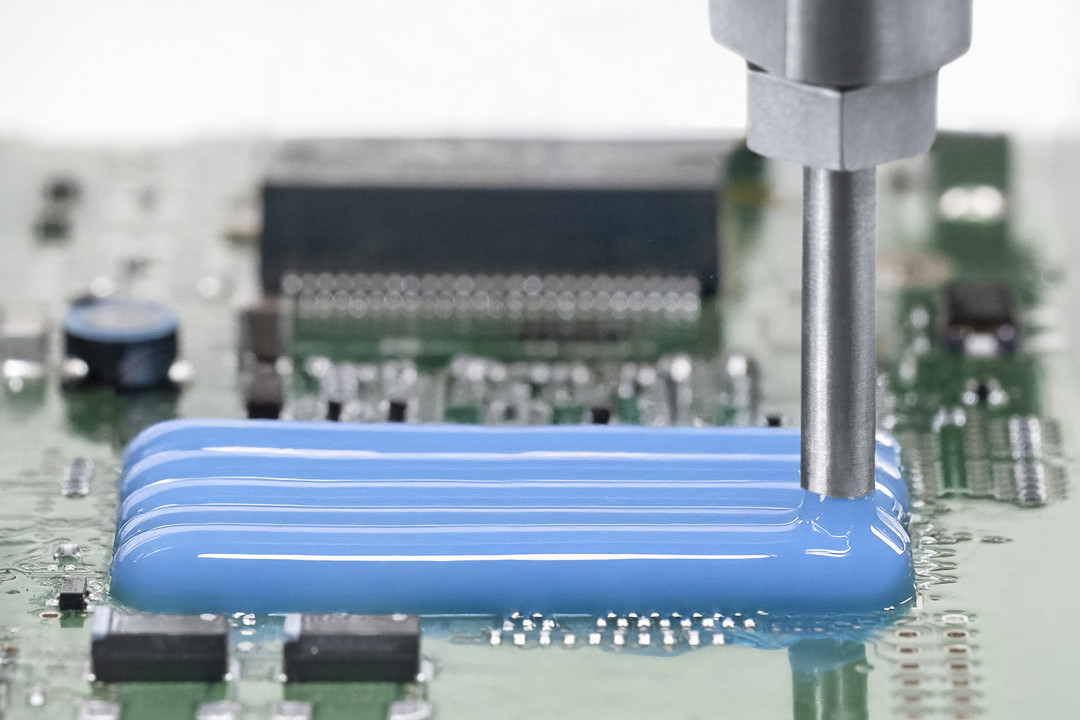
Wevo-Chemie is expanding its portfolio with the 2K silicone adhesive Wevosil 28015 FL. The new RTV silicone combines thermal conductivity with structural strength and residual flexibility – properties that are crucial for modern battery modules and power electronics. This material enables automotive manufacturers and electronics producers to implement targeted thermal management while producing mechanically stable components more efficiently than with the current standard products.
To achieve higher performance and new functionalities for traction batteries and power electronics, increasingly specialised high-performance adhesives are being used. The new addition-curing RTV silicone has been tested in practical applications together with customers and meets the demands of industry. Key technical properties at a glance:
- Thermal conductivity: 1.5 W/m·K (measured according to DIN EN ISO 22007-2:2015-12, hot-disk method) – ensures targeted heat dissipation even at high power densities
- Wide operating temperature range: high stability up to 200 °C, very good flexibility down to −60 °C – for reliable performance under extreme environmental conditions
- Mechanical properties: Shore A 70, high modulus of elasticity (60 N/mm²) – for structural bonding with high stability
- Residual flexibility: elongation at break 20 – 25 % – compensates for stresses and prevents cracking during temperature changes
- Easy application: thixotropic material for bead dispensing from cartridges, hobbocks or drums – for CIPG and FIPG (cured- and formed-in-place gasket) applications as well as flexible, efficient production processes
- Fast curing: initial adhesion > 2 MPa within minutes by infrared (IR) or laser curing – enables fast further processing
- Process reliability: addition-curing system – prevents shrinkage and gap formation for reliable bonding even in closed components or housings
Silicone adhesive for EV batteries
In electric vehicles, battery modules are increasingly taking on load-bearing functions in the bodywork. They must ensure crash safety, thermal resistance and mechanical stability. With its high Shore hardness and modulus of elasticity, Wevosil 28015 FL, as a silicone for the automotive industry, ensures stable structural bonding of the modules to the housing or adjacent components. At the same time, the adhesive ensures reliable thermal connection – for example, to the cooling system or the bodywork, which is often used as a heat exchanger.
The result: high resilience of the battery modules to extreme temperature changes, such as those occurring during high acceleration, at the same time dissipating heat in a targeted manner. Additionally, efficient processing is ensured – the rapid curing of the RTV silicone by IR or laser contributes significantly here: It shortens process times and enables easy integration into highly automated production lines.
Reliable power electronics with structural adhesive
In power electronics, chips and circuit boards with high power density must be cooled. Thermally conductive gap fillers and pastes used to date do not provide sufficient mechanical stability, meaning that additional screw connections or fastenings are required. This often results in complex sandwich constructions. The new thermally conductive structural adhesive from Wevo reduces process complexity by combining the required properties. This also ensures the long-term reliable operation of sensitive electronic components.
(Source: Wevo-Chemie GmbH)
Schlagworte
AdhesivesBatteryBattery ModulesBondingE-VehiclesEVJoining PlasticsSilicone