
02.10.2026
Unternehmen
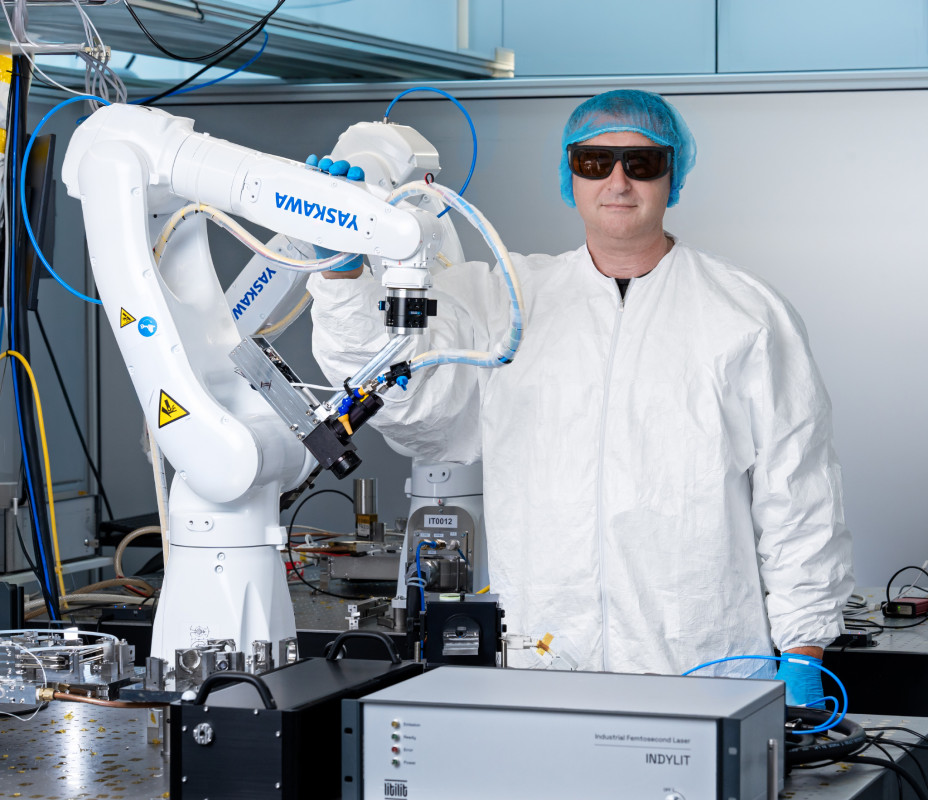
The AI boom has accelerated interest in robotics, with the global robotics market expected to grow dramatically over the next decade. According to experts at femtosecond laser company Litilit, recent advancements in robotics make new industrial robotic systems strong and precise enough to trade their screwdrivers and grippers for precision tools like advanced lasers.
During the first half of this year, investments in robotics increased to $47.4B, up 80 % compared to the same period last year, according to Crunchbase calculations. Industry analysts forecast that the robotics market could grow by around 25 times by 2035 on average, while a Barclays report estimates that the humanoid robotics market could grow from today’s 2 to 3B USD to 200B USD in the most optimistic scenario.
Humanoid robots are expected to account for a significant part of that expansion, easing labour shortages, automating repetitive workflows and taking over in physically demanding or hazardous work across manufacturing, logistics, agriculture and healthcare, the report claims. According to Nikolajus Gavrilinas, co-founder and CEO of laser manufacturing company Litilit, the advancements in robotics also present a great opportunity for higher-value manufacturing. As industrial robots become more powerful and precise, they can be equipped with more advanced tools such as femtosecond lasers.
“Most industrial robots today are used with tools for gripping, screwdriving, bolting, drilling, packing or similar tasks. Once you equip the same machine with an advanced laser, it can move into a different category of work: precision manufacturing. That means processing materials with much higher accuracy and creating more value from the same automated platform,” Gavrilinas says. Femtosecond lasers use extremely short pulses that can process materials without damaging nearby structures. This makes them useful in high-precision applications where even small amounts of heat can affect the material being processed. Mounted on a robotic system, such a laser could perform tasks such as drilling through-glass vias in semiconductor interposers, cutting curved cover glass for foldable phones, and marking durable traceability codes onto electric vehicle batteries, according to Gavrilinas.
However, the main obstacle to such applications is laser size. Many femtosecond lasers are too large and complex to be mounted directly on a moving robotic system. Gavrilinas says reducing size was a deliberate design goal for LITILIT, and its units run 1.5 to 2 times smaller than a typical femtosecond laser. "Most femtosecond lasers historically came from scientific systems. They can deliver strong performance, but they are often large, complex and require periodic maintenance. Our lasers use a modular design, high level of automation and reduced component complexity, making them compact enough for robotic integration and practical enough for industrial use," he explains.
The same architecture also lets Litilit manufacture advanced lasers at scale. The company is currently developing a femtosecond laser factory in Vilnius and plans to start laser production this October. Over the next few years, the company plans to manufacture up to 3,000 lasers per year.
(Source: Litilit)
Schlagworte
Advanced LasersAIFemtosecond LaserLaserManufacturingPrecision ToolsRoboticsRobots