
22.11.2026
Trending Topic

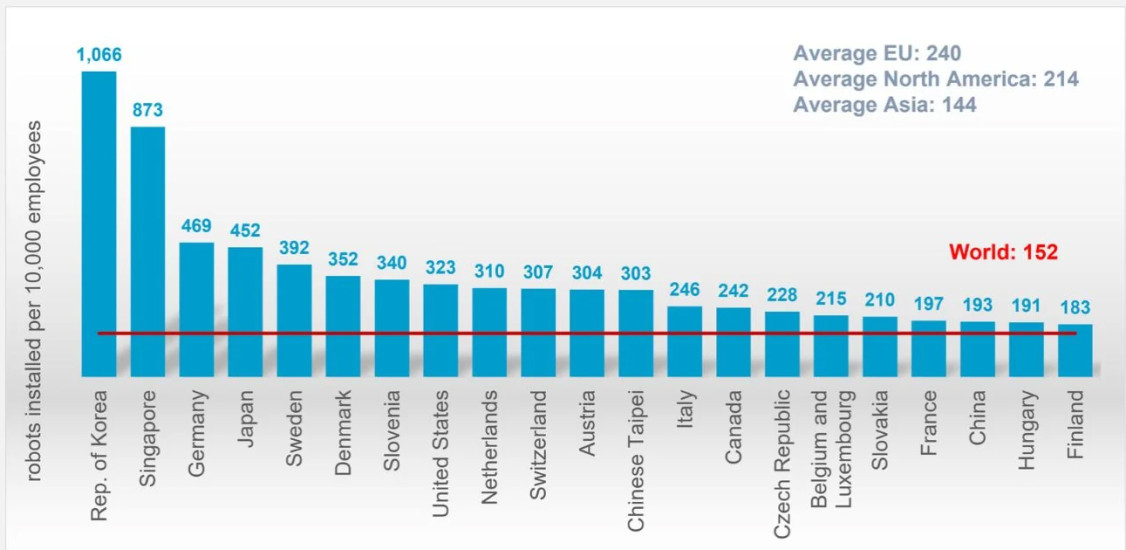
Robot density in the global manufacturing sector has reached a new peak. Driven by accelerating automation, South Korea remains the world’s undisputed leader in robot density, with 1,066 industrial units per 10,000 employees. Singapore follows in second place with 873 units, while Germany secures third place, at 469 units. All three nations vastly outperformed the new global average baseline, which has risen to 152 units per 10,000 employees.
"Tracking robot density creates a level playing field for global analysis by adjusting the number of operational industrial robots against every 10,000 employees in the manufacturing sector," said Jane Heffner, President of the International Federation of Robotics.
Robot density by region
Robot density in the European Union (EU-27) increased by around 35 % within five years (2020-2025), reaching a new record of 240 units. Five of the top ten most automated economies are members of the European Union: Germany, Sweden, Denmark, Slovenia and the Netherlands.
North America´s robot density rose by around 24 % over the same period (2020-2025) reaching 214 units. The United States remain 8th worldwide with 323 units per 10,000 employees. Canada follows with 242 units and Mexico with 64 units.
Robot density in Asia increased by about 47 % within five years (2020-2025), reaching 144 units. Next to the region's front runners, South Korea and Singapore, Japan with 452 units ranks in 4th position among the top 10 most automated manufacturing countries.
China, as the world´s largest market for industrial robots, now has a robot density of 193 units per 10,000 employees – ranking 19th globally. This result is based on employment data of the National Economic Census, conducted by China's National Bureau of Statistics. China’s robot density increased by 147 % from 2020 through 2025.
About robot density
Robot density is the number of operational industrial robots relative to the number of employees. It can cover the whole manufacturing industry or just specific industrial branches. The number of employees serves as a measure of economic size, so the quotient of operational stock over employees puts the operational stock on a uniform base.
(Source: IFR – International Federation of Robotics)
Schlagworte
AutomationIndustrial RobotsManufacturingRobotRobot DensityRoboticsSkilled Labour Shortage