
International
© Saarstahl
14.04.2025

New Business Segment for Schweißdraht Luisenthal

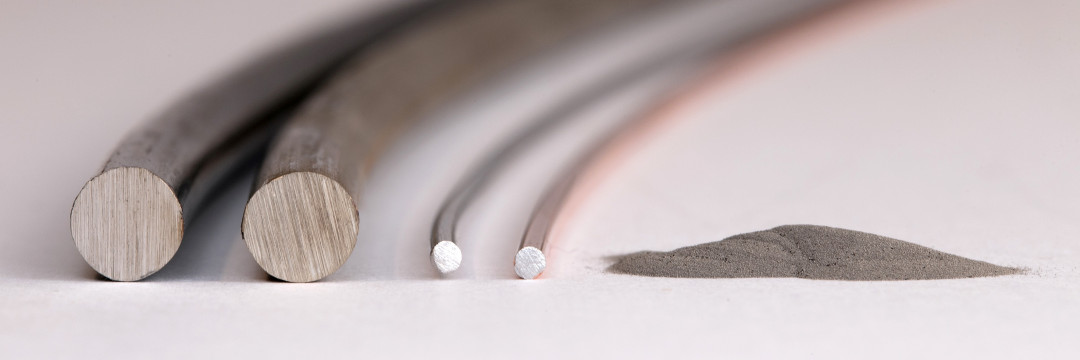
metallic powder for brake disks, 3D printing and AM

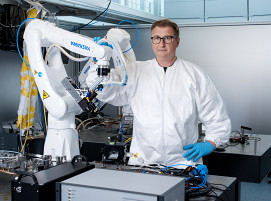
Schweißdraht Luisenthal (SDL), a company of the Saarstahl Group, is expanding its product portfolio to include a third product line: a new metallic powder for laser cladding of brake discs, 3D printing and additive manufacturing (AM) has been added to the range – in addition to the existing business segments of cylinder bore coating and filler metals for special applications. Because the hygroscopic property of the powder means that it can become damp and segregate easily during prolonged transport, SDL offers customers the alternative of purchasing the production system and wire so they can produce the powder themselves on demand.

“With our new powder product, we are developing a completely new business segment and focusing on the automotive industry as our target group,” said SDL Managing Director Marc Philipps. Background information: The Euro 7 emission standard will in future include all emissions from new vehicles, including particulate matter caused by tire wear or during braking. Brake discs will therefore have to be coated with a metal powder suitable for preventing abrasion.

Metallic powder can be produced using various technical processes. The most common process is vertical atomization, where the feedstock material is melted and atomized in a vertical container. The downside of this process is that the resulting powder has varying particle sizes and must be processed again in a subsequent step.

In contrast, Schweißdraht Luisenthal uses diagonal atomization in its manufacturing process. “We melt and atomize the wires diagonally here. This has the following advantage: it allows us to extract the undersized powder particles (below 35 µ) during the production process and to sift out the oversized particles (larger than 70 µ),” Philipps explained.

The resulting premium quality powder from SDL can thus be filled into containers or used without further processing. The space-saving system, which fits into a 40-foot container, can itself be flexibly converted for other types of metal and can also atomize smaller quantities. The company has acquired a system and a patent for a system for diagonal atomization. The company will in future market the powder, but primarily will sell the machine with the corresponding wire. 

(Source: Saarstahl Group)

Schlagworte

3D PrintingAdditive ManufacturingAMCladdingLaserSteel
Verwandte Artikel

Vom 22. bis 24. April 2026 fand in Aachen der AKL’26 - International Laser Technology Congress statt. Dort informierten mehr als 90 Vortragende die 544 Fachleute über den aktuellen Stand der industriellen Lasertechnik.
08.07.2026

Der Laser von morgen arbeitet autonom

Vom 22. bis 24. April 2026 fand in Aachen der AKL’26 - International Laser Technology Congress statt. Dort informierten mehr als 90 Vortragende die 544 Fachleute über den...

Automatisierung Energietechnik Laser Laserstrahl Laserstrahlauftragschweißen Lasertechnik Luftfahrttechnik Materialbearbeitung Mikroelektronik Photonik Quantentechnologie Schweißen
Read more
06.07.2026

Digital Parameter Design and Quality Assurance for Process Transferability in Laser Cladding

As part of the HIP-LMD project, a hybrid process model for laser material deposition was developed that combines physical simulations with data-driven methods.

AI Cladding Data Digitalisation Digitalization Laser Laser Cladding Laser Material Deposition NDT Non-Destructive Testing Quality Assessment Quality Control Research Research Paper
Read more
02.07.2026

Key Appointment Marks Next Phase of International Growth

Schoeller Werk has appointed a new head of sales: Jens Magenheimer has served as Chief Sales Officer (CSO) since June 1, 2026, joining CEO Alexander Mertens and CTO Micha...

Management Metal Work Stainless Steel Stainless Steel Tubes Steel Steel Pipes
Read more
„HYTANK“ – Kontaktfreie Atmosphärendruck-Plasma-Vorbehandlung einer CFK-Oberfläche.
16.06.2026

Fraunhofer IFAM entwickelt HYTANK-Technologien für nachhaltige Mobilität

Das Fraunhofer IFAM entwickelt im Forschungsprojekt „HYTANK“ ressourceneffiziente Fertigungs- und Fügetechnologien für großformatige, doppelwandige Wasserstofftanks aus c...

Automation Beschichtung Beschichtungen Beschichtungssysteme Fertigungsprozesse Forschungsergebnisse Fügen von Kunststoffen Fügetechnologien Gase Industrielle Fertigung Joining Plastics JP Kunststoff Laser Leichtbau Plasmatechnik Polymer Polymere Roboter Wasserstofftechnologien
Read more
16.06.2026

Fraunhofer IFAM Develops HYTANK Technologies for Sustainable Mobility

Fraunhofer IFAM is developing resource-efficient manufacturing and joining technologies for large-scale, double-walled hydrogen tanks made of carbon fiber reinforced plas...

Automation Bonding Coating Coatings Joining Laser Lightweight Construction Plasma Polymer Pretreatment Robot Surface Treatment
Read more