
22.03.2024
International
Quantum sensor for particle analysis improves quality control of printing powders in additive manufacturing
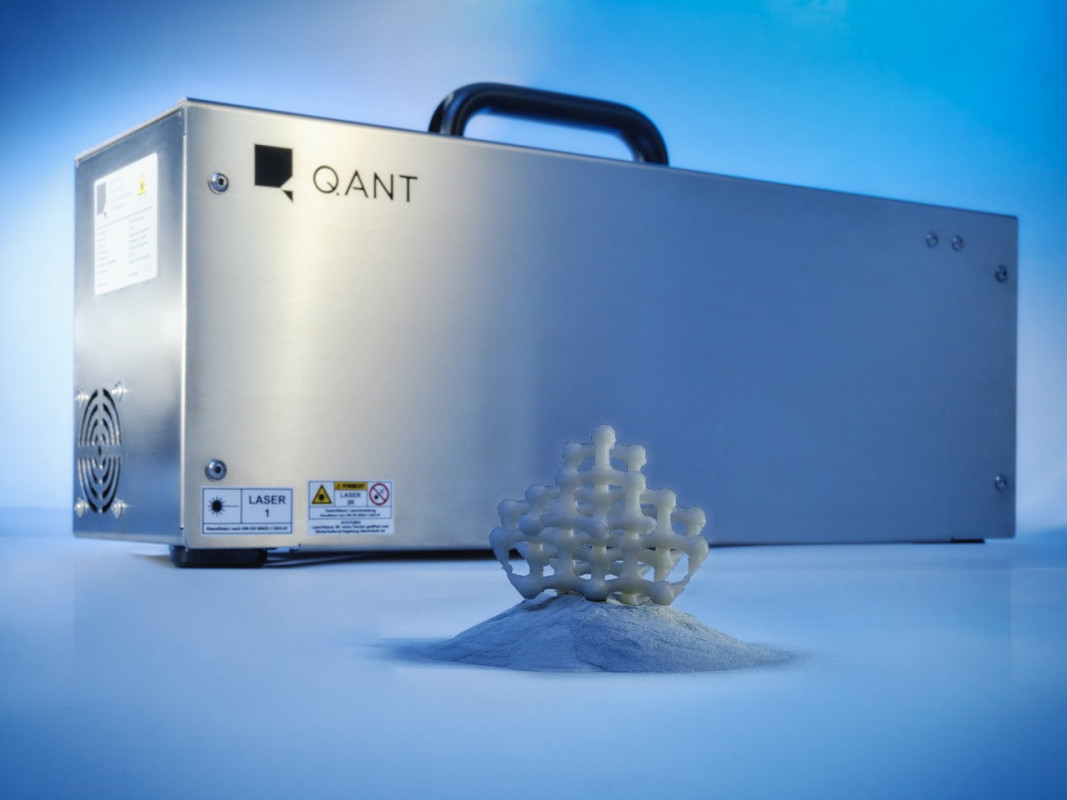
In additive manufacturing, the properties of the printing powder with particles from metal, plastic or ceramic play a decisive role. The size, number and composition of the fine particles influence the course of the process. The start-up Q.ANT offers a compact and industrialised particle sensor based on quantum technology that can be used to measure these parameters in real time and in a way that is easy to handle. With the help of AI, the shape of the particles can also be determined in future. Through a partner program, interested parties can customise the sensor for specific applications. Q.ANT will be demonstrating how the system works at the AM Forum from 20 to 21 March 2024 in Berlin.
Whether for powder production itself, in reprocessing or for the powder-based additive manufacturing of components: A mixture that is as homogeneous as possible and a high quality of the ingredients are crucial for the process flow. This means that different powder granulations can each result in specific material properties. In the powder reprocessing process, in which unused particles from the powder bed are reused, modified particles must be filtered out. The globally unique particle sensor from Q.ANT provides powder manufacturers and processors with immediate feedback on the process. The sensor detects and analyses particles in raw materials and feedstock, regardless of the medium, which can be liquid, gaseous or powdery. Process monitoring, process optimisation and quality control are therefore possible in real time.
AI can classify particles according to their shape
The quantum technology applied allows conclusions to be drawn about the size, number and distribution of the individual particles. In future, the quantum-based sensor will also be able to classify shapes. The AI built into it can be trained to distinguish predefined shapes, such as elliptical or spherical particles from round ones. To do this, it must be trained for specific use cases.
Q.ANT offers partnership programs for specific use cases
Pilot projects have demonstrated very high data quality. For example, the AI can distinguish particle agglomerates in metallic powders from individual particles. To develop further use cases for specific applications, Q.ANT offers partnership programs to interested companies. "This gives industry early access to this new solution for particularly challenging problems without having to go through long development cycles," says Vanessa Bader, Customer Project Engineer at Q.ANT. "Our partners have the opportunity to work with us to integrate the quantum sensor into their production processes and adapt it to their applications."

The compact sensor is easy to handle and fast to integrate
The compact quantum sensor fits on any laboratory worktable and the system is faster and easier to handle compared to the time-consuming conventional sampling process for analyzing particles. A normal computer is all that is needed to transfer and visualize the measured data. The sensor is immediately ready for use via a website in the browser. "Nothing needs to be installed, you don't need any extra computing power or complicated training for employees," explains Bader. The data itself is analyzed using a small server that is built directly into the particle sensor.
The AM Forum in Berlin, a combination of exhibition and conference, will be focusing on industrial applications in additive manufacturing over two days. Q.ANT will be welcoming visitors in the "B2B Area" at its stand 44.
(Source: Press Release QANT)
Schlagworte
ADAdditive ManufacturingAIAMApplicationsGasIFFManufacturingMetalMetallNormQuality ControlSystem