
07.03.2025
International
KPA Trade Fair 2025
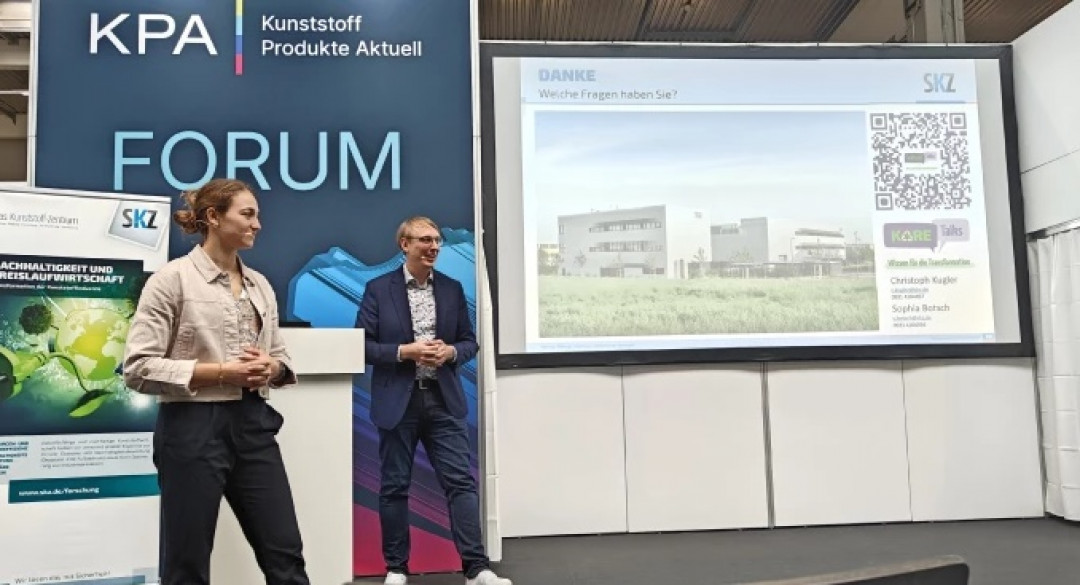
Megatrends such as sustainability and digitalization were the focus of the KPA in Ulm, Germany, in 2025. As is well known, both topics currently mean major changes for many companies in the plastics industry, but also offer immense potential. The SKZ Plastics Center also focused on these topics as part of its lecture session on the stage of the KPA Forum. This gave trade fair visitors the opportunity to supplement and broaden the many discussions on circular economy and digital transformation with knowledge from current application and best-practice examples.
Moderated by Andreas Bachmann, Head of Network and Events at SKZ, the focus was on the connction of those two major transformation processes. The Würzburg institute itself kicked things off with the presentation “Twin Transition – Digitalization for the circular economy”. The Digital Product Passport (DPP) as an example of the twin transition was first explained by Sophia Botsch, Scientist at SKZ, using a current research example. According to Botsch, the potential of the DPP results from the extensive data on the materials and components used, combined with information on repairability and proper disposal, among other things. In addition, the stated aim of the EU Ecodesign Regulation is for sustainable products to become the norm, which prescribes the introduction of the DPP for prioritized product groups from 2027.
Packaging and batteries were used to illustrate the benefits of the DPP for calculating the carbon footprint and reuse in a second application. In addition, Christoph Kugler, Group Manager Digitalization at SKZ, presented the current status and future requirements for the DPP with regard to technical scaling. Kugler emphasized the importance of system interoperability as a key challenge for the efficient and scalable use of digital product passports in the future. “The key to scaling is a high level of automation in order to exchange large volumes of data securely and as error-free as possible,” said Kugler. “The digital product passport is an excellent example of how digitalization can be a key instrument for the transformation to a circular economy. It also shows that transformation is only possible with closer collaboration along the entire value chain,” adds Botsch.
(Source: FSKZ e. V.)
Schlagworte
Circular EconomyEventsJoining PlasticsPlasticsSustainability