
23.09.2026
Trendthema
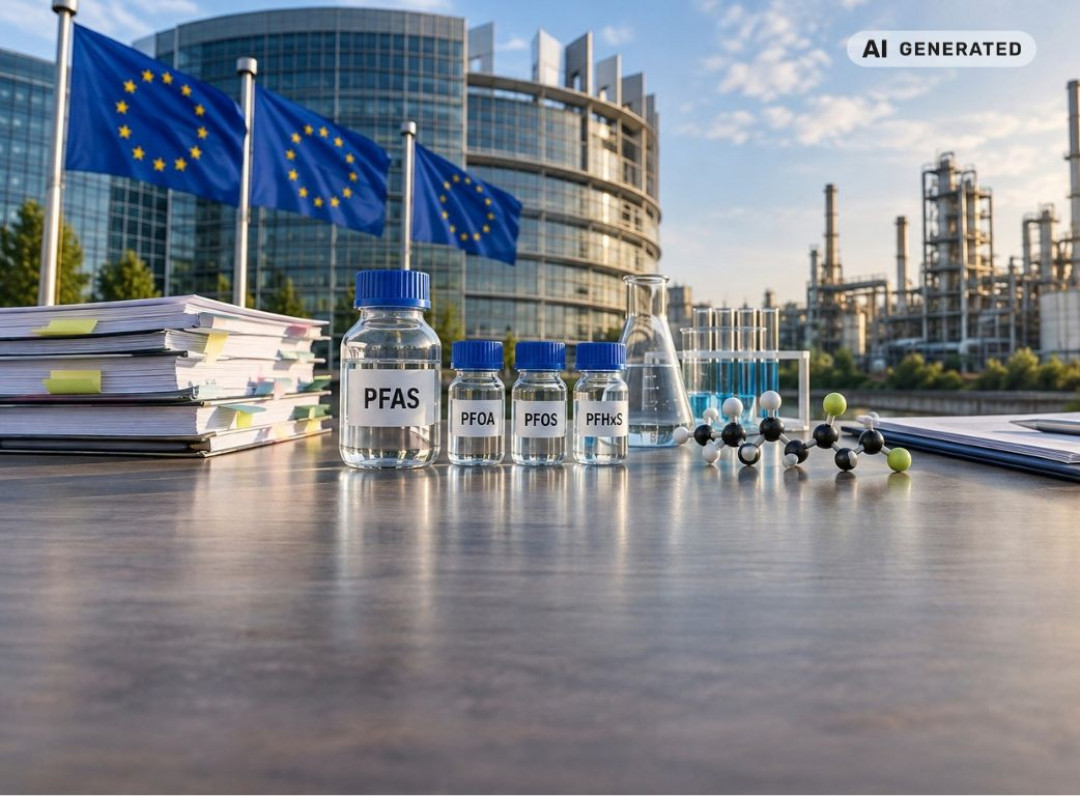
Poly- and perfluoroalkyl substances, also known as PFAS or simply as forever chemicals have revolutionised modern industry since the mid-20th century. Strong, highly polar carbon-fluorine bonds lend PFAS unique chemical properties. Specifically, their exceptionally high chemical and thermal stability, as well as their ability to repel both water and oil, has resulted in their almost ubiquitous use across a wide range of consumer products and industrial applications. From non-stick coatings in cookware, to waterproofing for jackets and boots, to vehicle AC refrigerants, to chemical etching in advanced semiconductor manufacture, PFAS is everywhere. Including in the environment.
A downside to PFAS's exceptional stability is that it is a highly persistent molecule in the environment, lasting up to hundreds, or even thousands, of years. They are often not broken down by the human body and accumulate over time. Some of the most prevalent PFAS, such as perfluorooctanoic acid (PFOA) and perfluorooctane sulfonic acid (PFOS), have been classified as "carcinogenic to humans" and "possibly carcinogenic to humans" respectively.
The PFAS umbrella covers thousands of molecules and long-term testing of each presents a gargantuan task. Some consider their dangers validated on the grounds simply of their persistence in the body, while others argue a more nuanced approach should be taken, given their importance in so many critical industries. IDTechEx's report "PFAS Regulations, Alternatives, Removal, and Destruction 2027-2037: Technologies, Players, Market Outlook" provides deep analysis of the PFAS regulatory landscape across the EU, the USA and APAC, providing clarity on the key differences facing PFAS in each region.
The EU supports a restriction on all PFAS
The European Chemicals Agency (ECHA) is the EU's key technical and scientific body, whose role is to prepare and offer evidence-led opinions to the European Commission to direct regulations and restrictions on harmful chemicals. The EU already regulates some PFAS, such as PFOA, PFOS and PFHxS, under "persistent organic pollutants" or "POPs" regulations and further restricts certain long-chain PFAS and the use of PFAS in firefighting foams (this latter restriction will begin to be enacted in October 2026).
However, in 2023 a restriction dossier was submitted, proposing a blanket ban on all PFAS across all industries. A public consultation followed, in which 5,642 comments were received. The document was updated in light of these comments and passed to ECHA's Risk Assessment Committee (RAC) and Socio-Economic Assessment Committee (SEAC). As of July 2026, RAC's final and SEAC's draft opinion, have been published. While these do not themselves constitute regulation, it enables some conclusions to be speculatively drawn.
A restriction on all PFAS, including polymers (used in applications such as coatings for non-stick pans), and PFAS some consider "less persistent" is likely to go ahead. It appears unlikely that any individual PFAS molecule is to be exempted from these restrictions. For applications where PFAS-free alternatives do not yet exist, time-limited derogations (exemptions) are likely to be put in place. Depending on how quickly alternatives can be manufactured at scale, derogations will last either five or twelve years, which committees agree are reasonable, albeit somewhat arbitrary, timescales. In "PFAS Regulations, Alternatives, Removal, and Destruction 2027-2037: Technologies, Players, Market Outlook", key application areas are identified and the state-of-play for PFAS-free alternatives is assessed.
This represents some of the strongest PFAS legislation worldwide and is predicted to be highly effective at reducing the amount of PFAS emitted in the EU by millions of tonnes over the coming decades. However, critics argue these restrictions would be highly detrimental to the EU economy, with a risk of erasing key EU industries such as semiconductor manufacture if alternatives cannot be found, at a time when developing sovereignty in these industries is considered by some to be critical.
EPA rolls back PFAS water limits, while state-by-state regulations vary wildly
On the other side of the Atlantic, the regulatory landscape looks very different. The closest legislation to a "restriction" is the Department of War's ban on the use of PFAS-containing firefighting foam. The USA's strongest legislation on PFAS revolves around limits of certain PFAS in drinking water, mandating removal and destruction if PFAS levels are found to be above the maximum contaminant level. "PFAS Regulations, Alternatives, Removal, and Destruction 2027-2037: Technologies, Players, Market Outlook" includes detailed analysis of incumbent and emerging removal and destruction technologies, including activated carbon, ion exchange resins, foam fractionation, as well as incineration, landfilling and supercritical water oxidation.
Under the Biden administration, the Environmental Protection Agency (EPA) established limits on six common PFAS molecules at 4.0ppt or 10ppt, depending on the PFAS. These remain the strictest limits on individual PFAS molecules and were to be enforced from 2029. However, under the Trump administration, the EPA proposes to decrease the number of PFAS restricted from six to two (PFOA and PFOS) and to extend the enforcement date from 2029 to 2031. These proposed changes are currently working through the American court system. There is a noticeable lack of PFAS restriction at a federal level in the USA and, given the polarised nature of American politics and the partisan nature of PFAS restriction, it is unlikely that federal-level restrictions resembling anything close to those proposed in the EU will be passed in the foreseeable future.
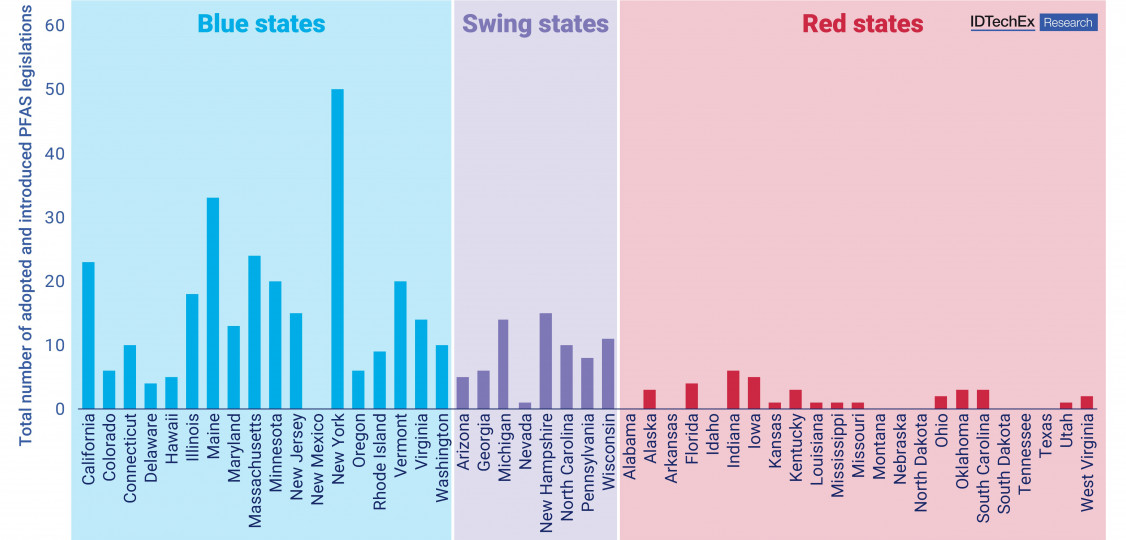
The partisan nature of PFAS restrictions is reflected in the states, where "blue" states average over 15 introduced or adopted legislations, while "red" states average under 2. Maine and Vermont offer some of the strongest PFAS restrictions, including for food packaging, cleaning products, textiles, cosmetics and more as well as for firefighting foam and pesticides. Minnesota's ban on "intentionally added PFAS" for all products unless exceptions are made by the commissioner, is the most reminiscent of the EU's proposed legislation.
With different regions tackling the PFAS problems in such different ways, industries will face varying knock-on effects depending on their geographical location. "PFAS Regulations, Alternatives, Removal, and Destruction 2027-2037: Technologies, Players, Market Outlook" provides clarity on PFAS regulations at a global scale and evaluates alternatives, as well as removal and destruction technologies, the uses of which exist in a fundamental symbiosis with the regulatory landscape.
(Source: IDTechEx)
Schlagworte
EUEU RegulationEuropean Chemicals AgencyEuropean UnionForever ChemicalsJoning PlasticsJPPFASPFHxSPFOAPFOSPlastics