
27.11.2024
International
How Artificial Intelligence Secures our Infrastructure
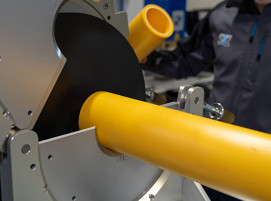
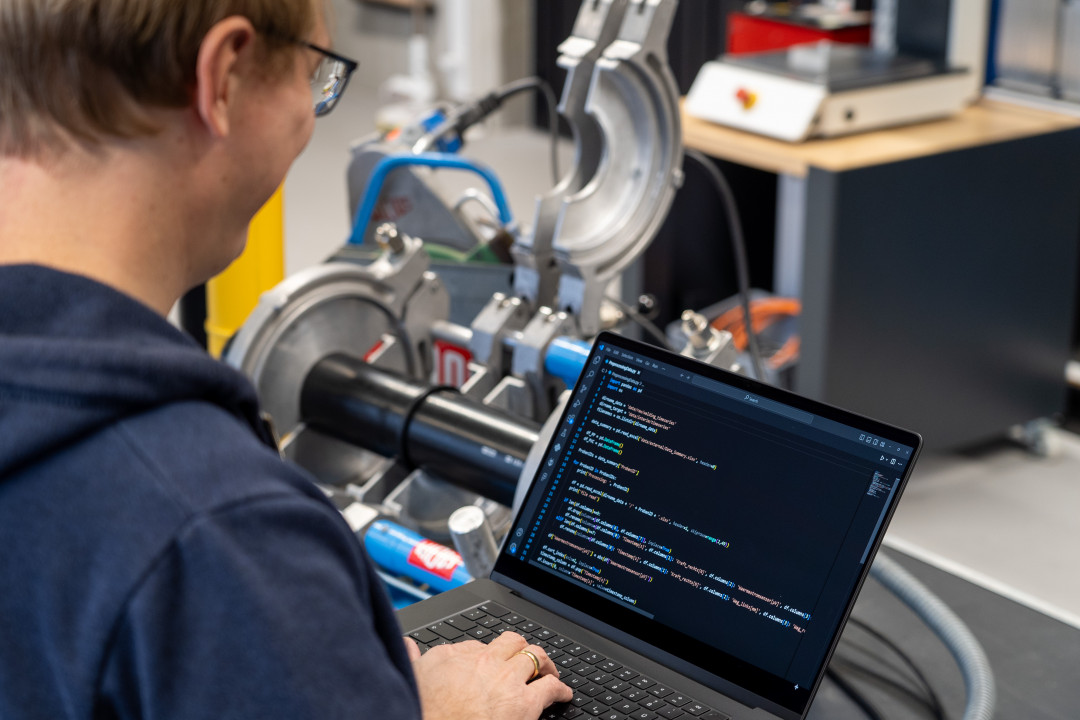
At the SKZ Plastics Center, the Pipe-safe project has been launched to put an AI assistant for quality assurance of welds in pipeline construction into practical use. This will enable the welded joints on gas and water pipes to be evaluated using AI, thus relieving the burden on skilled workers.
SKZ is launching a research project to evaluate pipe welds using AI
The safety of the supply infrastructure, especially in pipeline construction, depends to a large extent on the quality of the welds. That is why high standards apply in the training of plastic pipe welders – for example, welded joints are checked again by another specialist in the construction site trench. These are crucial measures to ensure the security of gas, water and wastewater supply and to avoid accidents.
Currently no 100 % control possible
The inspection of the weld seams in the trench must be non-destructive and carried out under construction site conditions. Currently, a welding supervisor is required who is a knowledgeable specialist. However, this does not correspond to a 100 % control, since optimal welding parameters and a visually flawless weld from the outside cannot reliably prove a flawless weld. For this reason, despite the high-quality training of welders and welding supervisors, defects can occur that can have serious consequences if a defective weld seam causes a pipe to burst. Whether gas or water, the effects can be dramatic. The Pipe-safe project at SKZ is therefore designed to support experts in the future using modern non-destructive testing technology and AI.
Project based on past research projects
The goal of the project is to develop an AI-based assistant for construction site work to detect errors in heated-tool butt welding (HTBW) of gas and water pipes automatically and independently of the user. The project is based on a previous research project in which the quality of the heating element butt welding process using a heat flow sensor and the process data from the welding machine could be successfully assessed by a trained AI. In pilot plant trials, all welding defects were reliably detected using the developed AI for the bulk plastics polypropylene and polyvinyl chloride. Pipe-safe is now to bring this into practical application.
Immediate evaluation of weld quality
“The approach chosen in the project for in-line quality assurance has the advantage over downstream, non-destructive testing techniques (e.g. via ultrasound) of an immediate evaluation of the weld quality directly after the welding process has taken place, without the need for additional testing technology,” explains Christoph Kugler, Group Leader Digitalization at SKZ. If successful, the burden on quality assurance experts in pipeline construction can be significantly reduced in the future and the quality of the weld seam can be ensured. In addition to transfering scientific knowledge into practice, the project also includes measures for socio-technical challenges, such as the acceptance of digital assistants and AI systems.
About the project:
The SKZ project is funded by the Federal Ministry of Education and Research (BMBF) through the DATIpilot funding guideline, which funds a total of 300 innovation sprints.
(Source: SKZ Press Release)
Schlagworte
AIJoining PlasticsPipesPlastics