
13.04.2026
International

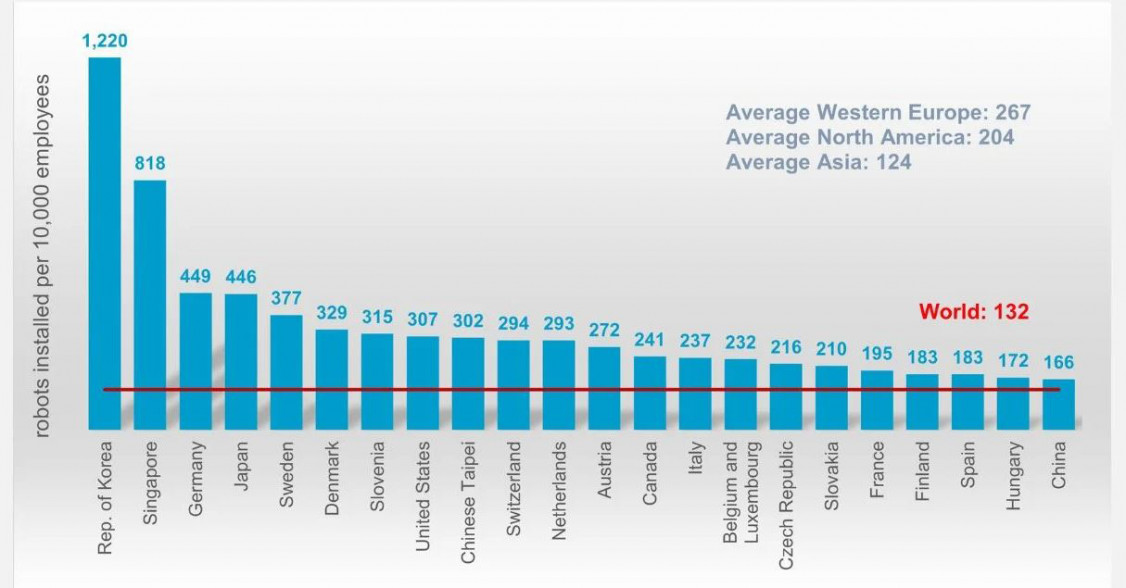
Economies worldwide are prioritising the integration of factory robots, as automation becomes a critical tool for boosting productivity. In the global automation race, the Western European countries reached a record 267 robots per 10,000 employees in the manufacturing industry 2024 – ahead of North America with 204 units and Asia with 131 units. This is according to the World Robotics 2025 report, presented by the International Federation of Robotics (IFR).
“The robot density metric provides a uniform basis for comparison by relating the total number of robots used in a country to its economic size, as measured by its workforce,” says Takayuki Ito, President of the International Federation of Robotics.
Robot density by region
The Western European countries recorded a robot density increase of 3 % year-on-year. Eight countries are within the global top 20, which are Germany, Switzerland, The Netherlands, Austria, Italy, Belgium & Luxembourg, France and Spain. The European Union (EU-27) has a robot density of 231 units, which is above the global average of 132 units per 10,000 employees.
North America´s robot density rose by 4 %. The United States ranks 8th worldwide with 307 units per 10,000 employees. Canada follows with 241 units and Mexico with 62 units.
Asia has an average robot density of 131 units per 10,000 persons employed in manufacturing – an increase of 11 %.The economies of the Republic of Korea, Singapore, Japan and Chinese Taipei are among the top ten most automated worldwide.
Based on updated labor market data issued by China's National Bureau of Statistics, China ranks 6th in Asia and 22nd worldwide. It has 166 robots for every 10,000 people employed, which is a year-on-year increase of 17 %.
As a large country with a huge manufacturing workforce, China requires a significant operational stock, with a presence not only in its manufacturing hubs, but also in its rural regions, in order to achieve high robot density. China's outstanding position in the field of industrial robotics is clearly demonstrated by its impressive operational stock, which is the largest in the world:
The country counts around 2M units – approximately 4.5 × more than Japan, which is in second place. The annual installation numbers are impressive too: 54 % of all robots installed worldwide in 2024 were deployed in China (295,000 units).
Top countries & territories
The Republic of Korea records the world´s highest robot density with 1,220 robots per 10,000 employees, growing by 7 % on average annually since 2019. With its globally recognized electronics industry and a distinct automotive industry, the Korean economy benefits from these two largest customers for industrial robots.
Singapore follows second, with 818 units. As a small country with a low number of manufacturing employees, Singapore can achieve a high robot density with a relatively small operational stock. The country's robot density had been growing by 13 % annually since 2019.
Germany ranks third, with 449 units per 10,000 employees. The robot density of Europe´s largest economy has grown by 5 % per year since 2019.
Japan is in fourth place with 446 units. Robot density of the world´s predominant robot manufacturing country had been growing by 5% annually since 2019.
Sweden (377), Denmark (329), Slovenia (315), the United States (307), and Chinese Taipei (302) and Switzerland (294) complete the top 10.
(Source: International Federation of Robotics)
Schlagworte
AutomationGlobal MarketManufacturingRoboticsRobots