
17.08.2026
Event
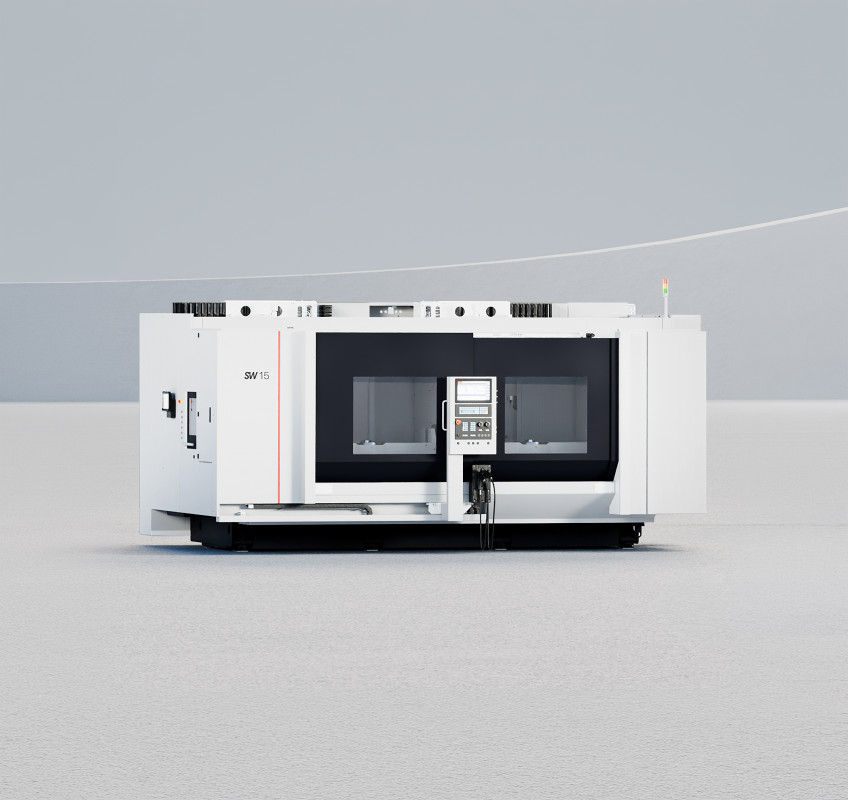
Schwäbische Werkzeugmaschinen (SW) will present machining and automation systems for different production volumes and industries at AMB 2026 in Stuttgart. The exhibits on stand C51 in Hall 10 include the four-spindle BA 342 machining centre, the new BF 15-21D for larger structural components and the mobile S-cell robot cell.
SW combines machining centres, automation and software into integrated manufacturing systems. The systems are designed to accommodate changing components and production requirements.
BA 342 for four-spindle, five-axis machining
The BA 342 is a four-spindle machining centre for four- and five-axis machining. It processes four workpieces simultaneously, producing four finished components within the cycle time required for one parallel machining operation. Performing the machining steps concurrently reduces chip-to-chip times.
A double swivel carrier allows workpieces to be loaded and unloaded while machining continues. The machine has an open interface for connection to different automation systems and is intended for continuous series production.
At AMB, SW will demonstrate the BA 342 using components from medical technology and humanoid robotics. The application will include four-spindle, five-axis simultaneous machining.
“We are demonstrating that even four-spindle, 5-axis simultaneous machining is possible. What matters is therefore not the industry, but the ability to design processes efficiently and flexibly,” says Elias Metzger, Head of Marketing at SW.
BF 15-21D machines large structural components
The new BF 15-21D machining centre is designed for larger, geometrically complex workpieces, including frame and structural components. One field of application is the machining of die-cast aluminium body parts for the automotive industry.
The machine uses a hybrid drive concept. A linear drive moves the X-axis, while the Y- and Z-axes are driven by ball screws. Its travel ranges are 1,550 mm in the X-axis, 1,000 or 750 mm in the Y-axis and 750 mm in the Z-axis.
The BF 15-21D has two working areas, each equipped with a three-axis unit and a spindle. This configuration supports the parallel machining of different workpieces. While a component is changed in one working area, the second spindle can continue machining in the other. This increases spindle utilisation and reduces auxiliary process times.
SW will demonstrate subframe machining on the BF 15-21D at AMB.
Mobile S-cell supports variable material flow
The S-cell is a mobile robot cell for automating production environments without fixed links between individual stations. It forms part of the Smart FMS flexible manufacturing system and can load and unload machining centres, cleaning systems and assembly stations.
The platform combines an industrial robot with a mobile base that navigates autonomously through the production area. This allows the robot cell to move between different machines and peripheral systems according to the current production sequence.
At AMB, SW will demonstrate an expanded application in which the S-cell moves between several stations and handles the workpieces independently at each one. The concept is intended to support adaptable production layouts and variable material flows without permanently connecting machines in a rigid line.
Integrated machining and automation
The BA 342, BF 15-21D and S-cell represent different elements of SW’s system approach. Parallel machining increases output per unit of floor space, while mobile automation connects production stations according to demand. The combination of machining centres, material flow and software is intended to reduce interfaces between individual process stages and adapt production systems to changing requirements.
(Source: Schwäbische Werkzeugmaschinen GmbH)
Schlagworte
AutomationKIMachine ToolsMESRoboticRobotics