
22.07.2025
International
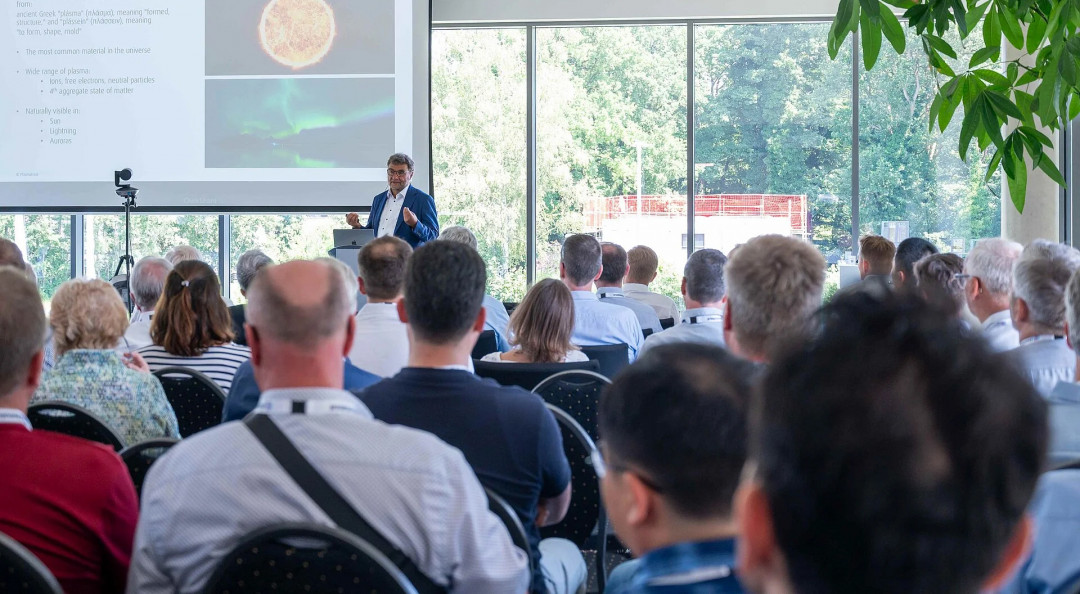
On July 2 and 3, Plasmatreat celebrated the 30th anniversary of the patent application for its Openair-Plasma technology with its Technology Days 2025 at the headquarters in Steinhagen, Germany. Three decades ago, this process for pretreating surfaces with industrially compatible atmospheric plasma began its advance. Due to its process stability, efficiency, environmental friendliness and ease of integration into production environments, it has transformed numerous industrial processes worldwide. New fields of application are constantly opening up for Plasmatreat's Openair-Plasma technology. This was the focus of the event with over 200 guests, 16 industry partners and the international sales team.
“The future of plasma technology has only just begun – as has our journey together. We are still at the beginning,” said Plasmatreat founder and CEO Christian Buske in his welcome speech to the Plasma(treat) Universe. “Our tool is ionized gas. All of our applications use this tool to modify the structure of surfaces of a variety of materials specifically. Our plasma technology provides countless possibilities for modifying the surfaces of plastics, metals, glass, cardboard, films, fibers, composites and recycled materials. We use plasma technology to give these materials special properties for further processing.” These basic tasks include ultra-fine cleaning, activation, reduction and coatings for a wide range of industrial applications.
Areas of process improvents with plasma technology
Think ahead, experience innovation was the motto of the Plasmatreat Technology Days. It was a recurring theme throughout the event. The agenda included a balanced mix of technical presentations, workshops, and discussions at the exclusive partner exhibition. During the workshops, Plasmatreat experts demonstrated how the company's solutions are used in applications.
Mobility of the future
Eagerly awaited was the presentation by Lukas Buske, CEO at Plasmatreat and in charge of sales, service, market segment development and more. He reviewed the development history of Openair-Plasma technology, using the automotive industry as an example. The technology originated from a joint project with a regional automotive supplier, in which both companies achieved a breakthrough in bonding headlights to polypropylene (PP) housings.
“Since then, we have collaborated closely with customers for over three decades to develop a wide range of solutions, from laboratory and stand-alone systems to fully automated lines. Our portfolio of nozzles and nozzle heads alone includes many different variants for static or rotating systems for a variety of applications. This means that, even for new applications, we can often meet the requirements with existing solutions and minor adjustments," Buske explained.
Plasmatreat technology is currently used in more than 100 automotive and battery production applications. E.g. PlasmaPlus PT-Bond technology serves as an environmentally friendly bonding agent that is often used to bond different materials in a stable, weather-resistant way. "Since development processes in the automotive industry are particularly sensitive and data-intensive, we now comply with Tisax standards for information security. This is a logical step for us and a clear signal to our automotive industry partners: Plasmatreat is reliable in more ways than one,” said Lukas Buske.
Hands-on workshop sessions
Many visitors came to the workshops with ideas for new applications or drew inspiration from the examples of applications shown here to optimize their companies' production processes with Plasmatreat solutions. To enable efficient work in the interactive workshops, Plasmatreat surveyed guests' main interests before the Technology Days. This allowed guests to be divided into smaller groups. As a result, each guest received an individual programme at the beginning of the event.
The workshop Perfect Images: Plasma for Demanding Printing Processes in the PT-Print room at Plasmatreat's Technology Center drew particular interest from participants. In addition to applications in packaging manufacturing and other areas. Many participants considered the production of a digitally printed, customized sports shoe to be a particularly interesting part of the workshop. The thermoplastic used in this process is activated with Openair-Plasma, which makes it ideal for printing with UV ink. Innovative nozzle technology in the form of a new nozzle for printing applications was also a focus.
Reduction and ultra-fine cleaning
The workshop Redox effect: Reduction to High-Performance Coatings showed how oxidized and contaminated metal surfaces are cleaned in the semiconductor industry to meet the strictest standards for manufacturing electronic components. Plasma systems and reduction were also demonstrated live.
The workshop Cleaning Reimagined: From Openair-Plasma to HydroPlasma showcased a world first from Plasmatreat. This innovation involves adding distilled water to a plasma jet, which enhances the plasma treatment's effectiveness. Using small metal plates contaminated with fingerprints, the experts demonstrated that HydroPlasma can reliably remove even the most stubborn contaminants, such as oils, salts and fats, without the use of wet chemistry and in a manner that can be verified with measuring instruments.
Application focus: coatings
As the title of another workshop in the main building, Innovative Technology and Forward-Looking Coatings, suggested, this workshop focused on PlasmaPlus PT-Bond technology. This technology enables the application of ultra-thin coatings to materials by injecting gaseous precursors into plasma jets via special plasma nozzles. The plasma, enriched in this way, then hits surfaces that were previously treated with Openair-Plasma technology, coating them with ultra-thin, transparent plasma polymer layers. These layers can include bonding agents for structural bonding, as well as barrier and insulation layers for corrosion protection. The workshop featured a thermoforming application in which sheet metal was coated with an ultra-thin protective layer instead of a film to prevent scratching.
Corrosion protection was also the subject of a separate workshop, AntiCorr as a protective shield for surfaces. This workshop took place in Plasmatreat's contract service area. It demonstrated the process of cleaning and coating a customer's battery housing made of aluminum die-cast and continuous cast aluminum with AntiCorr. For this purpose, a robot equipped with an Openair-Plasma nozzle and a PlasmaPlus nozzle was used. This process effectively protected the battery tray against crevice corrosion while using minimal precursors.
A total of eight workshops covered the current state and future of plasma technology in various application areas.
At this year's K trade fair in Düsseldorf, Germany, from October 8 through15, 2025, in Hall 11 (Booth I 65), Plasmatreat will showcase the latest plasma applications for the plastics industry. This is the next opportunity for customers and interested parties to speak with experts about trends in plasma pretreatment and new applications in this market segment.
(Source: Plasmatreat GmbH)
Schlagworte
BatteryCoatingE-MobilityEnergyEVJoining PlasticKPlasmaPlasticPolymerPretreatmentRecyclatesSurfacingWelding