
23.09.2025
International
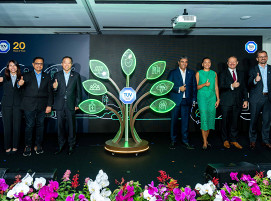
Speaking at the Science Summit during Climate Week New York City, TÜV SÜD, a global sustainability service provider with more than 150 years of experience in advancing safety, quality, innovation and sustainability, highlights urgent need for trust-based cooperation between developed and emerging economies to accelerate industrial decarbonization. This is possible through more comprehensive and reliable impact measurements to close the trust gap and enable green investment. TÜV SÜD is a partner of the Science Summit 2025 alongside the 80th United Nations General Assembly (UNGA).
TÜV SÜD has been at the forefront of sustainability for decades, driving measurable impact through independent assurance, certification and advisory services in areas such as renewable energy, sustainable infrastructure, and carbon management. This will also be the topic of the keynote speech by Dr. Céline Bilolo, Chief Sustainability Officer at TÜV SÜD, at the closing event at the UN headquarters.
Bilolo summarizes “We can overcome the major challenges to creating a better world in line with the SDGs, but this requires overcoming persistent barriers – chief among them, the lack of credible and consistent impact measurement. To close the trust gap and mobilize investment at scale, we need transparent, verifiable and high-integrity data. Emerging technologies such as digital measurement, reporting and verification (dMRV) offer powerful tools to enhance data reliability and credibility. If implemented effectively, they can catalyze a trusted market that drives ambitious climate action while delivering measurable benefits for investors, communities and ecoystems.”
Financing for climate technology and decarbonization
Achieving net-zero emissions by 2050 requires an estimated annual investment of US $ 7 trillion to US $ 9.2 trillion. Yet, financing remains deeply unequal: while capital is available in OECD countries, emerging markets and developing economies (EMDEs) – essential for global industrial growth and where the majority of the global population will live – face significant barriers in accessing climate finance mechanisms.
“The world cannot reach net-zero without emerging economies,” says Bratin Roy, Head of Decarbonization at TÜV SÜD. “But today, trust gaps in financing, regulation and technology are holding us back. Closing these gaps is not just about money – it’s about building confidence, creating global standards and accelerating cooperation.”
IRENA Green Finance Report – first key findings to be shared
Roy, who also chairs the Alliance for Industry Decarbonization (AFID) Green Finance Working Group, curated this year’s inaugural International Renewable Energy Agency (IRENA) Green Finance Report, to be published at the COP30 in November. The report outlines practical strategies to overcome the financing barriers facing emerging market and developing economies (EMDEs). During Climate Week, key findings of the report will be shared in advance through panels with the climate finance community.
Financing Industrial Decarbonization: Building Trust Across Global Value Chains
“With our heritage of trust and our global footprint, TÜV SÜD is uniquely positioned to bridge the gap between capital-rich nations and fast-growing economies,” adds Roy. “Decarbonization is not a choice – it is a necessity. What the world needs now is trust, cooperation and effective action.”
(Source: TÜV SÜD)
Schlagworte
ClimateClimate ChangeDecarbonizationEmissionsStandard