
02.10.2026
Forschung
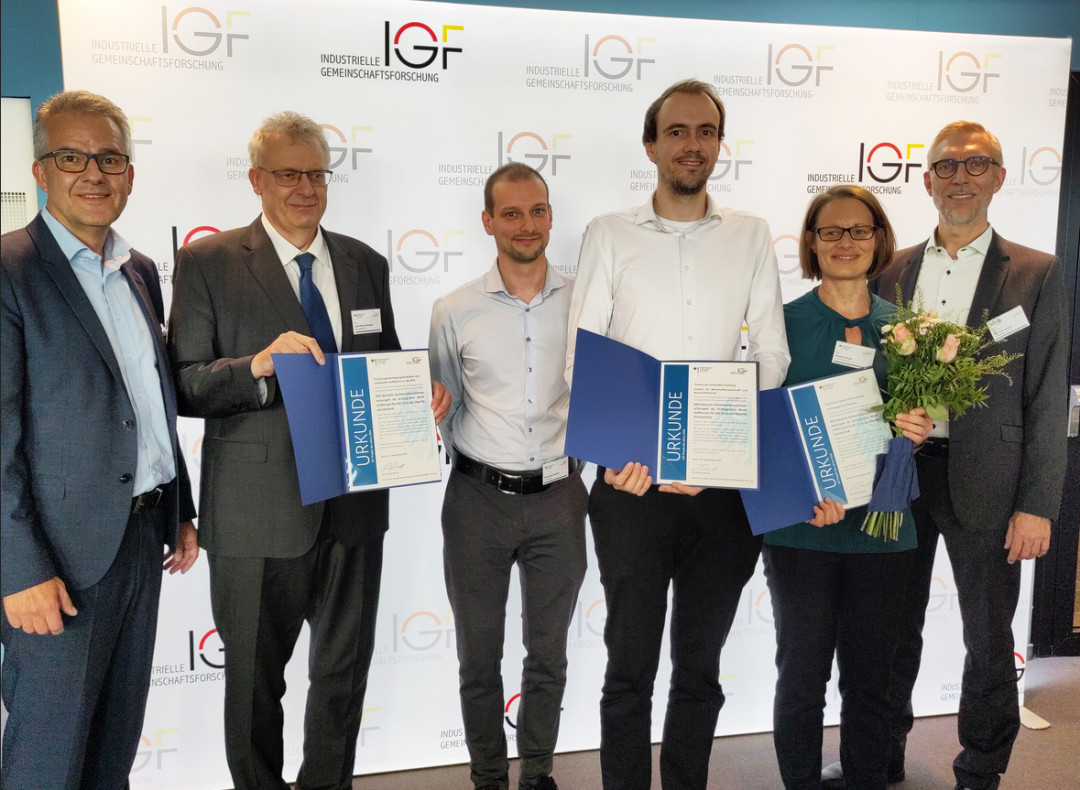
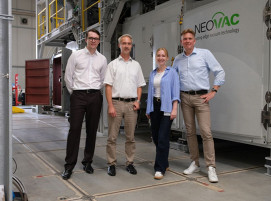
A broad smile and a great deal of pride were visible on the faces of Susan Conze and Lukas Tegelkamp, the scientists responsible for the IGF Project of the Year. With their research project "NbC-based Hard Metal Compositions as a Strategic Material Substitute for WC-Co in Surface Engineering," conducted by the Fraunhofer Institute for Ceramic Technologies and Systems (IKTS) and Chemnitz University of Technology, Institute of Materials Science and Engineering, they have just been honoured in Berlin as the "IGF Project of the Year 2026." The IGF project, which was initiated and applied for through the Research Association for Welding and Allied Processes (DVS), in short DVS Forschung (DVS Research), prevailed over its two competitors in a live voting. It convinced on substance through its broad, cross-industry relevance to industry as well as through its engaging presentation, delivered in the form of a dialogue between the researchers. The project focuses on substituting a critical material used for wear protection.
Wear protection is indispensable in numerous industries – from mechanical engineering to the energy and automotive industries all the way to aerospace. However, many of the solutions in use today are based on tungsten and cobalt. This makes companies dependent on these rather critical raw materials and brings additional challenges in terms of cost development, availability and material selection. The project therefore relies on an alternative material based on niobium carbide. The coatings developed offer high wear resistance and can be processed using established equipment technology. Successfully coated demonstration components – including brake discs – demonstrate the potential for far-reaching, concrete industrial applications. Tungsten carbide has been the backbone of industrial wear protection for decades – but Europe's dependence is becoming a strategic weak point. More than 80 % of the world's tungsten comes from China. Since 2022, prices have tripled and export restrictions are further exacerbating the situation. At the same time, cobalt, the standard binder in WC-Co hard metals, is classified as carcinogenic. The winning project delivers a concrete solution: niobium carbide (NbC)-based hard metals with non-toxic, iron-based binders – processable with existing equipment and around eight times more cost-effective than today's WC-Co standard. Niobium is available in the long term and is therefore a key building block for a resilient European industry. The project was carried out within the framework of Industrial Collective Research (IGF), funded by the Federal Ministry for Economic Affairs and Energy (BMWE).
Roland Boecking, Executive Director of DVS – German Welding Society (Deutscher Verband für Schweißen und verwandte Verfahren e.V.), emphasized: "I am very proud that a project from coating technology has been chosen as the IGF Project of the Year. The work of the research institutes and of DVS Forschung shows that through innovation, industry becomes less dependent on critical raw materials."
Jens Jerzembeck, Managing Director of DVS Forschung, added: "This project once again demonstrates that pre-competitive collective research is a central pillar of innovation support for small and medium-sized industrial enterprises. The research associations play a central role in this. They identify and pool research topics, separate industry-wide needs from individual interests and bring companies together across industries and value chains. We warmly congratulate the winners of the project, in particular Susan Conze and Lukas Tegelkamp, on this outstanding achievement."
(Source: DVS e. V.)
Schlagworte
AerospaceAutomotiveCoatingCobaltIGFNiobium CarbideResearch ProjectSurfacingThermal Spray BulletinThermal SprayingTSBTungstenWear ProtectionWear Resistance