
20.08.2026
Unternehmen
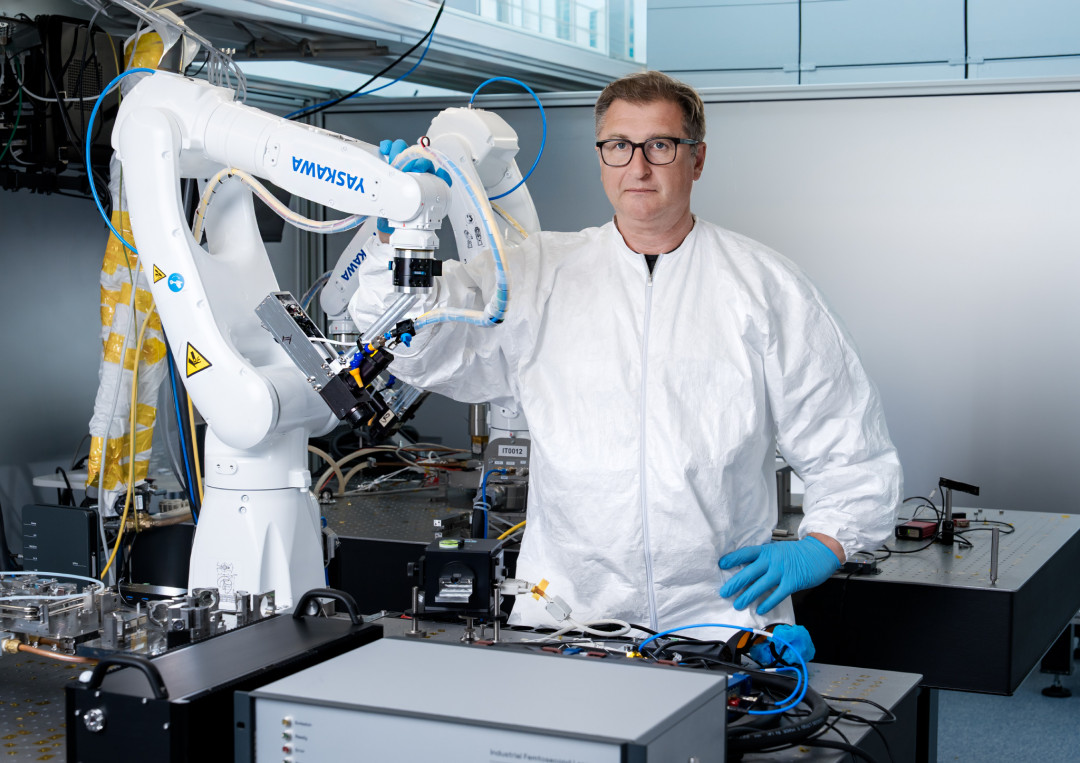
The expansion of AI data centers is expected to increase investment in AI infrastructure over the next five years. Therefore the demand for components that enable high-speed data transfer increases. Femtosecond lasers can be used to manufacture components for AI data center equipment, including parts used in advanced optical connections that speed up data transfer.
A Goldman Sachs report estimates that annual AI infrastructure capital expenditure will grow from $765 billion in 2026 to $1.6 trillion by 2031. According to the report, this development is being driven by increasing demand for computing capacity, data center construction and energy infrastructure. Power, labor and equipment bottlenecks could, however, increase the time between capital commitments and operational data centers. One challenge in increasing data center performance is the speed of data transfer. TrendForce forecasts that the market for co-packaged and near-packaged optics – optical connections used for high-speed data transfer – will grow from around $100 million in 2025 to more than $39 billion by 2030.
According to Nikolajus Gavrilinas, CEO of femtosecond laser manufacturer Litilit, the expansion of AI infrastructure is also increasing requirements for precision manufacturing technologies. “Many advanced AI components, from semiconductor packages, glass substrates, to optical interconnects and advanced PCBs, require manufacturing technologies that can process materials without introducing heat damage. Femtosecond lasers are becoming one of the key enabling tools for this transition, and we believe demand will grow rapidly as AI manufacturing scales,” Gavrilinas says.
Processing with limited heat input
Femtosecond lasers emit extremely short pulses lasting quadrillionths of a second. The short pulse duration allows workpieces to be processed with limited heat input into the surrounding area. According to Gavrilinas, the technology is increasingly used to manufacture components for equipment that enables faster data transfer. One example is the production of glass interposers, which serve as wiring layers in advanced AI hardware and data center equipment to connect chiplets.
In this application, the femtosecond laser drills microscopic holes through the glass. These holes can subsequently be filled with copper to form vertical electrical connections. “A normal laser or mechanical drill heats the material as it cuts, and glass can crack or chip when heated unevenly. A femtosecond laser fires pulses so short – quadrillionths of a second – that the surrounding glass has almost no time to heat up. The same precision is also used to manufacture other data center equipment wherever something needs to be cut, trimmed, or fixed with almost no heat,” Gavrilinas explains.
Industrial production of femtosecond lasers
Furthermore Gavrilina s states that producing femtosecond lasers in industrial volumes remains challenging. Many femtosecond laser systems originated from scientific applications and can require specialist personnel and complex production processes. Litilit has developed a laser technology based on patented inventions by company co-founders Kęstutis Regelskis, Nerijus Rusteika and Gavrilinas, in collaboration with the Center for Physical Sciences and Technology (FTMC) in Vilnius. According to the company, the technology is designed to reduce component complexity and enable a higher level of automation in femtosecond laser production.
In June 2026, Litilit started construction of a laser factory in Vilnius. The company plans to replicate the production model with international partners at a later stage.
(Source: Litilit UAB)
Schlagworte
AIAI InfrastructureData CenterData TransfersEquipmentFemtosecond LaserIndustryLaserTechnology