
14.10.2026
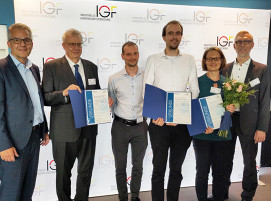
The following paper was named IGF-project of the year 2026. It was first published in THERMAL SPRAY BULLETIN 1/2026.
Inspired by developments in powder metallurgy, in the present work four novel NbC(N)-based compositions with Fe- and Ni-based binders were developed and prepared as agglomerated and sintered feedstock powders. Microstructure, particle size distribution, phase composition and melting behavior of these powders were studied. Coatings were deposited using an HVOF parameter set optimized for an NbC-FeCr powder. Coatings from established compositions (WC-10Co4Cr, Cr3C2-NiCr, (Ti,Mo)(C,N)-Ni) were sprayed for comparison. In addition to deposition efficiency (DE) determination, focus was made on analysis of the coating microstructures and tribological behavior under abrasive as well as sliding wear conditions. The results demonstrate that NbC(N)-based coatings possess a high potential as alternative coatings for wear protection and represent a promising alternative to WC-Co(Cr) coatings.
1 Introduction
Established and commercially available hardmetal feedstock powders for manufacturing of coatings for wear protection by thermal spraying are based on WC and/or Cr3C2 with Co or Ni as preferred binder metals [1]. The two most common compositions possess extreme wear resistance at low temperatures (WC-10Co4Cr) and high corrosion and oxidation resistance at temperatures up to 900 °C (Cr3C2-NiCr), respectively. Restrictions on the use of Co as an optimal binder for WC due to health issues have been discussed for a long time [1, 2]. The classification of W and Co as critical raw materials in Europe and the USA resulted in new activities for substitution of WC-Co(Cr). These include intensive investigations into the suitability of NbC [1], with Fe-based binders being of particular interest. In the field of sintered hardmetals, these are considered an interesting alternative and supplement to established compositions [3]. For this reason, development work with NbC-based materials is also currently being carried out in the field of surface engineering [2, 4–6]. Current geopolitical changes are catalyzing these efforts, as they not only lead to highly volatile prices for W and Co but even to limitations of market availability. In this project, four novel agglomerated and sintered (a&s) feedstock powders based on NbC and NbCN with Fe- and Ni-based binders were developed and used to deposit coatings by high-velocity oxygen fuel (HVOF) spraying. Besides investigations of the microstructures and phase compositions were conducted accompanied by testing the abrasive and sliding wear performance was studied. This was benchmarked against established commercial WC-CoCr and Cr3C2-NiCr coatings as well as (Ti,Mo)(C,N)-Ni as an additional alternative coating.
2. Materials and Methods
2.1 Feedstock powder compositions
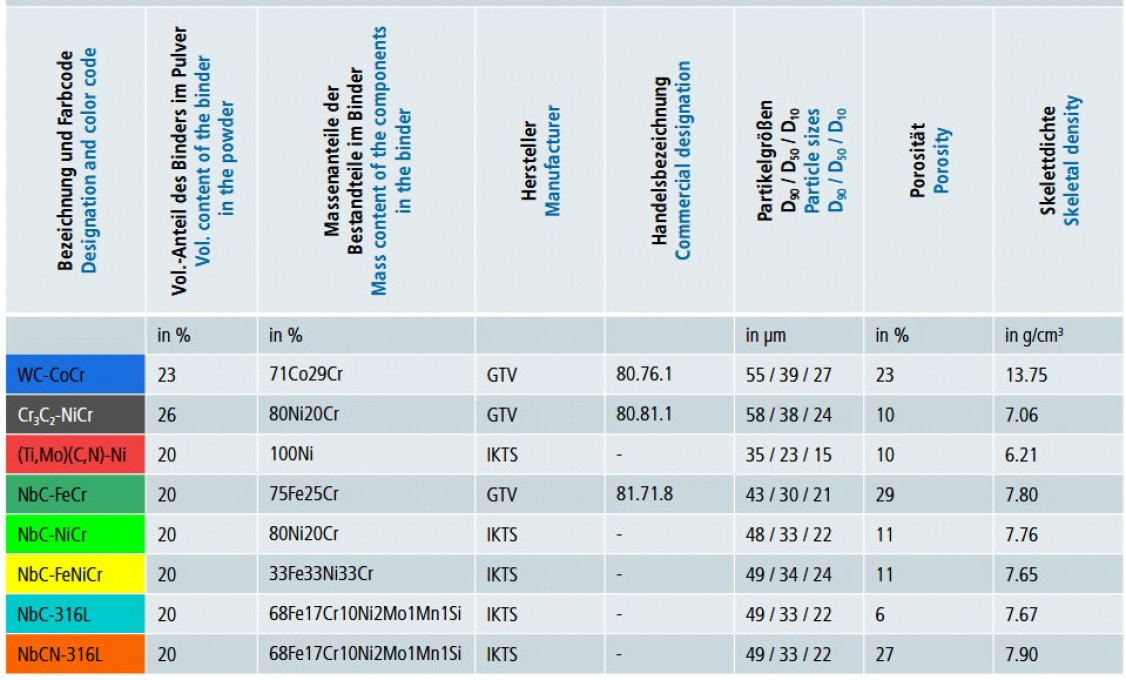
All powders and selected properties are listed in Table 1. The compositions of the four NbC(N)-based powders were selected based on preliminary experiments with sintered samples [7]. At a volume content of 20 %, Ni-based or Fe-based binders with low Ni content were used. Additionally, results for an NbC-FeCr powder [2,6] are presented as well. Besides the commercial powders WC-CoCr and Cr3C2-NiCr, additionally a (Ti,Mo)(C,N)-Ni powder was used for benchmarking. The structure of these powders and the properties of the coatings have been described previously [8].
The measurement of particle sizes was performed by laser diffraction with dry dispersion. Intragranular porosity was determined by mercury porosimetry according to the method described in [9]. The skeletal density was measured using a helium gas pycnometer according to ISO 8130-2 / ASTM B923-23. The morphology and microstructure (cross-section) of the powder particles were investigated by field emission scanning electron microscopy (FE-SEM). Additionally, EDX investigations were performed on these powder cross-sections. An investigation of the melting behavior of the powder particles was carried out using differential scanning calorimetry (DSC) up to 1500 °C, while the phase composition was studied using X-ray diffraction.
2.2 HVOF-Spraying
The influence of spraying parameters on the microstructure and wear resistance of NbC-FeCr coatings was studied in detail [2]. Based on these results, a uniform parameter set was established for the four experimental NbC(N)-based powders, while the parameters for the benchmark powders were adjusted with respect to the spray distance (305–355 mm) and the mass-based feed rate due to differences in skeletal density. All powders were fed at a volume-based rate of approximately 13 cm³/min in twelve passes (target coating thickness approximately 200 µm). All other parameters were identical for all powders: liquid-fueled HVOF spray process (K2, GTV Verschleißschutz GmbH), 2 disk feeders, Ar carrier gas (8 L/min), kerosene (26 L/h), O₂ (900 L/min), O₂/fuel ratio λ of 1.0, nozzle with 150 mm length and constant diameter of 11 mm, surface speed 1 m/s, and step increment 5 mm. The DE was determined according to ISO 17836 (steel substrates 300 mm × 300 mm × 3 mm). Only the time of the flame on the substrate was considered in the calculation. The pretreatment of the steel substrates was performed as described in [2].
2.3 Microstructural analysis
In addition to the analysis of the phase composition by X-ray diffraction, metallographically prepared cross-sections of the as-sprayed coatings were investigated by scanning electron microscopy (SEM) with SE and BSE detectors including EDX. Hardness was determined according to Vickers (HV0.3) with ten individual indentations.
2.4 Wear tests
All wear tests were performed with polished samples (Ra < 0.2 µm). Abrasion resistance was determined according to ASTM G65-16, procedure A using the dry rubber wheel test with quartz sand (rounded, D10=161 µm, D90=310 µm, Euroquarz, Laußnitz). Wear volume and rate were calculated using the skeletal density of the powders and the mass loss measured with an accuracy of 0.1 mg. The dry oscillating sliding wear test was performed modified from ASTM G133 using a commercial tribometer (SVT 40, Wazau, Berlin, Germany). The frequency was 40 Hz with an amplitude of 0.5 mm at a test duration of 30 min (= 72 m wear distance). The spherical Al2O3 counterbody had a diameter of 10 mm. The load was 26 N. The wear volume was measured directly by structured-light 3D profilometry.
3 Results
3.1 Powder Characterization
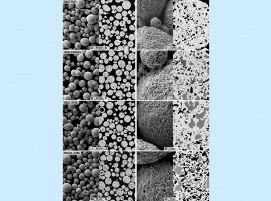
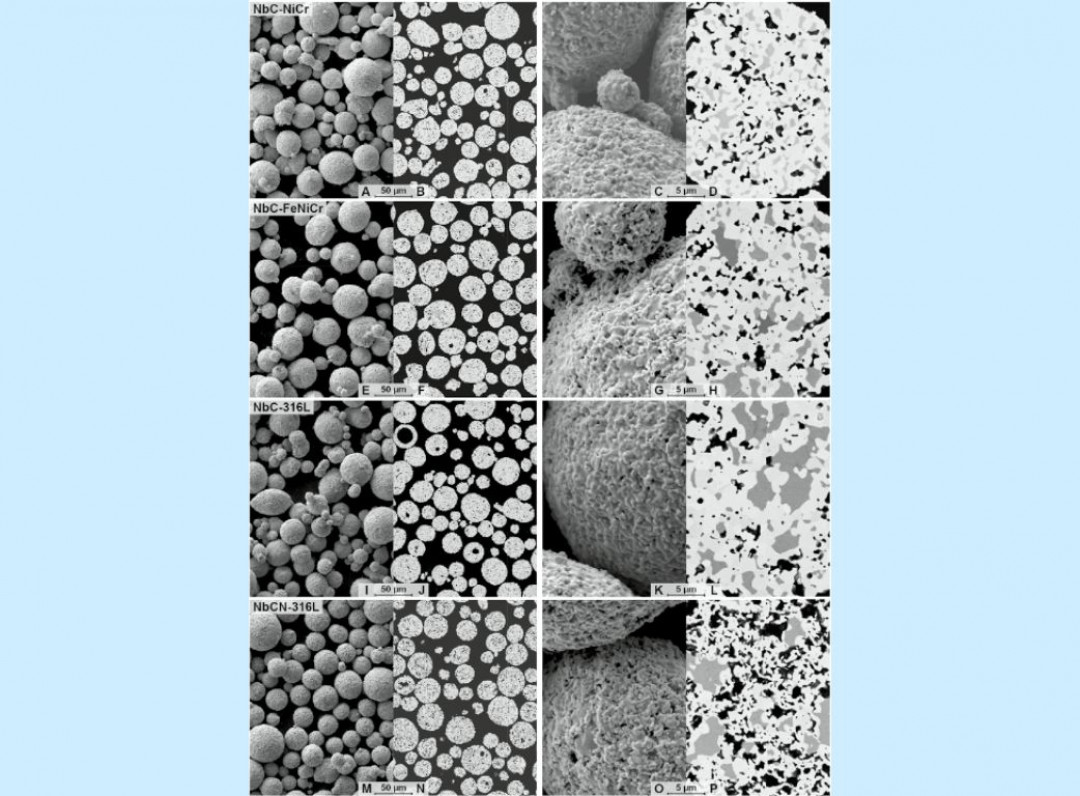
The experimental NbC(N)-based powders exhibit a normal distribution with a median D50 between 32.9 µm and 34.2 µm (Table 1). The porosity varies: for NbC-NiCr and NbC-FeNiCr powder it is approximately 11 %, while the NbC-316L and the NbCN-316L powders show only 6 % and 27 %, respectively (Table 1). This is confirmed by the SEM images of the powder cross-sections compiled in Fig. 1. The size of the commercial NbC used for the preparation of the experimental powders was D50 = 1.5 µm, while that of the synthesized NbCN was D50 = 2.1 µm. The particles are predominantly spherical with a rough surface typical for a&s powders, as well as a homogeneous microstructure with finely distributed porosity and only few hollow particles. Notably, the binder of the NbC-FeNiCr powder consists of Cr-rich and Cr-depleted regions, thus having different Ni contents (Fig. 1, H). This is also found for the NbC-316L powder, but to a significantly lesser extent (Fig. 1, L). The experimental (Ti,Mo)(C,N)-Ni feedstock powder used here exhibits a core-rim structure of the hard phases and a microstructure comparable to powders used previously [8].
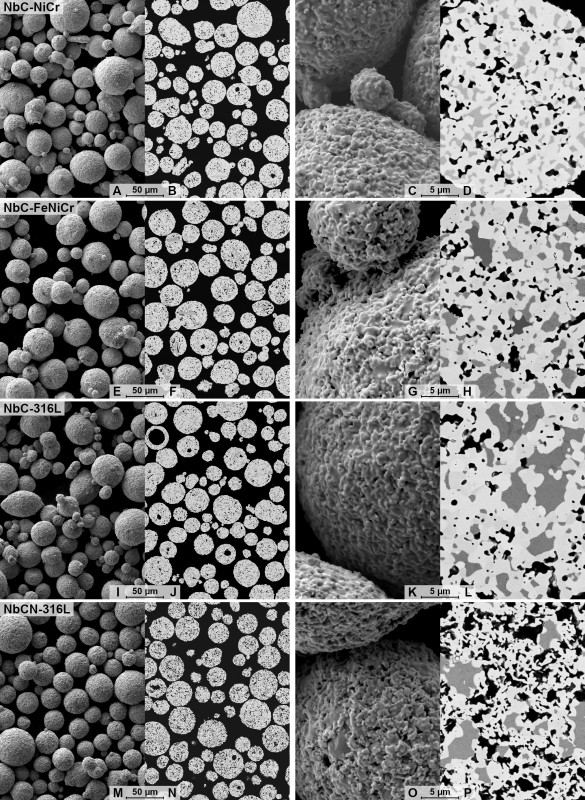
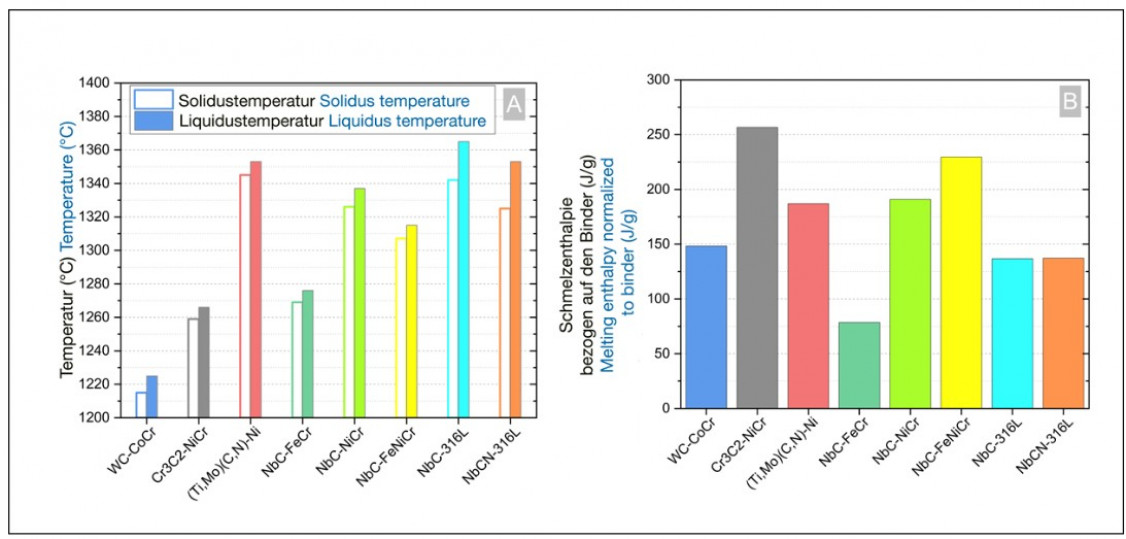
Fig. 2 depicts the results of the thermophysical investigations of the powders, showing the melting temperature ranges (Fig. 2, A) and melting enthalpies (Fig. 2, B) of the binders. Although Cr3C2-NiCr has a relatively low melting range, the melting enthalpy is the highest among the investigated compositions. However, the NiCr binder of the NbC-based powder does not show such behavior. Both melting range and melting enthalpy of the NbC(N)-based powders differ significantly.
3.2 Microstructural coating characterization
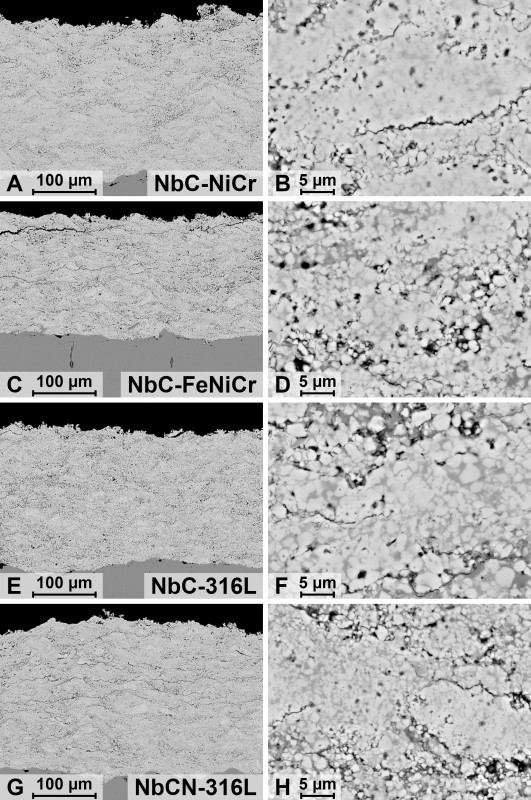
Overall, the SEM images show that the coatings from the new experimental compositions are macroscopically dense and homogeneous (Fig. 3). The BSE contrast enables a visual distinction between carbides (brighter) and binder (darker). Both voids and oxides appear almost black, making the coating appear more porous. At higher magnification, the coatings exhibit microcracks, which typically run along splat boundaries.
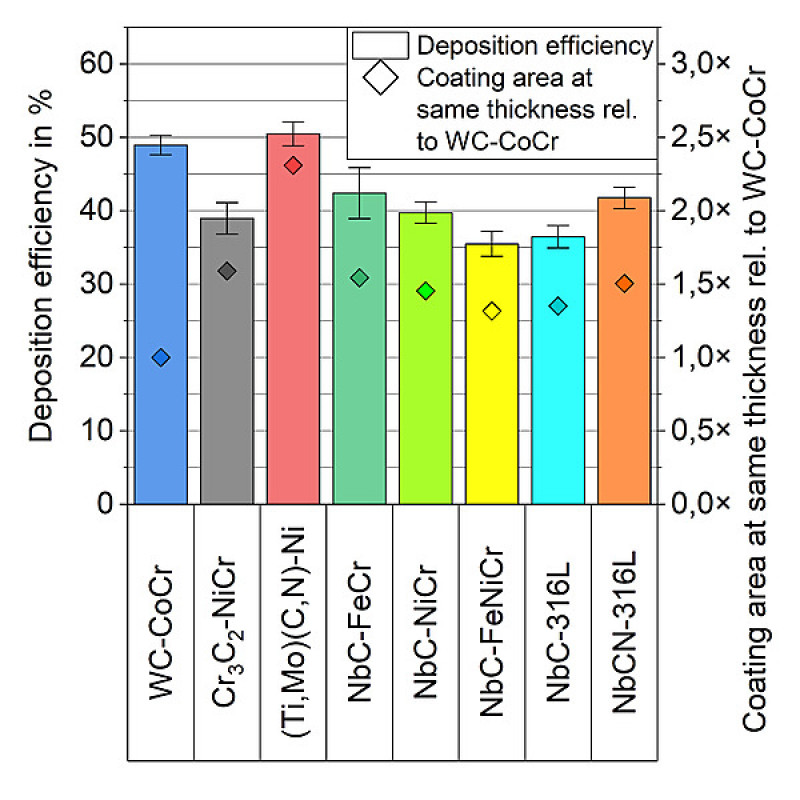
With approximately 40 %, the DE of the experimental compositions during spraying is comparable to or higher than the DE of the Cr3C2-NiCr powder. In comparison, WC-CoCr and (Ti,Mo)(C,N)-Ni are characterized by a DE of up to approximately 50 % (Fig. 4). However, it should be mentioned that these DEs still have potential for improvement due to the prioritization of spray parameter similarity. Considering the DE and the skeletal density of the powders, the amount of powder required to coat a certain surface area with defined thickness can be calculated. Due to its high density, WC-CoCr requires the highest amount of powder. Normalized to WC-CoCr, this yields a factor for the surface area which can be coated with the other materials with the same thickness. (Fig. 4, diamonds). This value shows that the NbC(N)-based compositions with a factor of 1.3–1.6 × compared to WC-CoCr are similarly effective as Cr3C2-NiCr. This is only outperformed by (Ti,Mo)(C,N)-Ni with an area with a factor of approximately 2.3 ×, which results from the combination of low density and high DE.
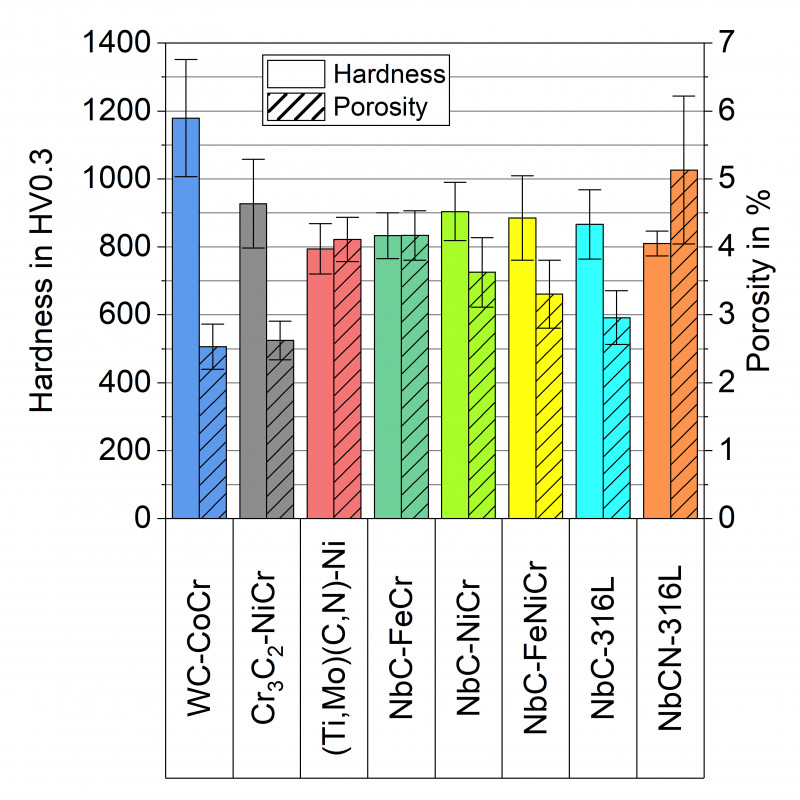
The WC-CoCr coatings exhibit the highest hardness of 1180 HV0.3. All other compositions range between approximately 790 and 930 HV0.3 (Fig. 5). The porosity is particularly low for the benchmarks WC-CoCr and Cr3C2-NiCr at 2.5 % and 2.6 %, respectively. Most other coatings range between 3.0 % and 4.2 %, with the exception of the NbCN-316L coating with 5.1 %.
3.3 Wear tests
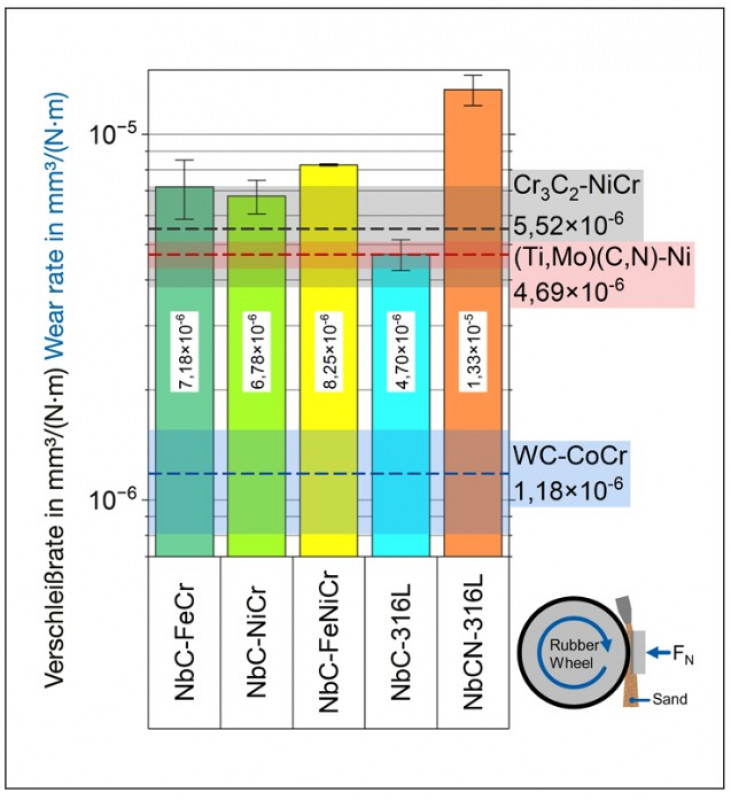
The resistance in the abrasion wear test shows that among the NbC(N)-based coatings, NbC-316L exhibits the lowest wear rate at 4.70×10⁻⁶ mm³/(N×m), thus being at the same level as (Ti,Mo)(C,N)-Ni and slightly lower than Cr3C2-NiCr. Apart from the NbCN-316L coating, for which the rate is only marginally higher, all other NbC-based coatings exhibit a wear rate that is between those of the benchmarks WC-CoCr and Cr3C2-NiCr (Fig. 6).
Compared to the abrasive wear test, the dry oscillating sliding wear test reveals a different behavior of the coatings: Among the NbC(N)-based compositions, the NbCN-316L coating and the NbC-NiCr coating show the lowest wear rate of about 0.66 × 10⁻⁶ mm³/(N × m), indicating a strong influence of wear conditions (Fig. 7).
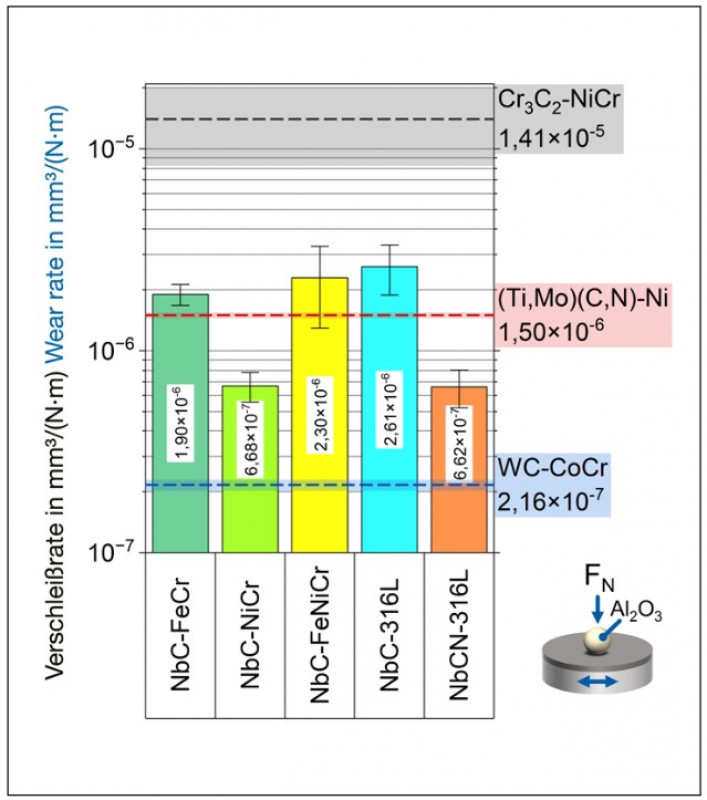
This is only outperformed by the WC-CoCr coating. All NbC(N)-based coatings show wear rates within one order of magnitude thus exhibiting a wear behavior similar to the (Ti,Mo)(C,N)-Ni coating. The Cr3C2-NiCr coatings show a significantly lower wear resistance under these test conditions. Other studies using high-energy milled powders [4, 5], the same relationship between the wear rates of WC-CoCr (low), Cr3C2-NiCr (high), and NbC-based coatings (intermediate) was found under similar test conditions.
4 Discussion
From the combination of EDX point measurement results in the cross-sections and the phase analysis of the NbC-FeNiCr and NbC-316L powders, it could be concluded that an additional phase was formed: in addition to an austenite phase (alloyed Fe with Ni and Cr), a dark-appearing M23C6 phase (M = Cr,Fe,Ni) is present, i.e., a structure of the chromium carbide Cr23C6 in which Cr is partially replaced by Fe and Ni. These precipitates occur at high Cr and C contents. The higher the chromium content in the Fe-based binder system, the greater the tendency for the formation of this carbide. In the case of a Ni-based binder, however, Cr remains completely in the binder. In the case of NbCN, the lower C content in the hard material prevents the formation of M23C6.
The measurements of the thermophysical properties melting range and melting enthalpy of the binders illustrate, for example for Cr3C2-NiCr, that the processability and DE of the powders are not solely determined by the melting range of the binders. In future work, the investigation of additional thermophysical properties, such as heat capacity, is planned. The melting behavior in the spraying process is additionally determined by the porosity of the powders.
The extremely high wear resistance of WC-based coatings at low temperatures and decades of experience with this material explain the continuing reluctance regarding substitution in industrial applications to date. However, current geopolitical changes may lead to a situation where, in addition to the already known health and environmental reasons for substitution, a greater diversification in the use of wear-resistant hard materials becomes essential. In this context, the density differences of the cemented carbide compositions offer the opportunity to make this economically viable: Despite the approximately 10-15 % lower DE of the NbC(N)-based powders compared to WC-CoCr under comparable spraying conditions, approximately 1.3-1.5× larger surface area can be coated due to the approximately 80 % higher skeletal density of WC-CoCr.
Wear resistance is not necessarily dependent on the measured hardness and porosity. The wear resistance of the WC-CoCr coating, which is significantly harder and less porous compared to the NbC(N)-based coatings, is larger only within one order of magnitude. This is even more pronounced for the Cr3C2-NiCr coating, which is sometimes even significantly less wear-resistant despite low porosity. The potential of NbC(N)-based compositions lies in the possibility of using Fe-based binders even without Ni content. Due to the low oxidation resistance of NbC, the low oxidation resistance of NbC-based coatings is a disadvantage. This does not allow higher operating temperatures compared to WC-CoCr coatings.
The development of the (Ti,Mo)(C,N)-Ni compositions took place at a time when the environmental and economic aspects of Ni use were not yet in the foreground [8]. One technical advantage is, among others, the better oxidation resistance compared to WC-CoCr. However, efficient Fe-based binders still need to be developed for this hard material. Further advantages are the lower density compared to NbC as well as a more uniform global distribution of Ti deposits compared to W and Nb.
5 Summary
The work presented in this paper demonstrates that NbC(N)-based coating materials represent a further alternative to increase material diversity for wear-resistant thermally sprayed coating solutions. This necessity arises particularly from current geopolitical developments, which require alternatives to the use of WC-based compositions due to health and environmental aspects as well as price fluctuation and restrictions in tungsten availability.
One specific advantage of NbC(N) is the possibility of using Fe-based binders. The wear rates of the developed compositions in abrasive as well as sliding wear tests are comparable to the benchmarks.
Autoren: Lukas Tegelkamp, Susan Conze, Lutz-Michael Berger, Maximilian Grimm, Thomas Lampke
Acknowledgement
IGF-project-No.: 01IF22577N / DVS-No.: 02.3526
The project is being promoted by the Federal Ministry for Economic Affairs and Energy (BMWE) on the basis of a resolution of the German Bundestag.
The project was carried out by the research association “Forschungsvereinigung Schweißen und verwandte Verfahren e. V. des DVS, Aachener Straße 172, 40223 Düsseldorf.
The authors thank GTV Verschleißschutz GmbH for providing the commercial powders. Thanks are also due to Kay Schlegel for his support in conducting the HVOF spray experiments.
References
[1] Reisel, G.; Berger, L.-M.; Dorner-Reisel, A.; Eronen, V.: Alternative Hard Materials for Thermal Spraying: A Review, in: Conf. Proc. 12. Kolloquium HVOF Spraying, Erding, 2023, pp. 63/82.
[2] Tegelkamp, L.; Grimm, M.; Conze, S.; Berger, L.-M.; Lindner, T.; Lampke, T.: Microstructure and wear resistance of environmentally friendly NbC-FeCr coatings: An evaluation of HVOF process parameters, Surf. Coat. Technol. 509 (2025). https://doi.org/10.1016/j.surfcoat.2025.132208
[3] García, J.; Collado Ciprés, V.; Blomqvist, A.; Kaplan, B.: Cemented carbide microstructures: a review, Int. J. Refract. Met. Hard Mater. 80 (2019)
pp. 40/68. https://doi.org/10.1016/j.ijrmhm.2018.12.004
[4] Gehlen, L. R.; Bolelli, G.; Puddu, P.; Forlin, E.; Colella, A.; Pintaude, G.; Lusvarghi, L.: Tribological and electrochemical performances of HVOF sprayed NbC-NiCr coatings, Surf. Coat. Technol. 474 (2023). https://doi.org/10.1016/j.surfcoat.2023.130098
[5] Bolelli, G.; Colella, A.; Forlin, E.; Rossi Gehlen, L.; Lusvarghi, L.; Miconi, L.; Pintaude, G.; Puddu, P.: Tribological performance of NbC-based hardmetal HVOF coatings with Fe-Cr-Mo matrix, Wear Vol. 564-565 (2025). https://doi.org/10.1016/j.wear.2024.205680
[6] Wank, A.; Schmengler, C.; Krause, A.; Müller-Roden, K.; Wessler, T.: Environmentally Friendly Protective Coatings for Brake Disks, J. Therm. Spray Technol. 32 (2022) pp. 443/55. https://doi.org/10.1007/s11666-022-01459-0.
[7] Conze, S.; Tegelkamp, L.; Berger, L.-M.; Lampke, T.; Pötschke, J.: Mechanical and tribological properties of NbC and NbCN-based cermets, in: 21st Plansee Seminar: Int. Conf. Refract. Met. Hard Mater., Reutte, Austria, 2025, pp. 1789/1800.
[8] Berger, L.-M.: Hardmetal coatings based on TiC - Alternatives to the state of the art?: Hartmetallschichten auf der Basis von TiC - eine Alternative zum Stand der Technik?, Therm. Spray Bull. 8 (2015) pp. 110/7.
[9] Thiele, S.; Heimann, R. B.; Berger, L.-M.; Herrmann, M.; Nebelung, M.; Schnick, T.; Wielage, B.; Vuoristo, P.: Microstructure and properties of thermally sprayed silicon nitride-based coatings, J. Therm. Spray Technol. 11 (2002) pp. 218/225. https://doi.org/10.1361/105996302770348871
Schlagworte
DVS German Welding SocietyDVS GroupDVS ResearchIGFThermal Spray BulletinTSB