
08.01.2025
International
Fraunhofer IWS Develops Innovative Material and Process Solutions
The scarcity of raw materials poses severe challenges to global industries. Recycling and the increased use of secondary raw materials have become essential for many companies. At the same time, rising raw material prices and uncertainties in supply chains are driving further research into materials. The Fraunhofer Institute for Material and Beam Technology IWS in Dresden is now involved in a new Fraunhofer flagship project, which aims to ensure the supply of structurally and functionally secure materials, particularly for the energy transition.
The demand for critical materials such as lithium, cobalt and rare earth elements is rising. These resources are indispensable for batteries, electronics and renewable energy systems. As these materials are often found in only a few countries, dependence and vulnerability of supply chains are increasing. Geopolitical tensions and trade restrictions further exacerbate the situation. In this context, the circular economy is gaining importance. Even conventional raw materials such as aluminium are increasingly affected by shortages. Until recently, aluminium was considered relatively abundant. “However, it is becoming increasingly difficult to obtain,” explains Prof. Martina Zimmermann, Head of the Materials Characterization and Testing department at Fraunhofer IWS. The production of primary aluminum – aluminium derived directly from ore – has steadily declined in Germany. This development is forcing industries to rely more on secondary raw materials produced by recycling of already-used metals. This is not only ecologically sound but also economically attractive. The use of secondary raw materials saves energy and reduces CO2 emissions.
However, there is a problem: contamination can occur during the recycling process. The cause is foreign substances such as paints, plastics or other metals in the recycled material. This complicates processing and reduces the quality of secondary raw materials. So, what is the impact of repeated recycling? “Another important aspect and a challenge for industries is batch variability,” adds Prof. Zimmermann. This issue is well-known, for example, with stainless steel sheets used to produce bipolar plates for batteries and fuel cells. Stainless steel contains nickel, but when nickel is in short supply, only the minimum amount is added. This affects the sheet’s formability and corrosion resistance.
Fast material testing through simulation and experiment
The goal is to determine the material composition and properties swiftly, precisely and cost-effectively, enabling timely adjustments to industrial processes. This is where the Fraunhofer flagship project Digital Ecosystem for a Resilient and Sustainable Supply of Functionally Secure Materials, or ORCHESTER for short, comes into play. Since early 2024, six Fraunhofer institutes, led by the Fraunhofer Institute for Mechanics of Materials IWM, have been working on this initiative. Fraunhofer IWS is one of them. By the end of 2027, the researchers aim to find new ways to address raw material shortages and to offer adaptation strategies for the processing industry. They use a modern approach to material research that closely combines digital models with practical experiments – known as combinatorial materials design. With this method, researchers can simulate various scenarios in the lab, such as how changes in material composition, adjustments during production, or repeated recycling affects the properties of a material. By combining digital simulations and experimental testing, they can better optimize material properties, predict outcomes and implement necessary adjustments more quickly.
Fraunhofer IWS benefits from the experience gained in a previous project. As part of the European M-ERA.net programme, Dr. Jörg Kaspar’s Materials and Failure Analysis group worked on high-entropy alloys (HEAs), considered promising materials for industries such as aviation, turbine construction and other high-performance sectors. These alloys consist of at least five different metals combined in nearly equal proportions, moving away from the traditional concept of metallic materials dominated by a single chemical element, such as iron in the case of steel. When designed correctly, HEAs offer an outstanding mix of properties: they have high strength and excellent ductility, are harder and more heat-, wear and corrosion resistant than traditional materials like steel or aluminium.

Digital methods for optimized material combinations
Despite their potential, HEAs are still rarely used, mainly because they are difficult to process and expensive to produce. Finding the ideal composition efficiently remains a challenge. Given the numerous possible combinations, manually testing each variant would take years. “We have developed a method to speed up this process significantly,” explains Dr. Kaspar. "First, we use a computer simulation. Based on extensive data about various chemical compositions, we identify and preselect attractive alloys. Then, we conduct practical testing."
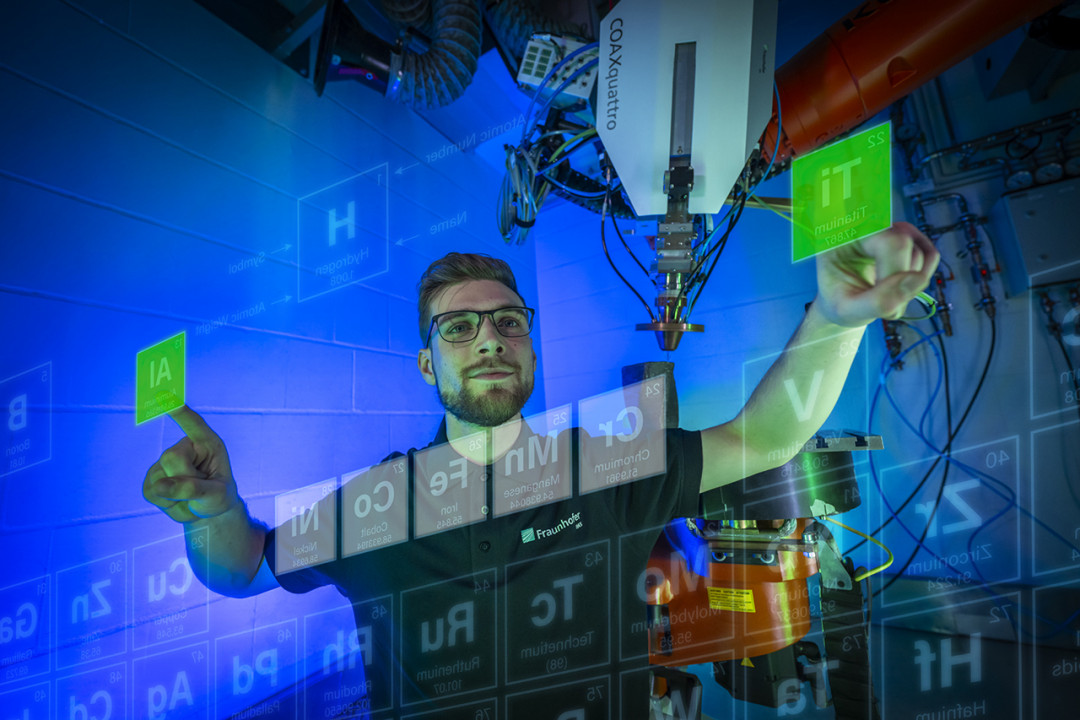
Using Additive Manufacturing systems, researchers quickly produce samples of the predicted HEA compositions. The systems mix elemental powders such as iron, chromium and nickel, melt them with a laser and deposit them onto a sample plate. The machine automatically adjusts the composition and each new alloy is tested with respect to hardness, strength, and other relevant properties. This semi-automated approach allows for much faster identification of the optimal alloy.
Further ideas for sustainable material supply
“We plan to leverage this expertise in the new ORCHESTER project,” says Prof. Martina Zimmermann. She explains the project’s name with an analogy: an orchestra combines various instruments, each playing different notes but ultimately merging into one harmonious sound. Different base substances come together in materials, each contributing to its properties. “We aim to determine and evaluate these compositions and properties efficiently.” Simulations and experiments will create a digital knowledge base about material properties, enabling recommendations for industrial applications and deeper insights into material performance.
The ideas go even further. The researchers are already developing new concepts for future projects. “A fascinating question would be how we can use our combinatorial materials design to efficiently determine how to continuously recycle materials from scrap without compromising their property profile,” says Dr. Kaspar. The Fraunhofer IWS projects alone cannot solve the problem of raw material shortages, “but together with our partners, we aim to make a significant contribution,” adds Prof. Martina Zimmermann.
(Source: Fraunhofer IWS Press Release)
Schlagworte
MaterialsRecyclingResearchSupply Chain