
International
© Christoph Wilsnack/Fraunhofer IWS
03.06.2024

Process Monitoring for Direct Metal Deposition

Process Monitoring for Direct Metal Deposition

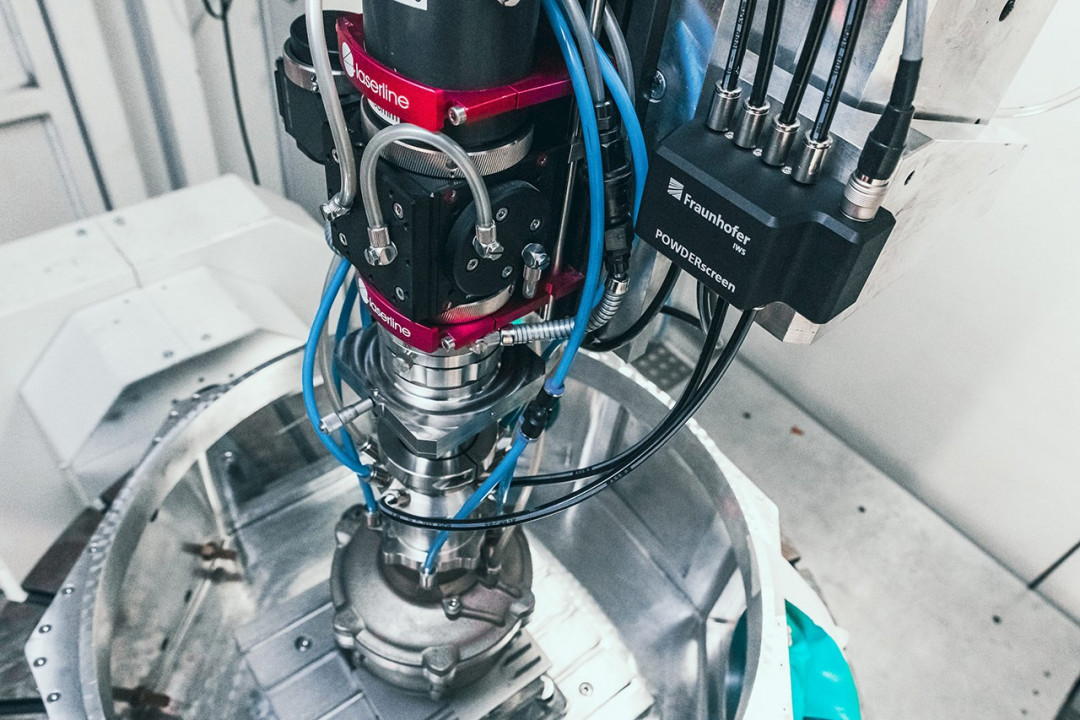
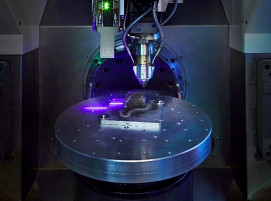
“POWDERscreen” detects powder particles: Increased process reproducibility through permanent monitoring of the powder mass flow rate

For a stable and therefore reproducible process, in addition to process shielding with “COAXshield” and the qualification of the powder cone by the “LIsec” device, it is also necessary to know all input variables exactly and to control them, if necessary. Especially the continuous measurement of the fed powder quantity has been a great challenge so far. The fed powder mass can be calculated exactly on this basis. As a result, it is possible to detect fluctuations in the particle mass flow and report them to a downstream controller.

Not only does this significantly increase the process reliability, but it also enables several different powders to be mixed in a targeted manner during the welding process. A discrete-time measurement of the powder mass flow also significantly increases the process digitization level and provides data for creating a digital twin of the created component.
© gierig media / Ben Gierig
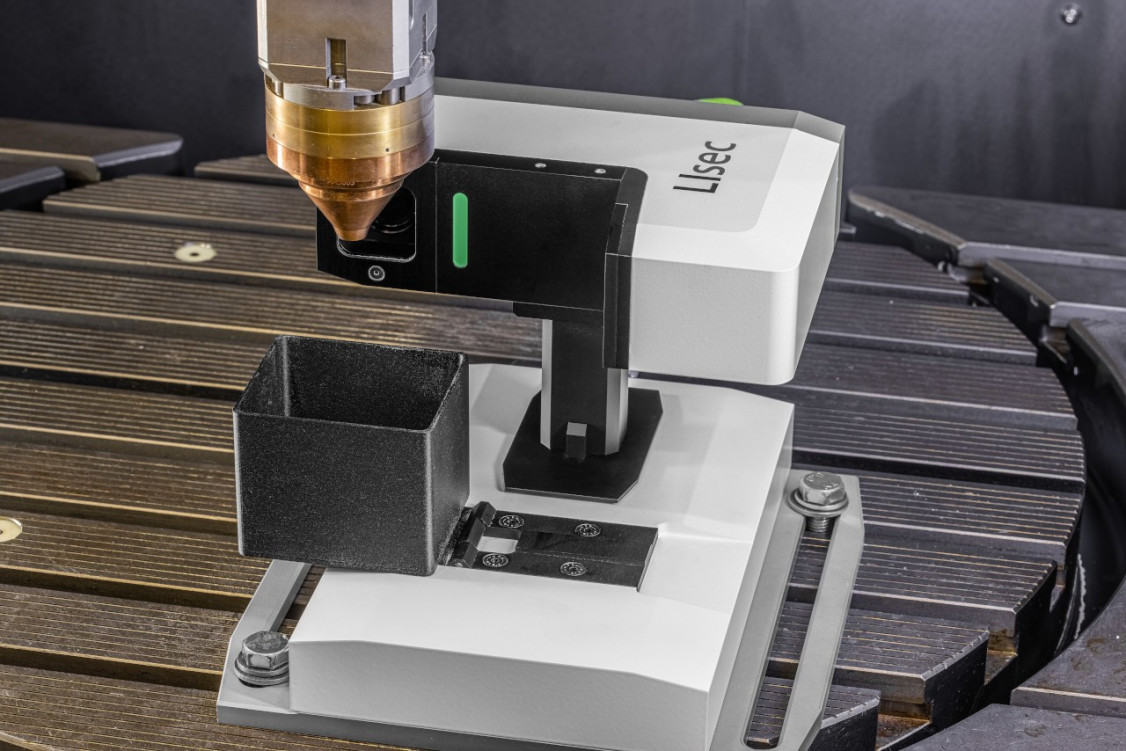
Plant integrated measurement: The "LIsec" powder nozzle measurement system reveals powder flows after leaving the nozzle. © gierig media / Ben Gierig
“LIsec” lights the powder flow: A measuring system for automated characterization of the powder nozzle during laser powder build-up welding

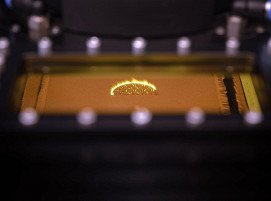
While tool calibration is state of the art in conventionally used ablative processes such as milling, in laser powder build-up welding it is still a great challenge. Fraunhofer IWS developed the measuring device ”LIsec” to solve this challenge and to move the limits to technical feasibility. The abbreviation stands for ”Light Section” and already reveals the principle: A measuring laser scans the powder flow after leaving the nozzle. A right-angled camera records light sections through the powder and forwards them to an analysis software. The three-dimensional distribution of the powder flow can be calculated with high precision. This allows significantly simplified quality control and provides information on the wear degree of the powder nozzle.

For example, it can be used to repair damaged or worn turbine blades on aircraft in higher quality and more reliably than before. In this respect, the measuring device can contribute to greater safety and lower maintenance costs in aviation.

(Source: Fraunhofer IWS Press Release)
Schlagworte

CladdingDMD

Verwandte Artikel

17.11.2026

Formnext 2026: Nippon Sanso introduces 3DPro RotoTIG

Nippon Sanso will showcase the 3DPro RotoTIG torch in Europe at Formnext 2026, presenting a new approach to wire-based metal additive manufacturing.

Additive Manufacturing AM Cladding Electrode Tungsten Welding Welding Wire Wire-based Metal Additive Manufacturing
Read more
14.11.2026

Mould Repair by Laser

Of the ten typical defects found on moulds and dies, nearly all are local and can be repaired by laser build-up welding directly on the tool.

Automation Cladding Heat Cracks Laser Laser Beam Build-up Welding Laser Beam Welding Moulds Steel Welding Welding Wire
Read more
23.10.2026

Diodenlasersysteme für additive Fertigung und Cladding

Auf der Formnext 2026 vom 17. bis 20. November präsentiert Laserline diodenlaserbasierte Lösungen für die additive Fertigung und das Laserauftragschweißen.

Additive Fertigung Beschichtung Cladding Diodenlaser Diodenlasersystem Formnext Laser Cladding Laserauftragschweißen Lasersystem Oberflächen Oberflächenbeschichtung Optiken Prozessüberwachung Pulverbettverfahren Thermal Spraying Thermisches Spritzen TSB
Mehr erfahren
06.07.2026

Digital Parameter Design and Quality Assurance for Process Transferability in Laser Cladding

As part of the HIP-LMD project, a hybrid process model for laser material deposition was developed that combines physical simulations with data-driven methods.

AI Cladding Data Digitalisation Digitalization Laser Laser Cladding Laser Material Deposition NDT Non-Destructive Testing Quality Assessment Quality Control Research Research Paper
Read more
Extreme high-speed Laser Material Deposition (EHLA) enables the additive deposition of functional surfaces with high precision and speed. This allows components to be efficiently coated, repaired, or manufactured with close-to-final-contour precision.
10.06.2026

Longer Service Life for Moulds and Tools

Manufacturing and maintaining die-casting tools professionally is crucial to the foundry industry: As one of the most expensive assets, these tools play a decisive role i...

AI Cladding CNC Coating Laser Cladding Laser Material Deposition LMD Materials and Laser Technology Steel Surface Treatment Surfacing Thermal Spray Bulletin TSB
Read more