
03.06.2025
International
A pioneering research project has been successfully completed at the SKZ Plastics Center. The aim of the project was to develop a time-lapse testing method that, for the first time, enables the quantitative evaluation of stress crack failure in plastic components under the influence of media. Unlike established, standardized test methods – such as the ISO 22088 series of standards – which generally only allow material ranking, the new test concept enables a well-founded prediction of service life. This represents a significant advance for quality assurance and product development in the plastics processing industry.
Stress crack failure, which occurs under the simultaneous influence of mechanical stress and chemical media, is one of the most common causes of damage to plastic components. The methods standardized to date, such as ISO 22088, generally only allow for qualitative material ranking. Until now, it has been virtually impossible to reliably predict service life.
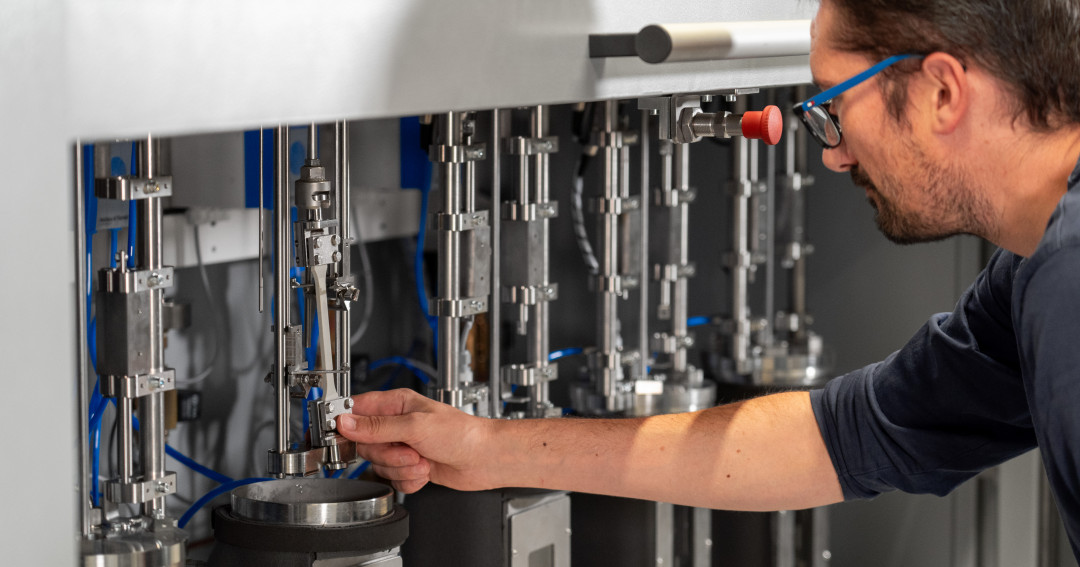
As part of a research project funded by the German Federal Ministry for Economic Affairs and Climate Action (BMWK), the SKZ plastics center has now succeeded in developing and validating a new testing and evaluation concept. This enables, for the first time, a quantitative assessment of stress crack behavior under realistic conditions. The method allows statements to be made about when a plastic will fail under defined test conditions, such as medium (e. g., disinfectants, oils), load level and temperature. The basis is a specially developed, heatable measuring setup that can be adapted to common universal testing machines. The test can be accelerated considerably by raising the temperature in a targeted manner (time-temperature superposition principle).
The measurement setup with continuous force and strain measurement offers a particular advantage: in addition to failure times, the influence of stress duration and medium on stiffness can also be investigated – for example, through the effect of plasticizers. Processing-related factors such as residual stresses or molecular orientations can also be evaluated.
The project was funded by the Federal Ministry for Economic Affairs and Climate Protection (BMWK) under the Industrial Collective Research (IGF) program and supported by a committee of interested companies.
In a supplementary R&D cooperation project with IPT Institut für Prüftechnik Gerätebau – funded by the Central Innovation Program for SMEs (ZIM) – a corresponding test device with several measuring stations was developed. In its current version, the new test device has six autonomous measuring stations. This allows parallel tests with different media, plastics, or test conditions (temperature, test type, test parameters). It is now available at SKZ for industrial applications to perform (time-lapse) tests for the quantitative assessment of the media stress crack resistance (failure times and creep deformation) of plastics.
With this development, SKZ is making an important contribution to damage prevention in plastic components.
More information on Component Properties
(Source: FSKZ e. V.)
Schlagworte
Crack TestsJoiningPlasticsPolymersQCQuality ControlTesting