
International
© Fraunhofer IGP
23.01.2024

Upgraded 2MN Resonance Testing Machine More Efficient and Versatile

Upgraded 2MN Resonance Testing Machine More Efficient and Versatile

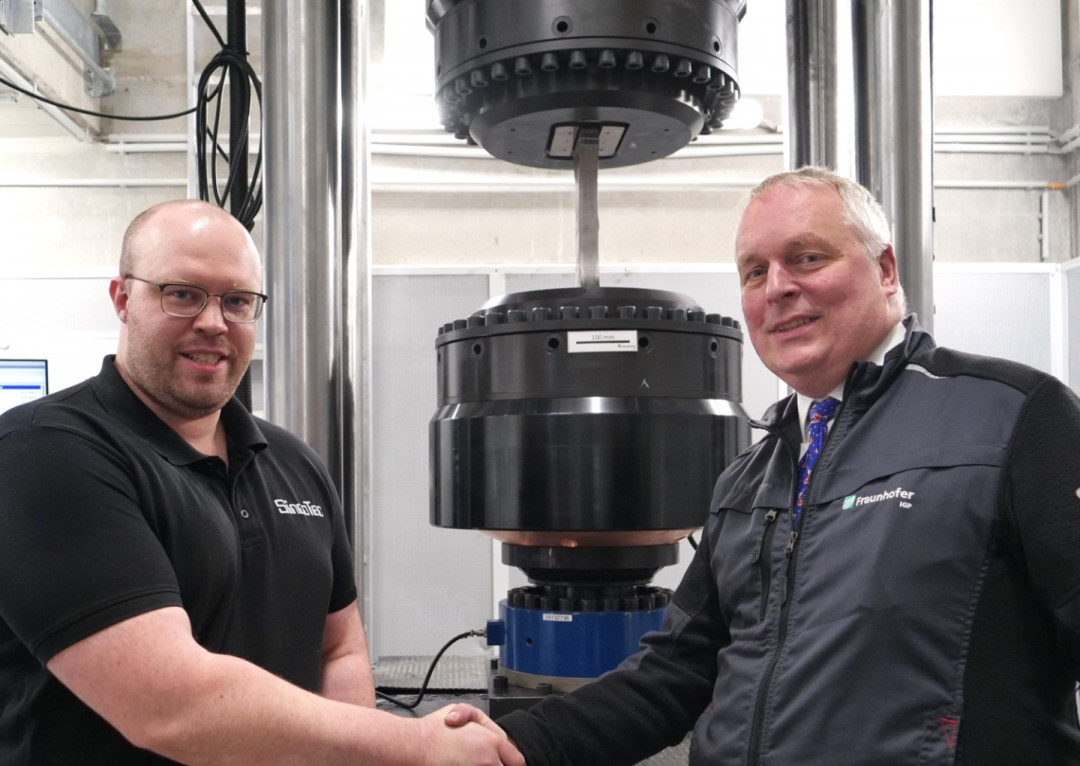
Representatives of the manufacturing company SincoTec recently visited Fraunhofer Institute for Large Structures in Production Technology IGP on-site to install a universal clamping device that did not exist for resonance testing machines in these force ranges. This upgrade makes the testing equipment more flexible.

The 2MN resonance pulsator is the first testing machine from SincoTec equipped with this device. In terms of the size of the enclosed test space and the maximum possible force application, the testing equipment is currently unique in its newly created configuration. As a result, it can be particularly used in areas where large sheet thicknesses are used or high forces occur, such as in construction of on- and offshore wind turbines, in steel, plant, or shipbuilding.

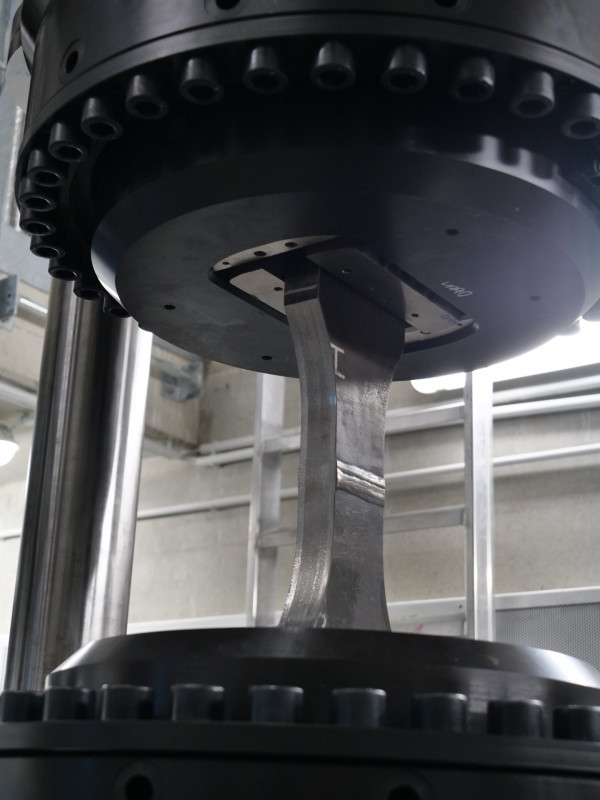
With the equipped testing machine, large cross-sections (diameters up to 80 mm) or large sheet thicknesses up to 90 mm (including welded components) under high loads up to 2MN can be dynamically testet. In comparison to the "conventional" testing machines, this one also allows for much faster testing times. This enables not only "normal" fatigue tests but also endurance strength tests up to very high load cycle numbers (up to 10 million cycles and beyond) within a reasonable time frame.

The newly developed hydraulic clamping device by SincoTec streamlines operational processes during which the test pieces are mechanically clamped. This method serves several advantages: It enhances the durability of the sealing system and simultaneously ensures higher operational safety. The testing machine also offers sustainability benefits. In the execution of experiments to create a Wöhler curve, energy savings compared to a hydraulic testing machine can reach up to 70 per cent.

Thanks to the reconfiguration of the 2MN resonance testing machine, Fraunhofer IGP is now able to dynamically test materials with large cross-sections or sheet thicknesses under high loads up to 2MN within a significantly reduced time and cost framework.

© Fraunhofer IGP
Reconfiguration of the 2MN resonance testing machine allows dynamic testing of materials with large cross-sections or sheet thicknesses under high loads © Fraunhofer IGP

(Source: Fraunhofer IGP Press Release)

Schlagworte

ADAIAMEnergyInstituteManufacturingMESNormOffshorePPESafetyShipbuildingSteelSustainabilitySystemTechnologyTestingTIG
Verwandte Artikel

Rüdiger Brockmann und Richard Steinbrecht, Geschäftsführer der iQLASE GmbH
08.09.2026

Combined Expertise in Laser Process Control and Monitoring

Blackbird Robotics), the leading provider of technology solutions for remote laser welding, and Lessmüller Lasertechnik, the manufacturer of quality monitoring systems fo...

Laser Laser Beam Welding Laser Systems Management Monitoring Remote Laser Welding RLW Robot Robotics Software System Solutions Testing Welding
Read more
05.09.2026

Oerlikon Announces 1. Q 2026 Results

Michael Suess, Executive Chairman of Oerlikon, stated: “The strong first half results confirm that Oerlikon is developing in the right direction. Some of our markets are...

Additive Manufacturing Aerospace Aviation Coating Defence Defense Energy Materials Power Generation Simiconductors Surface Treatment Surfacing Thermal Spray Bulletin TSB
Read more
30.08.2026

BGHM-Jahresbericht 2025: Arbeitsschutz und Berufskrankheiten im Fokus

Die Berufsgenossenschaft Holz und Metall hat ihren Jahresbericht 2025 veröffentlicht. Er enthält Kennzahlen zu Arbeitsunfällen, Berufskrankheiten und Ausgaben sowie Infor...

Arbeitsschutz Arbeitsunfälle Berufsgenossenschaft Berufskrankheiten Gefahrstoffe Gesundheitsgefahren Metallbranche Norm
Mehr erfahren
26.08.2026

Recycling von Aluminiumschaum: Späne und Altteile als Rohstoff

Das Fraunhofer-Institut für Werkzeugmaschinen und Umformtechnik IWU untersucht neue Recyclingverfahren für Aluminiumschaum. Produktionsreste, Aluminiumspäne und ausgedien...

Emissionen Fahrzeugbau Fraunhofer Fraunhofer IWU Leichtbau Maschinenbau Materialkreislauf Pulver Schienenfahrzeugbau Schneiden TIG TWI Umformtechnik Werkzeugmaschinen
Mehr erfahren
Schematische Darstellung eines Kameramoduls: Blaue Pfeile symbolisieren die Niedertemperaturhärtung der neuen SLT-Klebstoffe
26.08.2026

Klebstoffe für Consumer Electronics härten ab 45 °C aus

Delo hat seine Klebstofffamilie Dualbond LT um Klebstoffe für die Niedertemperaturhärtung erweitert. Die Materialien härten bei 60 °C innerhalb von zehn Minuten oder bei...

Batterien Elektronik Elektronikfertigung Kleben Klebprozesse PE TIG TSS
Mehr erfahren