
23.06.2026
International

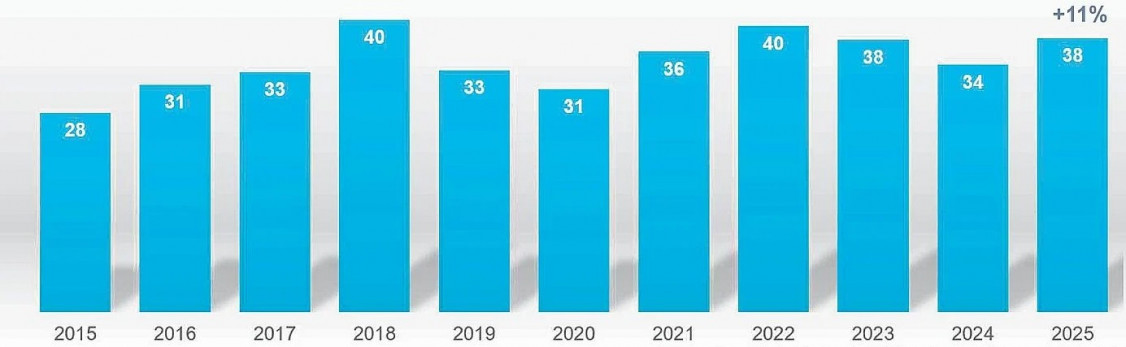
The number of industrial robot installations in the United States rose by 11 % year-on-year, to reach 38,000 units in 2025. This recovery is driven by growth in the food industry and other non-manufacturing sectors. However, the automotive industry remains the largest adopter and reached 13,500 units, just 1 % below last year's result. “The United States are back on the growth track,” says Takayuki Ito, President of the International Federation of Robotics. “While automotive achieved its third-best result in seven years, the data highlights a growing demand for flexible automation in the food industry: Adoption in this sector surged by 30 %, now ranking alongside metal and machinery and electrical-electronics, all with approximately 3,000 installations in 2025.”
Robot density
The degree of automation in the US, as measured by robot density, stands at 307 industrial robots in use for every 10,000 employees in the manufacturing industry. This places the US in 8th position worldwide (two ranks up from the previous year) behind top automated countries such as South Korea (1,220 robots), Germany (449 robots) and Japan (446 robots), but ahead of China (166 robots).
United States vs. China
However, China outperforms the rest of the world in terms of market size: Annual installations in China reached 295,000 units in 2024. This represents a global market share of 54 %. Preliminary results for China 2025 are not published yet, but according to IFR´s estimates, installations are about ten times higher than the number in the United States. This is based on the country's national robotics strategy, which was launched ten years ago. China's recently published 15th Five-Year Plan (2026–2030) now has placed robotics at the heart of its modern industrial system. The aim is to focus its AI research on physical applications, with robots being the main driver of economic growth.
National robotics strategy
North America’s largest automation trade association, A3, has officially published and presented its "Vision for a National Robotics Strategy" to lawmakers. The trade group advocates a framework for a Federal Robotics Office and a National Commission to coordinate policy, with the aim of harmonising government research and fostering public-private partnerships. The proposed national strategy also calls for market-driven tax incentives, expanded technical workforce retraining, updated safety standards and a federal mandate to purchase domestic robotics technology to accelerate commercial deployment.
Outlook
The industrial modernization outlook in North America and the U.S. remains highly positive. This is driven by accelerating factory reshoring initiatives and a persistent shortage of skilled labor. IFR projects a resilient, long-term growth trajectory for the region's automation sector, as manufacturers are increasing automation investments to mitigate structural workforce gaps and as demand diversifies beyond traditional sectors.
About robot density
Robot density is the number of operational industrial robots relative to the number of employees. It can cover the whole manufacturing industry or just specific industrial branches. The number of employees serves as a measure of economic size, so the quotient of operational stock over employees puts the operational stock on a uniform base.
(Source: International Federation of Robotics)
Schlagworte
AutomationAutomotiveManufacturingMarket GrowthRoboticsRobots