
02.10.2025
International
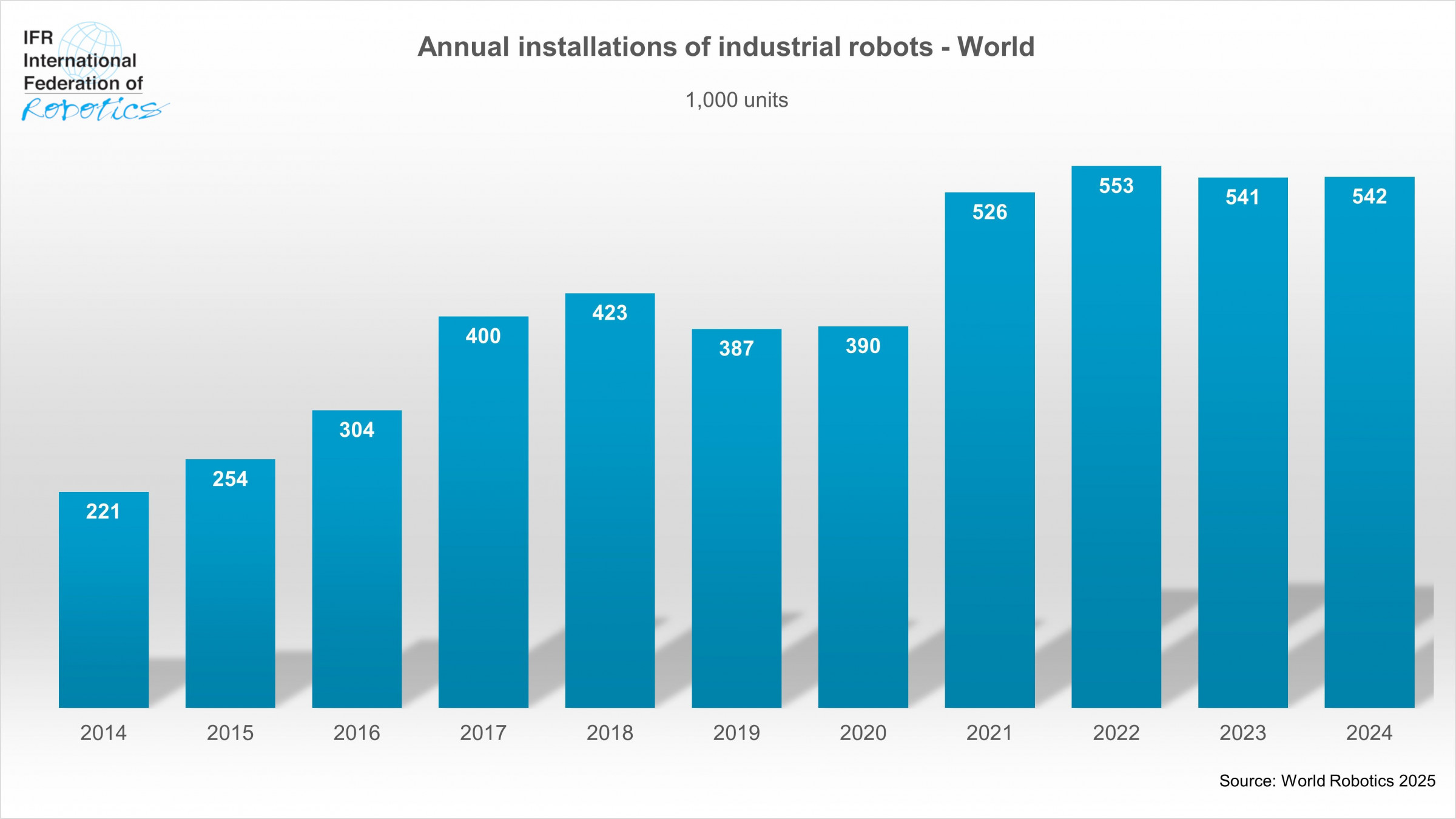
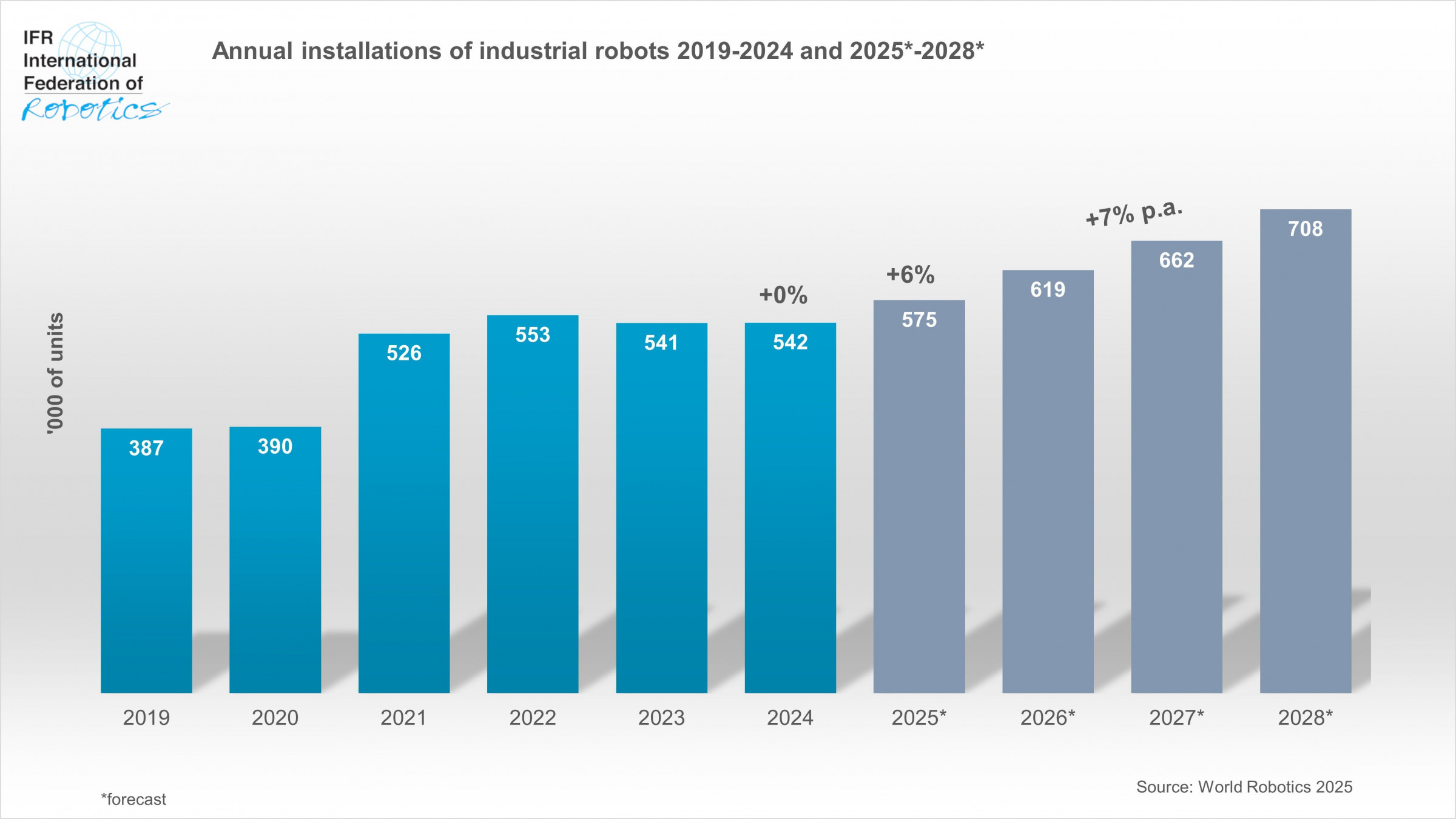
The new World Robotics 2025 statistics on industrial robots showed 542,000 robots installed in 2024 – more than double the number 10 years ago. Annual installations topped 500,000 units for the fourth straight year. Asia accounted for 74% of new deployments in 2024, compared with 16% in Europe and 9% in the Americas.
Asia, Europe and the Americas – overview
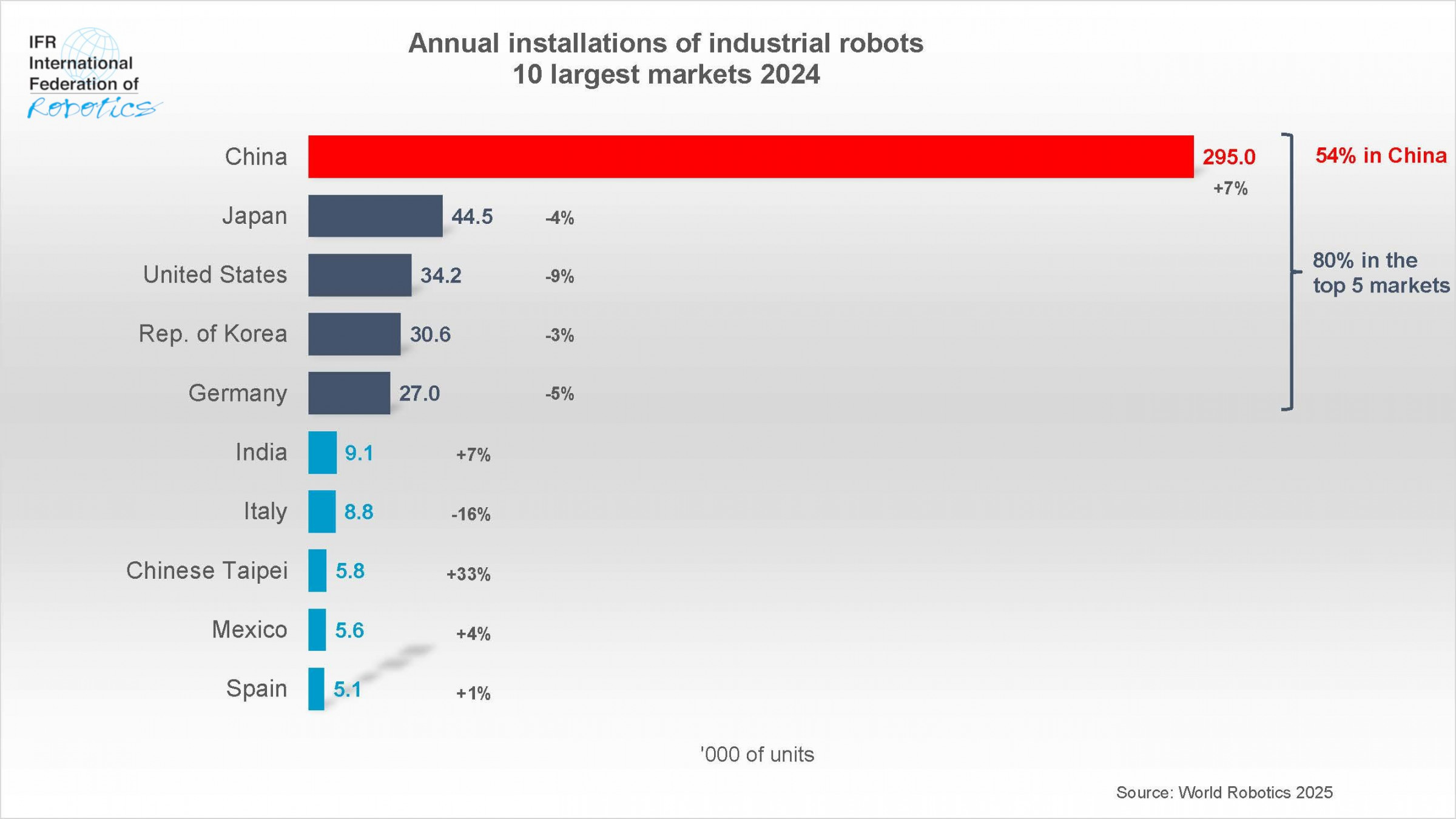
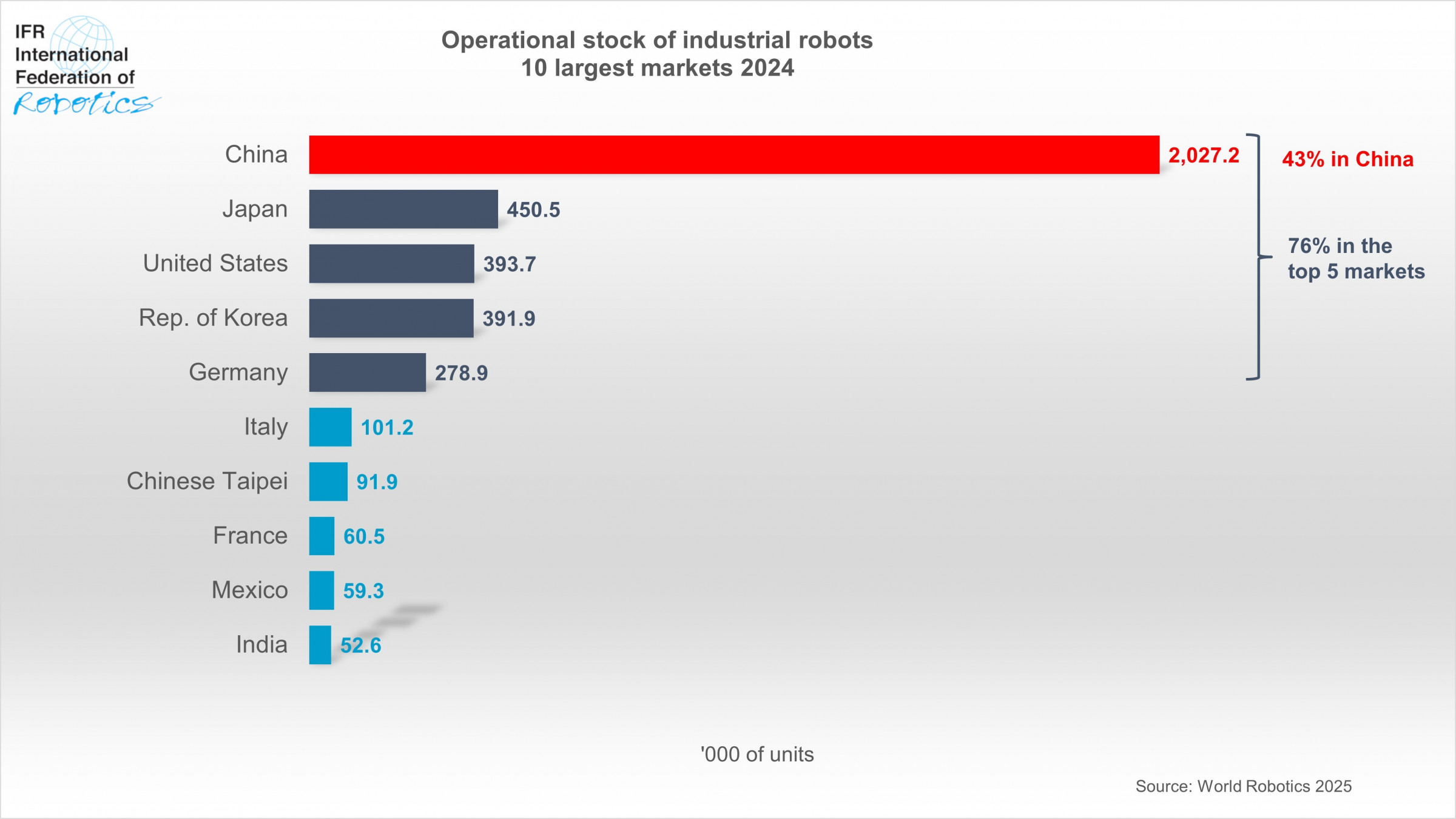
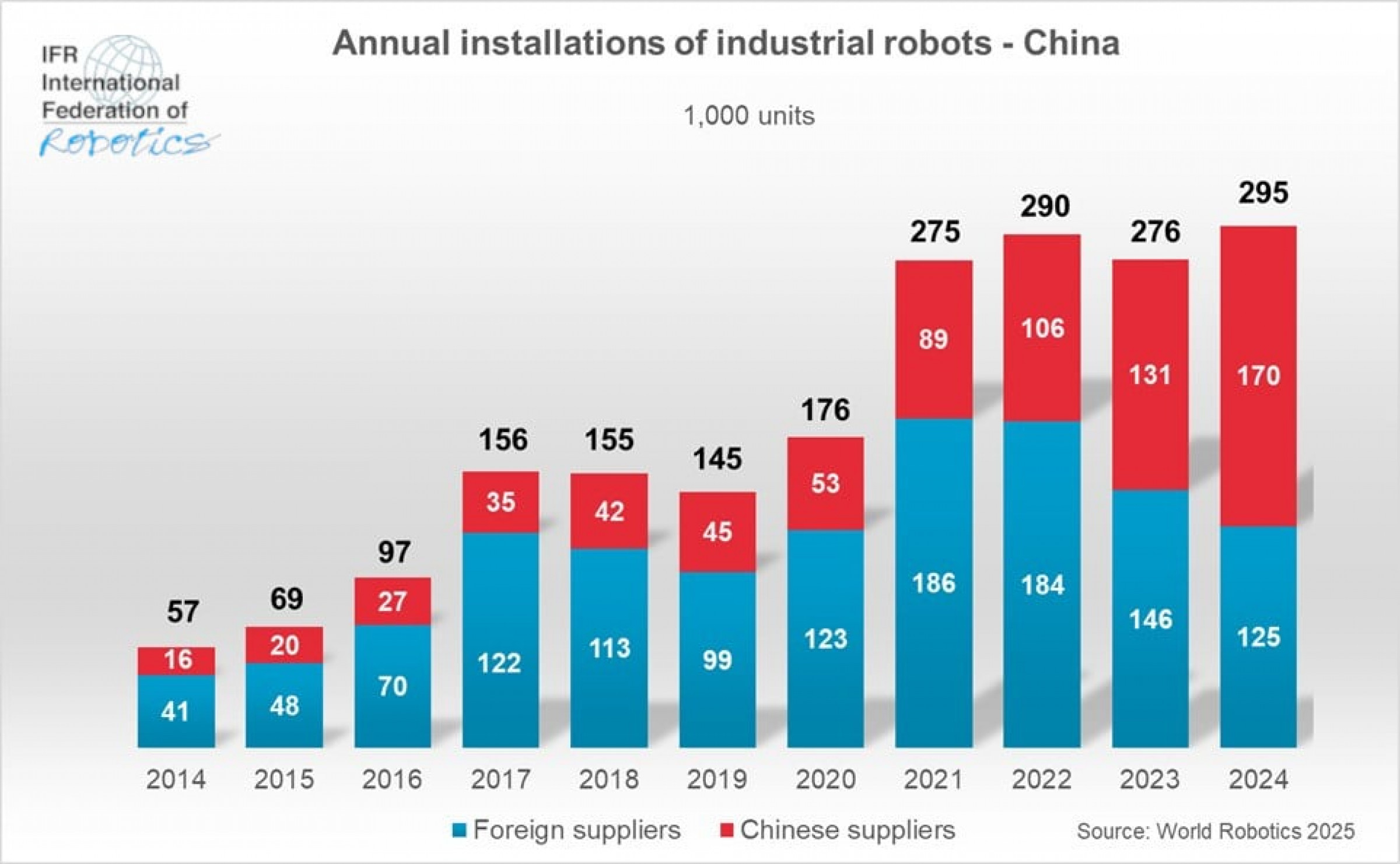
China is by far the world’s largest market in 2024, representing 54 % of global deployments. The latest figures show that 295,000 industrial robots have been installed – the highest annual total on record. For the first time, Chinese manufacturers have sold more than foreign suppliers in their home country. Their domestic market share climbed to 57 % last year, up from about 28 % over the past decade. China’s operational robot stock exceeded the 2 million mark in 2024, the largest of any country. As robotics in China is opening up new markets, there is no indication that robot demand in China will decrease. There is still potential in Chinese manufacturing for 10 % growth on average each year until 2028.
Japan maintained its position as the second-largest market for industrial robots, with 44,500 units installed in 2024 – a slight 4 % decrease. The country's operational stock rose by 3 %, with 450,500 units now in use. Demand for robots will grow slightly by lower single-digit rates in 2025. It will then accelerate to a medium single-digit rate on average in the next few years.
The market in the Republic of Korea installed 30,600 units in 2024 – down 3 %. Annual installations had been trending sideways of around 31,000 units since 2019. The country is the fourth largest robot market in the world in terms of annual installations in 2024, after the United States, Japan and China.
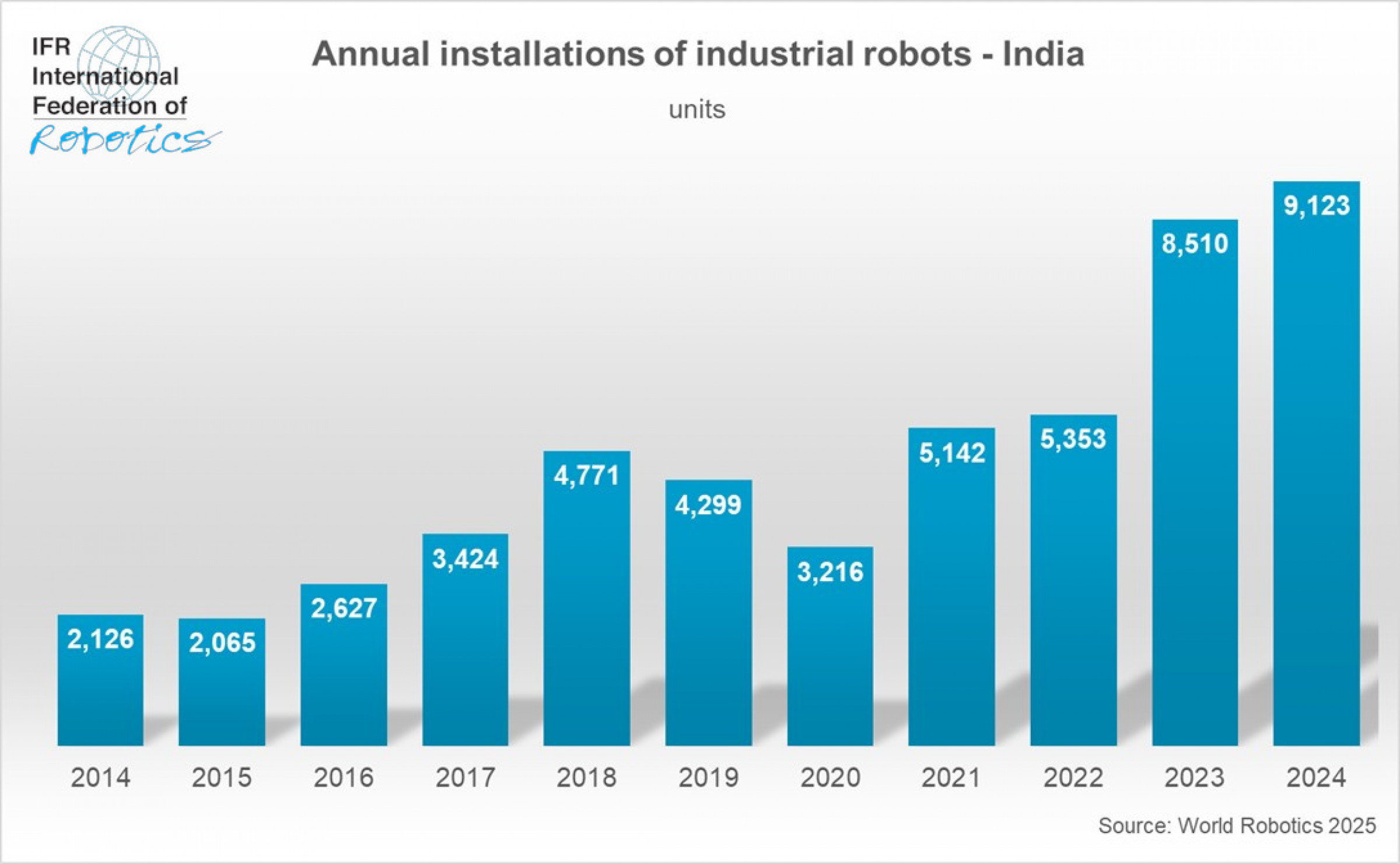
India continues to grow with a record of 9,100 units installed in 2024 – up 7 %. The automotive industry was the strongest driver with a market share of 45 %. In terms of annual installations, India ranks sixth worldwide, one place up behind Germany.
Europe
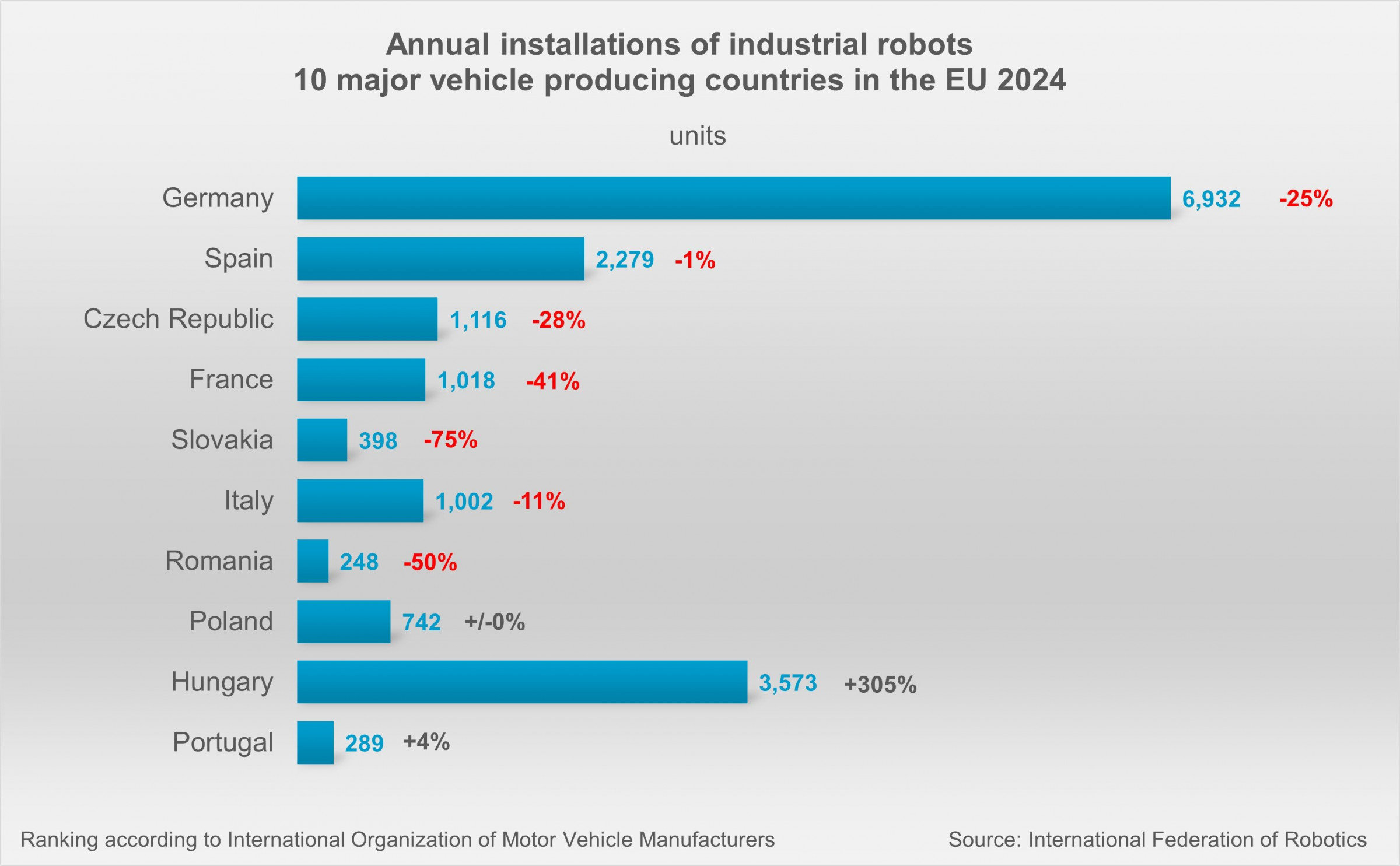
Industrial robot installations in Europe fell 8 % to 85,000 units in 2024, still the second largest number recorded in history. 80 % of all European robot installations took place in the European Union (67,800 units). Robot demand in Europe benefited from the nearshoring trend. The annual average growth rate from 2019 to 2024 was plus 3 %.
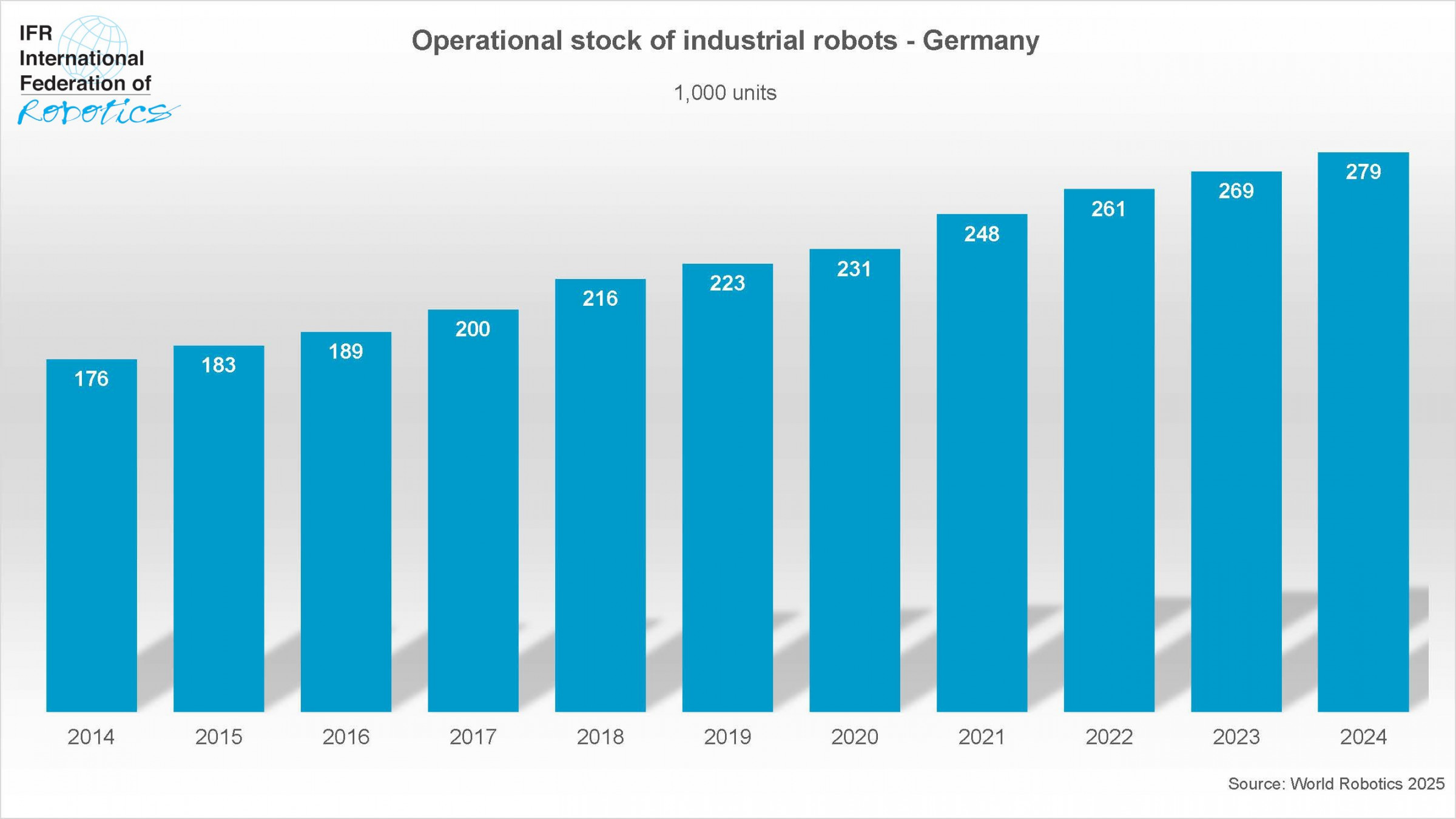
Germany is the largest robot market in Europe and the fifth-largest in the world. Installations fell 5 % to 26,982 units in 2024, which is the second-best result recorded after the record year of 2023. This represents a 32 % market share of the annual total in Europe. The number of installations in Italy, the second largest European market, fell by 16 % to 8,783 units. Spain is now in third place (5,100 units), with a strong demand from the automotive industry. France (4,900 units) moved down to fourth place, with a 24 % decrease.
In the UK, industrial robot installations were down 35 % to 2,500 units in 2024. The record number of 3,800 units in 2023 was a one-off peak, driven by the super-deduction tax credit program, which ended after the first quarter of 2023. Installation counts moved sideways with some cyclicity over the past decade. Robot installations in the UK rank 19th worldwide in 2024.
The Americas
Robot installations in the Americas exceeded 50,000 units for the fourth year in a row: 50,100 units were installed in 2024, down 10% below the level reached 2023. The United States, the largest regional market, accounted for 68 % of installations in the Americas in 2024. Robot installations were down by 9 % to 34,200 units. The United States imports most of its robots from Japan and Europe, with few domestic suppliers. However, there are numerous domestic robot system integrators implementing robotic automation solutions.
Total installations in Mexico reached 5,600 units in 2024, a decrease of 4 %. The automotive industry remained the key customer of industrial robots in Mexico, accounting for 63 % of the installations in 2024. In Canada, robot installations declined by 12 % to 3,800 units. Installation figures in Canada largely depend on automotive investment cycles. The share of the car industry was 47 % in 2024.
Outlook
The OECD and the IMF expect global growth in a range of 2.9 % to 3.0 % in 2025 and 2.9 % and 3.1 % in 2026. However, geopolitical tensions, violent conflicts in Eastern Europe and the Middle East and trade disruptions are exerting their negative impact on the global economy.
The robotics industry is not immune to global macroeconomic conditions, but there is no indication that the overall long-term growth trend will come to an end any time soon. While regional trends vary substantially, the aggregate global trajectory remains positive. Globally, robot installations are expected to grow by 6 % to 575,000 units in 2025. By 2028, the 700,000-unit mark will be surpassed.
(Source: International Federation of Robotics)
Schlagworte
AutomationFactory RobotGlobal MarketRoboticsRobotsSkilled Labour Shortage