
16.08.2025
International
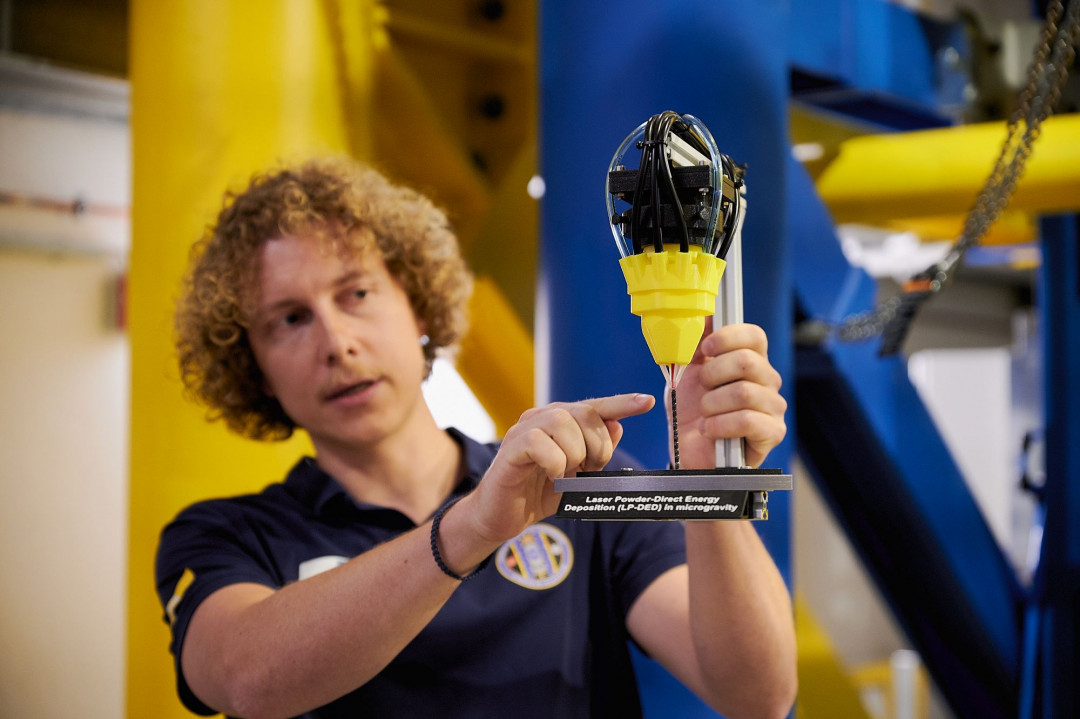
A research team, led by Leibniz University Hannover, has developed the first flexible 3D printing process in the world, which uses metal powder to produce and repair components in microgravity conditions.
In order to achieve the vision of inhabiting the moon or Mars, production processes need to be developed that enable everyday necessities to be produced with the resources available on site. Notwithstanding the immensely challenging aspects of manufacturing in space, 3D printing presents promising potential. Until now, the efficient production and repair of metal components under microgravity conditions has been challenging due to the complex nature of handling powder.
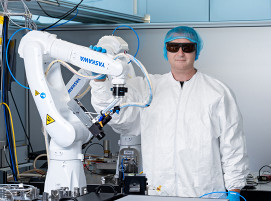
In collaboration with partners from Otto von Guericke University Magdeburg, researchers at Leibniz University Hannover have succeeded for the first time in producing components under microgravity conditions by means of laser metal deposition with metal powder. In this process, a laser melts the metal powder, which is then used to coat a substrate and build the component layer by layer. On space missions, for example, this would be a major advantage as damaged components could be repaired and costly spare parts could be avoided.
Using the Einstein Elevator, the interdisciplinary research group were able to simulate the complex condition of a space mission. The globally unique large-scale research device – located at the university’s Hannover Institute of Technology (HITec) – enables simulation of various gravitational conditions, such as microgravitational conditions or the intensive forces of a rocket launch. To conduct the project, the experiment was set up in an enclosed gondola in which all components – including the powder delivery system and laser system – were adapted to the special microgravity conditions. The materials that were processed included titanium and nickel alloys, which are widely used in the aerospace industry.
As a next step, the researchers plan to collaborate with Laser Zentrum Hannover (LZH) to process lunar regolith. Success in processing this grey dust – which is prevalent on the moon – would be decisive for future production on the moon or even Mars.
(Source: Leibniz Universität Hannover)
Schlagworte
3D PrintingAerospaceLaserLaser Metal DepositionMetalResearchTechnology