
26.02.2026
International
How Welders discover Value through Use
In the third part of this interview series, experts from 3M Speedglas provide insights on product development, feedback from users and the worldwide market of welding equipment.
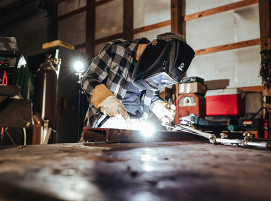
From variable colour tones to TAP functions: turning an idea into a feature welders embrace is rarely a straight line. In this interview, Erik Lindquist, 3M Global Product Manager and Mats Svensson, 3M Senior Project Manager & Innovation Lead, explain how they use prototypes, interviews and multi-month field trials to implement new functions and why the benefits often only become clear once welders worked with the products.
How do you turn the individual feedback from welders into a common consensus you can use to guide your product development?
Erik Lindquist: The feedback from welders is high on our priority list. Therefore, we work with interviews, field trials, prototypes and hands-on concepts. In fact, all functions and benefits in the new generation of helmets are a result of this work. We proceed in several steps. First, we let users test new ideas and technology and gather feedback. We examine the data, filter out the commonalities and compare the results with our hypothesis. The hypothesis forms the basis of the entire development process. The development of the new generation of welding helmets was based on the hypothesis that the products must take individual preferences and basic requirements into account. As a result, we categorised the feedback into individual preferences and basic requirements. While the requirements are covered in every helmet, the individual preferences were translated into features that can be adjusted or addressed through optional accessories.
Mats Svensson: Since we also want to introduce new functions, we want to challenge users with our prototypes. Working with prototypes and field trials is crucial in determining how new ideas can be optimally integrated into the product.
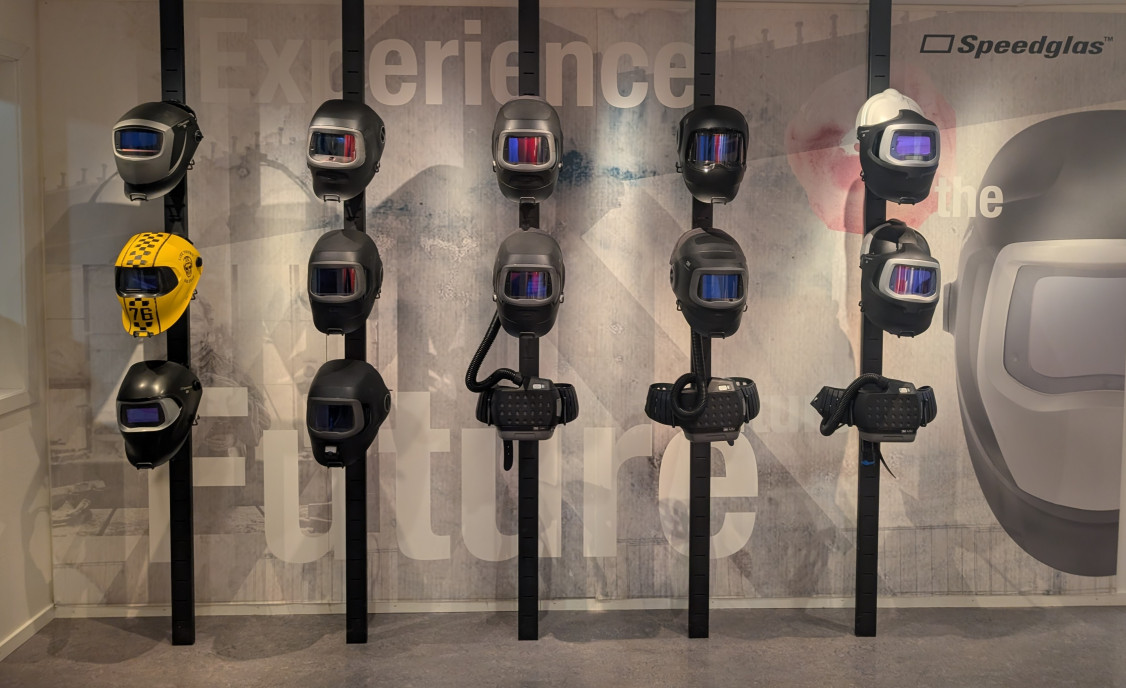
The new welding helmet allows you to switch between the grinding and welding mode of the Auto Darkening Filter using an intuitive TAP function: simply tap the side of the helmet three times to change the mode. Is this function to be understood as such an implementation?
Lindquist: Yes, and another example is the variable colour we introduced with an earlier helmet model. We knew welders had the basic need to see as clearly as possible. We asked ourselves: “What is the best colour to achieve the best vision?” We did a lot of trials with prototypes displaying different colours. After collecting feedback on the preferred colour, we observed an
even distribution across the different colours. That is when we started digging deeper, trying to understand the preferences. In the end the colour preference is tied to several reasons, from the welding environment and material to the welders’ daily constitution. It becomes clear that it is not a preference for colour but rather a preference for choice.
Svensson: It was a rather similar case with the directional airflow. It was important to provide the possibility to change and adjust which is done through levers on the outside of the helmet.
You introduced an app that is connected to the helmet. The app collects data such as the hours spent welding. Has any supplier, like a gas or wire supplier, ever asked to get access to this data?
Lindquist: No, they did not and even if they did, it is not our data. We do not have access to it either since it is data from the user. In a future world it is conceivable that a company would like access to that data. I believe this path will evolve over time. When we first proposed app connectivity, welders expressed considerable scepticism. However, there are tangible benefits, such as quick access to user guides and instructional videos. Introducing new technology is inherently challenging, and direct questions such as “Do you think this is good?” are often ineffective – users unfamiliar with the new technology cannot assess its value yet. The needs are often implicit and emerge progressively as technology becomes embedded in daily workflows.
Svensson: Naturally, welders need sufficient experience with new features to provide adequate feedback. That is why our field trials typically run for two to five months. We use these field trials to calibrate our assumptions about new features – how welders respond to them and how much effort we need to invest in guidance, such as instruction videos and similar support. It is a learning process for us as well.
Lindquist: This learning curve is clearly reflected in the TAP function of the latest helmet model. We thought it was a brilliant idea because you remove a button that can break, you remove cables and you can do it with both hands regardless of whether your hands are gloved or not. But every new function or feature has a threshold, you need time to adapt. In a conversation with a welding influencer, I asked which helmet model he preferred among the ones he owns. He stated that the TAP function was the reason he favoured the G5-03. After an adjustment period, it became simple and effortless.
With every new development you use prototypes. How many prototypes did you need to develop the TAP function? How long did the tests take?
Lindquist: The field trials take a long time, so we can make sure to pick up on any issues, pain points or benefits. The number of prototypes we usually go through in the project depends.
Svensson: The number of prototypes required is also influenced by the fact that we test globally and take different markets into account.
We thank you for the conversation.
Schlagworte
Auto Darkening FilterDevelopmentField TrialsPersonal Protective EquipmentPPEPrototypesSafety Requirements SpecificationTAP FunctionTechnologyWeldersWeldingWelding EquipmentWelding HelmetWorkflowWorkplace Safety