
02.11.2024
International
Material with Novel Stretching Properties Developed
Metamaterials are artificially engineered materials that do not naturally occur in the environment. Their building blocks function like atoms in conventional materials but possess unique optical, electrical or magnetic properties. The key to their function lies in the interaction between these building blocks: until now, these interactions have typically been possible only with immediate neighboring blocks, meaning locally. Researchers at the Karlsruhe Institute of Technology (KIT) have developed a mechanical metamaterial capable of triggering these interactions over larger distances within the material. This material could find applications in force measurement or structural monitoring. The results have been published in the journal Nature Communications (DOI: 10.1038/s41467-024-52956-5).
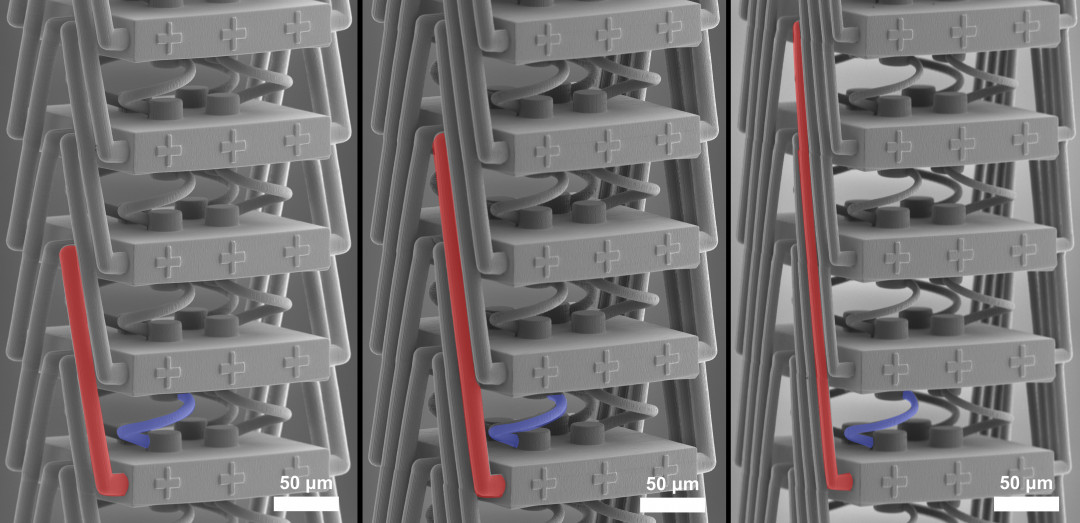
The research team led by Professor Martin Wegener at the Institute of Applied Physics (APH) at KIT has thus managed to overcome a limitation in metamaterials. Lead author Dr. Yi Chen compares this to human communication and an effect known from the game "Chinese whispers": When communicating with a person through an intermediary, the final message can differ significantly from direct communication with that person. This principle also applies to metamaterials, says Chen. "The material we designed has special structures (marked in red in the figure). Through these, individual building blocks can “communicate” not only through their neighbors but also directly with all other blocks in the material,” explains the scientist.
Experiments on 3D-printed microscopic samples
“These structures give the material fascinating properties, such as unusual stretching characteristics,” reports co-author Ke Wang from the APH. The team demonstrated this on micrometer-sized samples produced using 3D laser printing technology, which they observed under a microscope and recorded with a camera. They found that a one-dimensional strand (1D) stretched from one end did not elongate evenly.
Unlike, for example, a rubber band, which stretches uniformly when pulled, this metamaterial exhibited localized compressions at certain points. Additionally, shorter segments of the metamaterial could sometimes stretch more than longer segments, even when the same force was applied throughout. “This unusual behavior, where specific stretching and compressing occur only locally, is impossible in conventional materials,” says Jonathan Schneider from the APH, also a co-author. “We will now investigate this in two-dimensional (plate-like) and three-dimensional materials.”
One potentially useful feature is that the metamaterial responds highly sensitively to stresses. Depending on where force is applied within the material, this can result in vastly different stretching reactions at distant points. In a conventional material, reactions are observable only at the point where force is applied, while distant areas of the material exhibit only weak or negligible effects, according to the research team. A material with this sensitivity could be valuable for applications where forces need to be measured on a larger scale, such as monitoring building deformations in engineering or characterizing cellular forces in biological research.
The research was supported by the Excellence Cluster 3D Matter Made to Order (3DMM2O) of KIT and the University of Heidelberg.
(Source: KIT Press Release)
Schlagworte
MaterialMaterial PropertiesResearch Paper