
20.07.2025
International
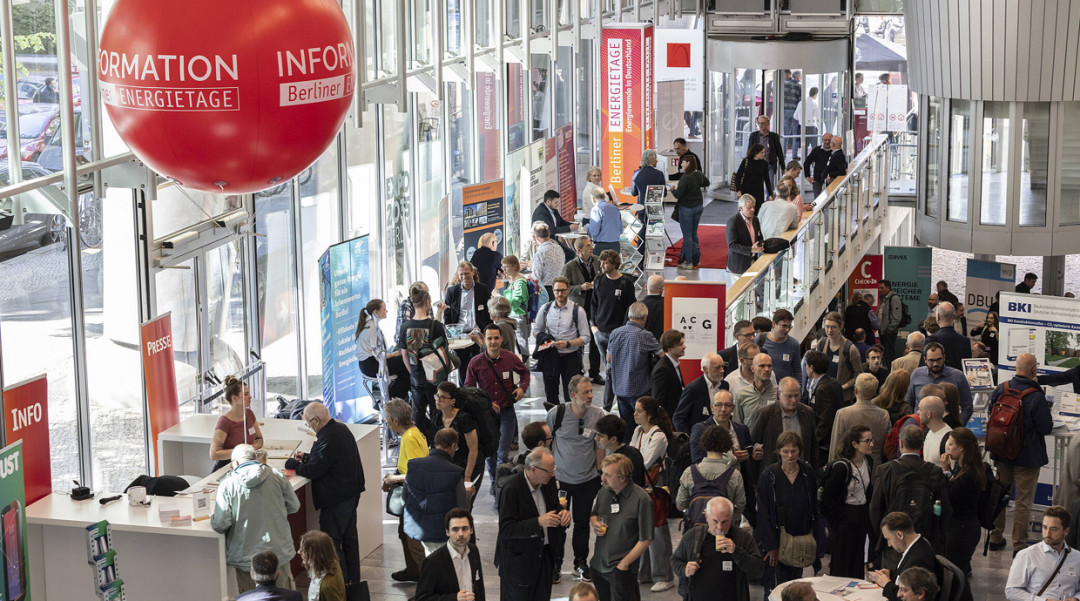
At the Berlin Energy Days 2025, more than 100 sessions brought together today’s key energy policy debates, showcased innovative solutions and explored the latest advancements driving the energy transition. The event kicked off online in early May and wrapped up with an in-person gathering in Berlin at the end of the month – bringing the energy community face-to-face once again.
The three-day virtual event launched on 5 May 2025. From May 26 through 28, the event moved to Berlin’s Ludwig-Erhard-Haus for its in-person part, held under the theme Energy transition now – boosting security, mitigating climate change. Leading figures from government, associations (including the Association of Local Public Utilities (VKU), the German Renewable Energy Federation (BEE) and the Federal Association of German Housing and Real Estate Companies (GdW)), research institutions (such as the Fraunhofer Institutes), and industry took part. Across both formats, 60 in-person and 40 online sessions took place. An accompanying trade fair showcased innovations already being used in practice.
In his opening address, Jürgen Pöschk, Managing Director of EUMB Pöschk and lead organiser of the event, emphasised the need for greater public acceptance and participation, urging stakeholders to “build bridges in every direction.” In his keynote speech, Professor Fritz Reusswig from the Potsdam Institute for Climate Impact Research called for a broad-based, consistent climate and energy policy. “Conflicts will persist,” Reusswig noted, “but it’s how we deal with them that matters.” He called on policymakers to pair expertise with emotional commitment.
BMWE sessions
As official patron of the event, the Federal Ministry for Economic Affairs and Energy (BMWE) hosted several sessions on site, including a panel discussion on innovation funding. Under the theme New needs, new impulses, participants explored how funding innovation is not only critical to achieving climate goals, but also to maintaining global competitiveness. “Innovation funding is essential to keep Germany competitive on the global stage,” emphasised the managing director of a hydrogen start-up founded in 2021. As climate tech competition heats up worldwide, German companies are finding themselves at the centre of a rapidly evolving global race.
Digitalisation, decarbonisation & thermal storage at BMWE expert forums
The BMWE’s expert forums focused on three central pillars of the energy transition: digitalisation, decarbonisation and thermal storage in heating networks, exploring the challenges and potential solutions. Each 90-minute session featured thematic overviews by experts, real-world examples from research, and participant interactive Q&As with participants.
One highlight was the session on Decarbonising industry through hydrogen use in process industries, which presented four ministry-funded research projects on converting to hydrogen and electricity use – especially for high-temperature processes in steel, ceramics and glass manufacturing. Another standout was Digitalisation in the distribution grid, showcasing practical, forward-thinking approaches to optimising modern energy distribution networks.
(Source: Federal Ministry for Economics and Energy)
Schlagworte
CeramicsClimateCuttingEnergyGlassManufacturingPolicySteelTransformationTransitionWelding