
14.10.2026
Interesting Facts
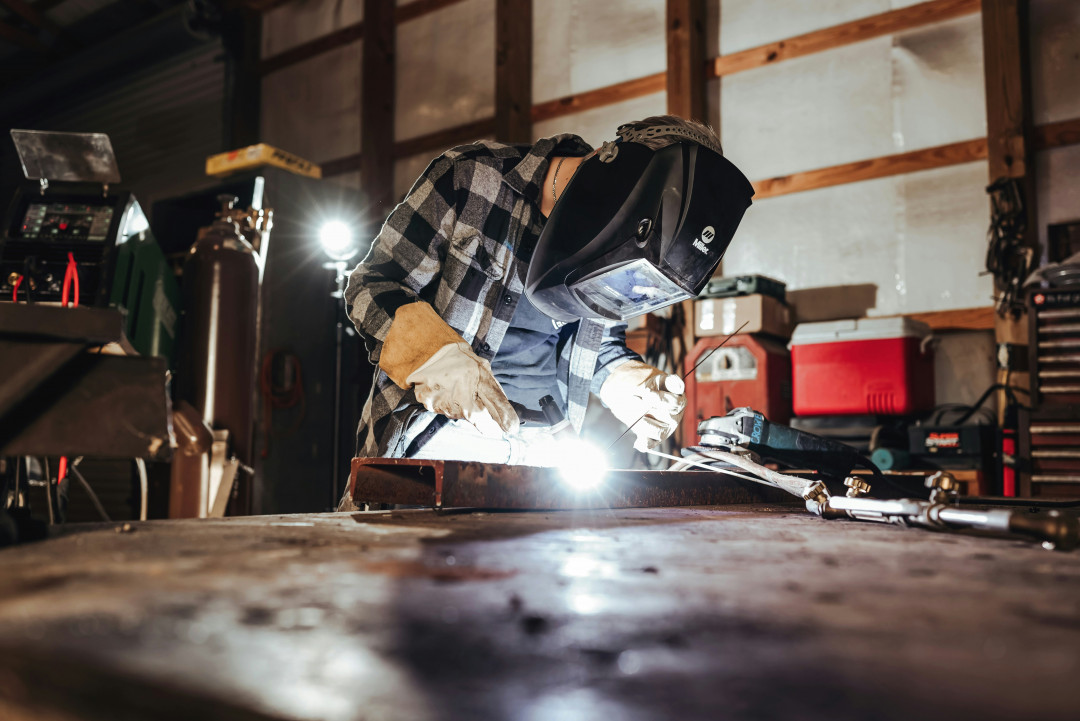
A welding hood is an investment in operator safety and productivity for any European welding business. The right hood protects against UV radiation exposure, arc flash and molten metal hazards while enabling clear, comfortable visibility throughout a shift. Choosing the right one requires evaluating compliance, optical clarity and physical durability. The following factors address a specific aspect of welding protection, performance and comfort that affects long-term value and operator safety.
Certification to ISO 16321-2:2021
Any hood purchased should carry a valid certification demonstrating compliance with ISO 16321-2:2021. This standard sets the protection benchmarks for welding filters sold and used in Europe. It replaced earlier designations, such as EN 175 and EN 379, which can still appear on cheaper or older stock. Certification is non-negotiable, as welders are the largest occupational group exposed to hazardous artificial UV radiation at European worksites. The UV radiation from a welding arc can cause acute eye damage and skin burns, and without proper protection, exposure can exceed daily occupational limits by several thousand-fold.
Shade range suited to the welding process
Shade numbers indicate how dark the lens becomes during welding, and the appropriate range depends on the welding process and amperage. Here are the general guidelines for filter scale numbers:
- TIG welding: Ranges from 9 for under 20A up to 14 for 251–400A
- MIG welding on heavy metals: Ranges from 10 for under 100A up to 14 for over 500A
- MIG welding on light alloys: Ranges from 10 for under 100A up to 15 for over 500A
- Covered electrode welding: Ranges from 9 for under 40A up to 14 for over 500A
Matching the hood's available shade range to the shop's amperage levels ensures operators can dial in the correct protection for each task without purchasing multiple hoods for different processes.
Field of view
When the lens offers only a limited line of sight, operators must compensate by repositioning their heads and necks. If light scatters within the lens or contrast falls off, the operator loses the ability to see detail in the molten pool. These physical and visual demands accumulate across hours of work, resulting in slower welds. Per ISO 16321-2:2021, welding protectors must provide a minimum unobstructed field of view of 8 degrees toward the outer edge and 15 degrees toward the nose in the horizontal direction, and 24 degrees total in the vertical direction. Beyond these minimums, a wider practical viewing area can provide comfort for out-of-position work.
Auto-darkening vs. passive lens technology
Passive lenses use a fixed, single shade that stays dark at all times, requiring the welder to manually flip the hood up before striking an arc and down again afterwards. Auto-darkening lenses stay light until the sensor detects the arc, then switch automatically to the preset shade. In shops that perform frequent tack welds or move between processes, using auto-darkening lenses reduces workflow interruptions and awkward neck movements throughout the workday. The trade-off is that auto-darkening models typically run on replaceable batteries, solar cells or a combination of both. Buyers should check how often batteries need replacement and whether the hood offers low-battery warnings. Solar-powered units may perform inconsistently in low-light environments or indoor shops with limited overhead lighting.
Arc sensor count and switching speed
The number of sensors built into a hood determines how reliably the lens will darken when the arc strikes. Each sensor functions as a detection point, and hoods with three or four sensors offer broader coverage than single- or dual-sensor models. In out-of-position applications, the welder's hand can obstruct one or more sensors. When the hood has only a limited number of sensors, the lens may fail to trigger, allowing unfiltered arc light to reach the welder's eyes. Switching speed measures how quickly the lens transitions from light to dark once the arc is detected. Hoods with faster response times limit the cumulative exposure operators experience across repeated arc starts. For shops running high-frequency operations or out-of-position work, a hood with multiple sensors and fast switching speed offers measurably better protection.
Weight, comfort and heat-resistant construction
A hood worn for an entire shift needs to perform both physically and optically. These three factors determine how well a hood holds up under extended use:
- Weight: Prioritising lighter models and checking how the hood balances front-to-back when worn. Poor weight distribution places constant strain on the neck over an eight-hour shift.
- Headgear adjustability: Having control over the tightness, height and how far the headgear sits from the face supports comfort. The hood should stay secure during overhead work without slipping or drifting.
- Heat-resistant shell construction: The shell must be designed to be ignition-resistant. This ensures that even when struck by spatter from a 1500 °C welding arc, the helmet material will not catch fire or continue to burn, though the surface may be damaged.
Finding the hood that fits the work
The right hood balances compliance, process fit and comfort regardless of price point. Shops evaluating equipment should weigh the factors above against their processes, amperage ranges and work environments to find the model that meets safety requirements and daily demands.
(Source: Outlaw Leather)
Schlagworte
CertificationHeadgearISO 16321-2:2021MAGMIGPersonal Protective EquipmentPPESelf-Darkening LensesTIGUV RadiationWeldingWelding ArcWelding HoodWorkplace Safety