
19.06.2025
International
Cross-industry Initiative Investigates the Use of Synthetic Data, Simulation and AI to In-crease Efficiency in Production, Logistics and Robotics
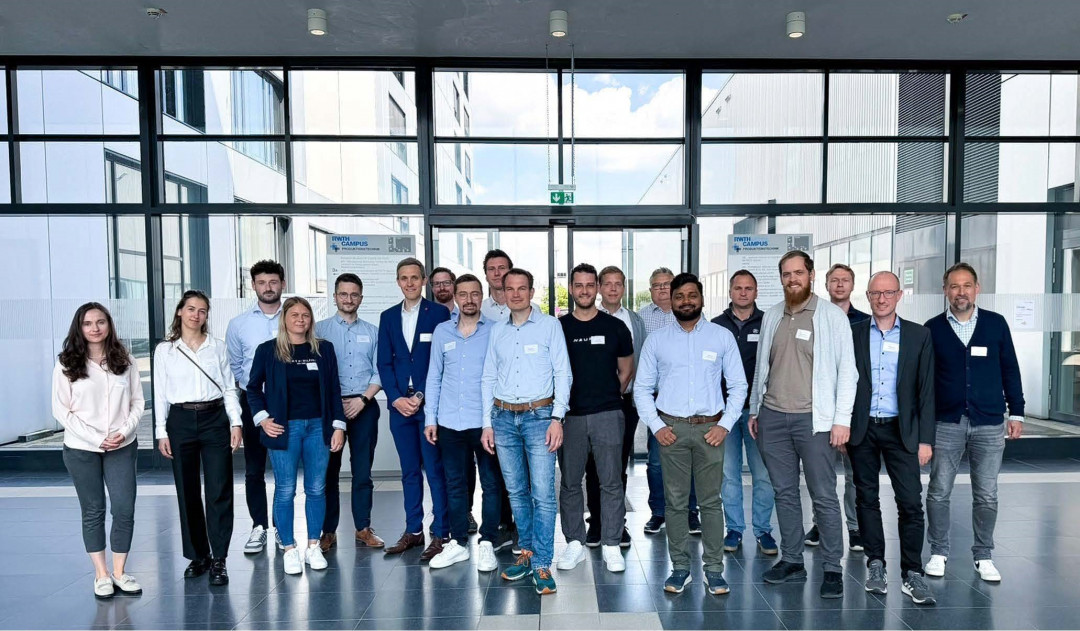
With the newly launched consortium study “MetaVision - Vision Applications powered by the Industrial Metaverse”, the Laboratory for Machine Tools and Production Engineering (WZL) of RWTH Aachen University and WZL Aachen GmbH are initiating a cross-industry research project to develop new technologies for camera-based applications in industrial practice. The twelve-month study addresses a central problem of modern AI systems: the lack of high-quality, diversified training data for reliable image processing under real production conditions.
Industrial Metaverse as a Key Technology for Data-based Vision Systems
The concept of the so-called “Industrial Metaverse” is at the center of the investigation. This refers to a digi-tal-physical ecosystem that combines simulation, digital twins, immersive technologies and AI in order to de-sign industrial processes holistically and based on data. By using synthetic data, vision applications can be trained before real data is even available - in a resource-saving, flexible and scalable way.
The aim of the study is to identify specific industrial use cases for synthetic data in vision systems such as object detection, quality inspection, robotics handling and virtual testing and to systematically evaluate their implementation using industrial metaverse methods. Among other things, the consortium partners are investigating how automated labelling, digital twins and AI-supported simulations can be used to make vision applications more efficient, robust and cost-effective.
Strategic Use of Synthetic Data for Future-proof Vision Applications
In the course of the study, individual opportunities and challenges are systematically analyzed, central tech-nologies are evaluated and tested using specific use cases. The findings will be used to develop company-specific strategies and practical guidelines that will serve as a decision-making basis for the partners in-volved when introducing innovative vision technologies.
The project is supported by an interdisciplinary team of experts from the WZL of RWTH Aachen University, who contribute in-depth expertise in the fields of simulation, computer vision, automation, robotics and human-machine interaction. The participating companies include Accenture, Johnson Electric, KSB, ligenium, NEURA Robotics, Oerlikon, SMS group, Volkswagen, Vorwerk and ZF Group.
The consortium study not only provides the participants with technological insights, but also access to a top-class network and a sound basis for decision-making for the strategic development of their digital competencies. At the same time, it contributes to strengthening the business location through the practical application of future technologies.
(Source: WZL and RWTH Aachen)
Schlagworte
ADApplicationsDigital TwinEngineeringIndustryInspectionITKMachine ToolsMAGProcessingResearchRobotRoboticsRWTHSimulationStudySystemTechnologyTIGTools