
12.03.2026
International
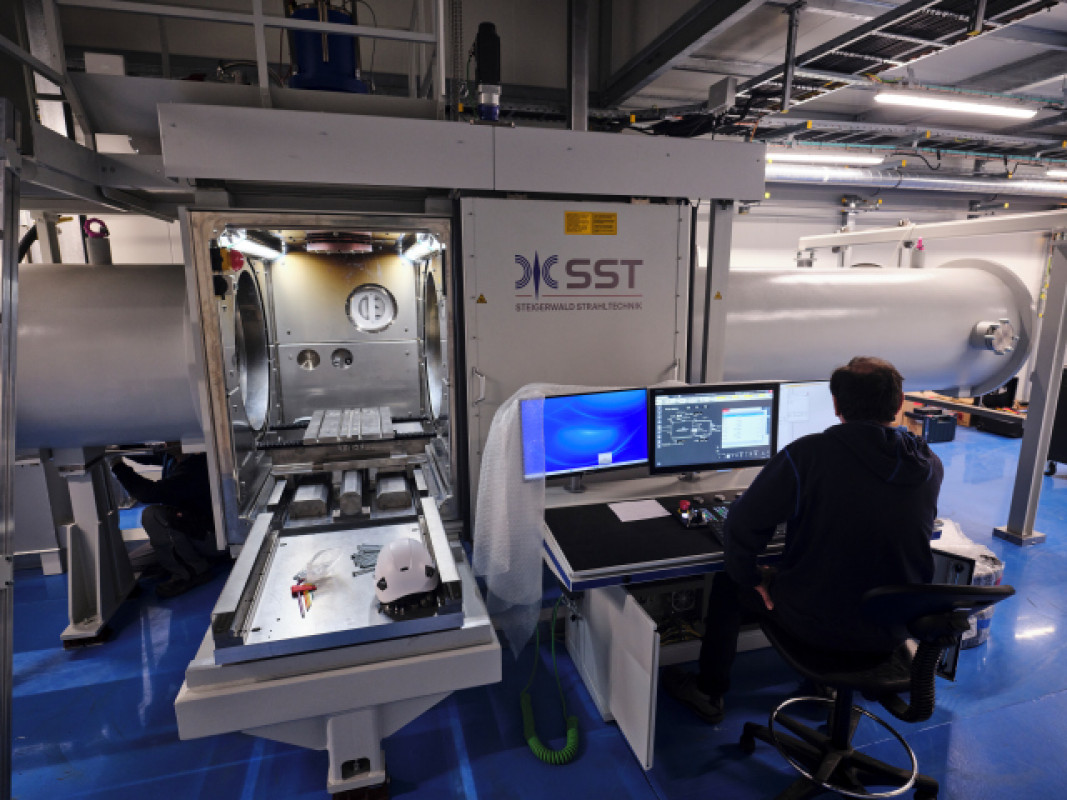
Steigerwald Strahltechnik has delivered a high‑precision electron beam welding system to the world‑renowned research center CERN (Conseil Européen pour la Recherche Nucléaire). This advanced system will play a pivotal role in the future production of beryllium vacuum chambers for the upgrade of the Large Hadron Collider (LHC) – the world’s largest and most powerful particle accelerator.
Precision in challenging environments
In the Large Hadron Collider (LHC), proton beams travel in opposite directions at nearly the speed of light, guided through vacuum chambers that prevent interference from gas particles. At four points along the 27‑kilometer ring, these beams collide, generating high‑energy particles that are studied by sophisticated detector systems.
To ensure that the particles produced in collisions reach the detectors with minimal disturbance, the vacuum pipest in the collision region must be exceptionally radiation‑permeable, mechanically stable and manufactured with the highest precision. The material of choice is beryllium – extremely light, strong and transparent to radiation – yet so demanding to process that it requires adherence to the strictest safety standards.
Redefining research
Since the world’s sole supplier of these complex components ceased production in 2023, CERN has taken the decision to manufacture beryllium pipes in its own workshop at the Prévessin site in France. To achieve this, welding technology was needed that is both powerful and reliable. SST's electron beam welding system enables contact‑free welding in a high‑vacuum environment with precision – an essential requirement for the production of sensitive components, where even the slightest deviation in tolerance could have serious consequences for particle beam experiments.
The new production facility will, in the coming years, manufacture the next generation of beryllium vacuum pipes for the High‑Luminosity LHC (HL‑LHC) upgrade. Production for the ALICE, ATLAS and CMS experiments is scheduled to begin in 2026, with the first installations planned during the next LHC maintenance phase, Long Shutdown 3 (2027-2028).
Beyond the immediate benefits for CERN, this project also reinforces Europe’s technological sovereignty and ensures the preservation of expertise in a security‑critical high‑tech field over the long term.
(Source: Steigerwald Strahltechnik GmbH)
Schlagworte
BerylliumCERNEB WeldingElectron Beam WeldingEuropeResearchScience