
10.05.2026
International
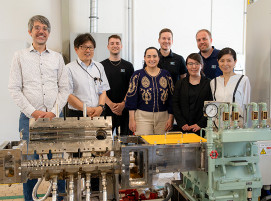
Scientists from Thuringia, Germany, launched a large-scale research project to develop a new high-precision machine capable of fabricating nanostructures spanning up to one square meter – with a positioning accuracy smaller than an atom. The machine could be used for a wide variety of purposes in the future: to manufacture electronic or photonic circuits, high-performance optics for Earth observation, or even in the energy research of the future. The research project is scheduled to run through 2032 in three phases – the first of which is being funded by the German Research Foundation (DFG) with 4M Euros over three years as part of its New Devices for Research programme.
With conventional methods, high-precision nanostructures on photonic components can currently only be produced up to a size of 30 cm. The new 3D nanolithography and nanomessuring machine (3D-NLM) developed by the Thuringian researchers is intended to enable the processing and measurement of photonic components with dimensions of up to one metre in the future – more than three times the size as before. TU Ilmenau, Friedrich Schiller University Jena and Fraunhofer Institute for Applied Optics and Precision Engineering (IOF) in Jena have now begun development work.
High-precision nanostructuring for a wide range of future applications
Nanostructures are extremely fine structures that manipulate light in a targeted manner by influencing its wavelength. Over the past twenty years, these minuscule structures have become a key factor in overcoming a wide range of technological challenges. Machines for nanostructuring large-area components are already available today. Many modern televisions have displays that incorporate nanotechnology. But these are nowhere near as precise as what is required in the diverse fields of science and industry.
Nanostructures play a central role, for example, in the manufacture of integrated electronic or photonic circuits, high-performance optics for Earth observation, measurement technology and sensor technology, as well as in space research. For the planned Einstein Telescope – one of Europe’s most ambitious scientific projects: a planned underground observatory designed to observe the universe not with light, but through gravitational waves – the Fraunhofer IOF has developed highly sensitive sensors. High-precision machines made in Thuringia are used to manufacture nanostructured components for international space missions – and in the future, also photonic quantum chips for future quantum computers, a completely new computer technology that will be able to solve problems that today’s supercomputers would fail to solve even over thousands of years.
Target precision a hundred times smaller than an atom
In addition to its ability to scale up to one square meter, the machine’s high precision is its key feature. The experts from Ilmenau aim to create nanostructures that enable precision of up to twenty picometers across the entire one-square-meter surface – one picometer corresponds to one trillionth of a meter, which is about a hundred times smaller than the diameter of an atom. At the same time, in addition to sub-atomic positional resolution, they allow for maximum structuring deviations of less than ten nanometers across the entire 3D volume of the workspace.
(Source: TU Ilmenau)
Schlagworte
3D-NLMElectronic CircuitsMeasringNanostructureResearchTesting