
10.09.2023
International
Game Changer Openair-Plasma – live at Fakuma 2023:
Atmospheric plasma technology is the tool of choice when it comes to the surface treatment and subsequent processing of plastics: through targeted surface modification, it significantly improves processes such as bonding, printing, painting or sealing. Plasmatreat GmbH, the world market leader in this field, will be demonstrating the efficiency of this environmentally friendly and efficient technology at Fakuma 2023 in Hall A1, Stand 1210.
Overmolding of sensitive electronic components with thermosets
At the Plasmatreat booth, a joint project will demonstrate the pretreatment and overmolding of printed circuit boards using injection molding. In a fully automated process, the electronic components are first subjected to gentle ultra-fine cleaning with Openair-Plasma. They are then coated with an adhesion-promoting layer using the special PlasmaPlus process and finally overmolded with a temperature-resistant thermoset in an injection molding system. The plasma treatment and coating ensure reliable adhesion of the plastic to the circuit boards and protect them from environmental influences. In addition to Plasmatreat (Steinhagen), the project partners are the machine manufacturer ARBURG GmbH (Lossburg), the toolmaker Siegfried Hofmann GmbH (Lichtenfels), the special machine manufacturer Barth Mechanik GmbH (Zimmern o.R.) and the plastics supplier Sumitomo Bakelite Co., Ltd. (Japan).
Plasma makes the impossible possible: expanding material choices
The selection of a plastic for economic and environmental reasons can affect an entire process, for example, the required adhesiveness or printability. Plasma technology supports material substitution. Through targeted surface modification, it improves the adhesion of adhesives and coatings in industrial applications, and even makes it possible to bond plastics that were originally incompatible. This allows manufacturers to benefit from a wider choice of materials, for example replacing costly engineering plastics with less expensive commodity plastics or even recycled materials. Well-known manufacturers of household appliances such as Miele & Cie. KG in Gütersloh, Germany, or Mamur Teknoloji Sistemleri in Turkey, use Plasmatreat's Openair-Plasma technology for such applications.
Large area and selective pretreatment of automotive dashboards
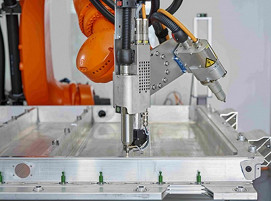
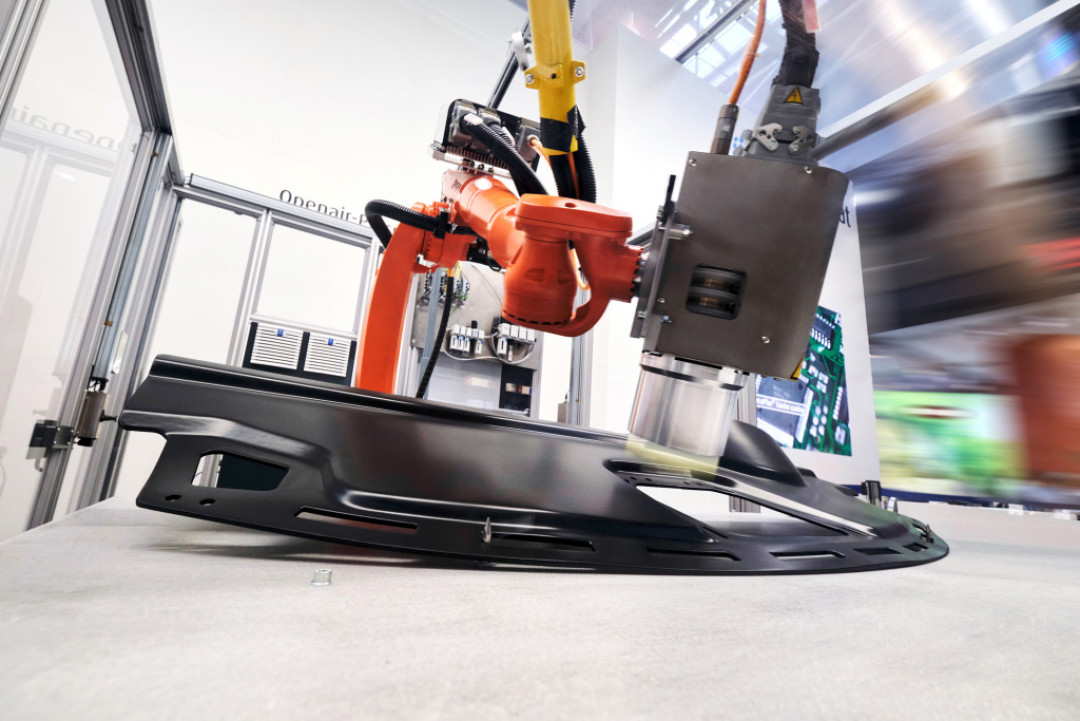
Plasma pretreatment has been integrated into the automotive industry with its high-quality requirements and specifications for many years. Various manufacturers use Plasmatreat's plasma technology for surface pretreatment: plasma pretreatment makes the non-polar (recycled) plastics receptive to subsequent adhesion processes and ensures a strong bond between the different, sometimes even incompatible materials, e.g. when laminating dashboards made of recycled materials with powder-sintered molded skins made of soft plastic. The traditional flame pre-treatment method used to pre-treat dashboards required the use of thermally stable masks to cover all areas of the component where adhesion was not desired. The use of Openair-Plasma completely eliminates this step, because the plasma jet is selective and, unlike flame, follows the part geometry with millimeter precision using automated robot technology. In addition, plasma treatment generates very little heat, so treated components remain dimensionally stable and can be further processed.
Flatbed system for full surface pretreatment
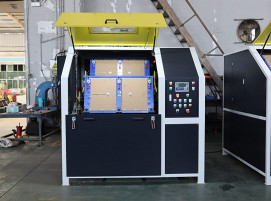
Plasmatreat demonstrates how full surface pretreatment of flat plastic materials, such as honeycomb panels for lightweight applications, can be achieved with an innovative flatbed system.
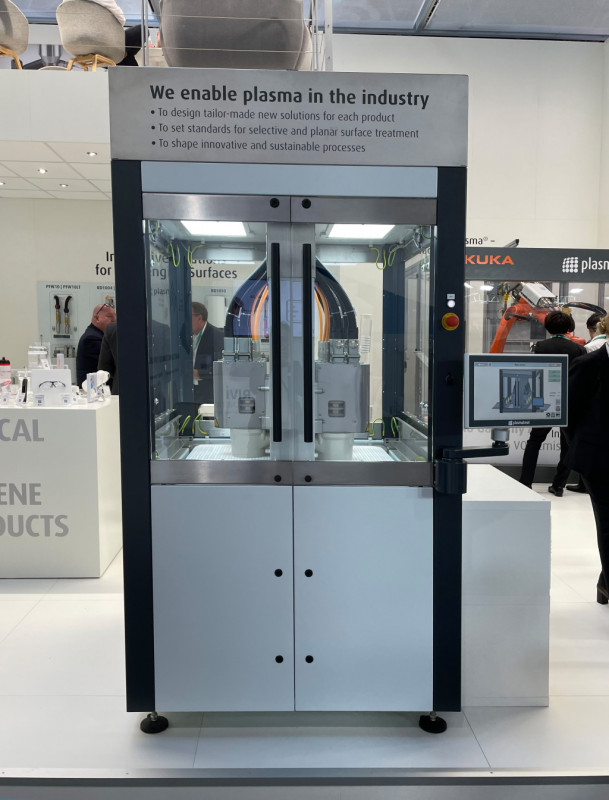
This special PTU (Plasma Treatment Unit) pre-treats various flat plastic substrates efficiently and reliably. The unit is equipped with three RD2010 rotating nozzles on each side. For maximum flexibility and to optimize set-up times, Plasmatreat has added a function to the cell: the nozzles can now be moved in height, depending on the thickness of the material to be treated. The setting of other parameters, such as the exact adjustment of the speed and intensity of the plasma jet to the respective application, is also one of Plasmatreat's core competencies. The innovative system for this patented process can be easily integrated into existing lines. Customers from a variety of industries use full-surface pretreatment with Openair-Plasma, including Hymmen GmbH in Bielefeld, Germany, for individual digital printing on garage doors, and Schmitz Cargobull in Horstmar, Germany, for truck walls or tarpaulins.
See the Plasma Effect at the Live Table
Discovering the plasma effect with your own eyes – visitors can do this at the live table at the Plasmatreat booth: Using various test methods (e.g. water spray test, test inks or with the help of adhesive strips), the plasma experts will demonstrate the effectiveness of plasma treatment on site and make it visible, even with regard to materials that are difficult to process, such as PP and PE.
Visit Plasmatreat at Fakuma at booth 1210 in hall A1.
More information is available at: www.plasmatreat.com
How Openair-Plasma and PlasmaPlus optimize industrial processes
When plasma with its high energy level comes into contact with materials, it changes the surface properties, for example from hydrophobic to hydrophilic. Plasma technology requires only compressed air and electricity for operation. Fine cleaning with Openair-Plasma gently and reliably removes dust, release agents, additives, plasticizers and hydrocarbons from surfaces. Especially with non-polar plastics, plasma treatment achieves surface activation. It supports the increase of surface energy by introducing hydroxyl groups and thus improves adhesion in subsequent processes such as bonding, printing, painting and sealing. Plasmatreat's PlasmaPlus technology can also be used to create targeted functionalized surfaces with defined properties by applying (depositing) nanocoatings, e.g. as an additional adhesion promoter layer.
(Source: Press Release of Plasmatreat GmbH)
Schlagworte
Atmospheric Plasma TechnologyPlasmaSurface Treatment