
06.10.2026
Unternehmen

Kuka has reached a milestone in industrial automation with the deployment of Kuka AMP (Automation Management Platform) at KTPO in Ohio, one of North America’s major automotive manufacturing facilities. The open orchestration platform is now live and actively supporting production operations, connecting existing automation infrastructure with next-generation AI-powered technologies. "Manufacturing is entering a new era," says Marc Fleischmann, Chief Software and AI Officer of KUKA Group. "Traditional automation is expanding and transforming. The future lies in combining the precision and reliability of proven industrial automation with the capabilities of AI-powered systems. Kuka AMP provides the foundation for that next step."
The implementation represents another step in Kuka Group’s strategy to bring artificial intelligence out of pilot environments and into real-world manufacturing at scale. The United States is a significant market for Kuka Group and home to more than 3,400 employees across engineering, manufacturing, software development, systems integration and customer support functions. Since 2006 Kuka has been operating Kuka Toledo Production Operations (KTPO).
The next major leap forward will be driven by Physical AI – a new generation of intelligent technologies that enable machines and robots to better understand their environment, learn continuously from operational data and make increasingly informed decisions in real time. Factories generate enormous amounts of data. Until now, much of this information remains dormant in isolated systems. Kuka AMP helps customers to transform this data into actionable insights, allowing automation systems to better understand production processes, coordinate activities across workflows and continuously improve performance.
"Kuka AMP creates a scalable foundation for Physical AI," says Fleischmann. "It provides an automation platform that lets customers integrate their own AI models and generalise them in production with a shared context layer. By continuously collecting and analysing operational data, it creates a closed loop system that can improve performance over time and helps organisations scaling intelligent automation."
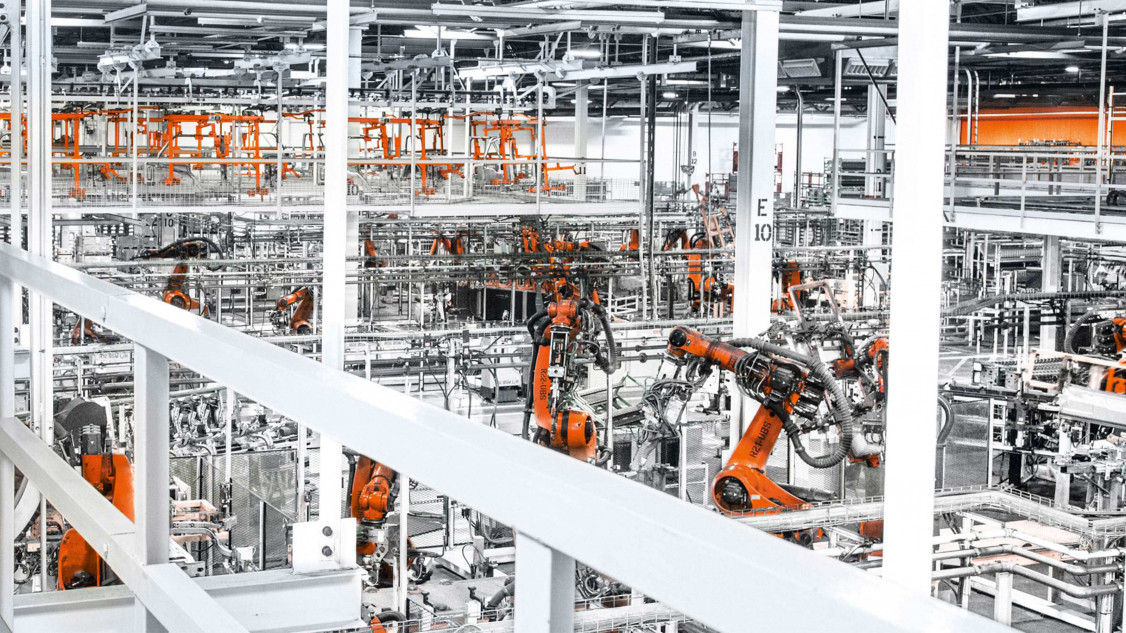
First deployment of initial version at Kuka Toledo
The first operational deployment of Kuka AMP is taking place at Kuka Toledo Production Operations (KTPO) in Ohio, USA, and initially focuses on autonomous, mobile robots (AMR). The 335,000-square-foot facility manufactures more than 300 vehicle bodies per day – approximately one every 2 minutes KTPO has produced over two million vehicle bodies, generating vast amounts of production data. Since 2006, KTPO has produced the body-in-white for every Jeep Wrangler sold worldwide and, since 2019, for the Jeep Gladiator. The automated facility combines Kuka's expertise in welding, joining technologies and systems integration, operating with 285 robots and more than 60,000 connected devices across the production environment.
The facility offers an ideal environment for demonstrating how established industrial automation can be enhanced through AI-driven technologies. “Testing the alpha version of Kuka AMP at KTPO is an important step forward. KTPO is a familiar environment for us, so we can focus on evaluating the platform under realistic conditions and accelerate improvements that will help deliver the best possible experience for our users”, says Fleischmann. The goal is to help manufacturers drive higher efficiency through more comprehensive automation without replacing existing assets. By connecting mobile robots, machines, software systems and data sources, Kuka AMP enables companies to automate more complex processes, increase operational flexibility, reduce changeover times and unlock greater value from existing factory data.
"Physical AI should not be viewed as a disruption, but as the next evolution of industrial automation," Fleischmann adds. "Manufacturers want a practical path forward that builds on decades of investment. Kuka AMP is being developed in the United States and provides that path by connecting and gradually augmenting today's factory with the autonomous factory of tomorrow."
(Source: Kuka Group)
Schlagworte
AIAutomationAutomotiveJoiningPhysical AIRoboticsRobotsWelding