
01.04.2026
International
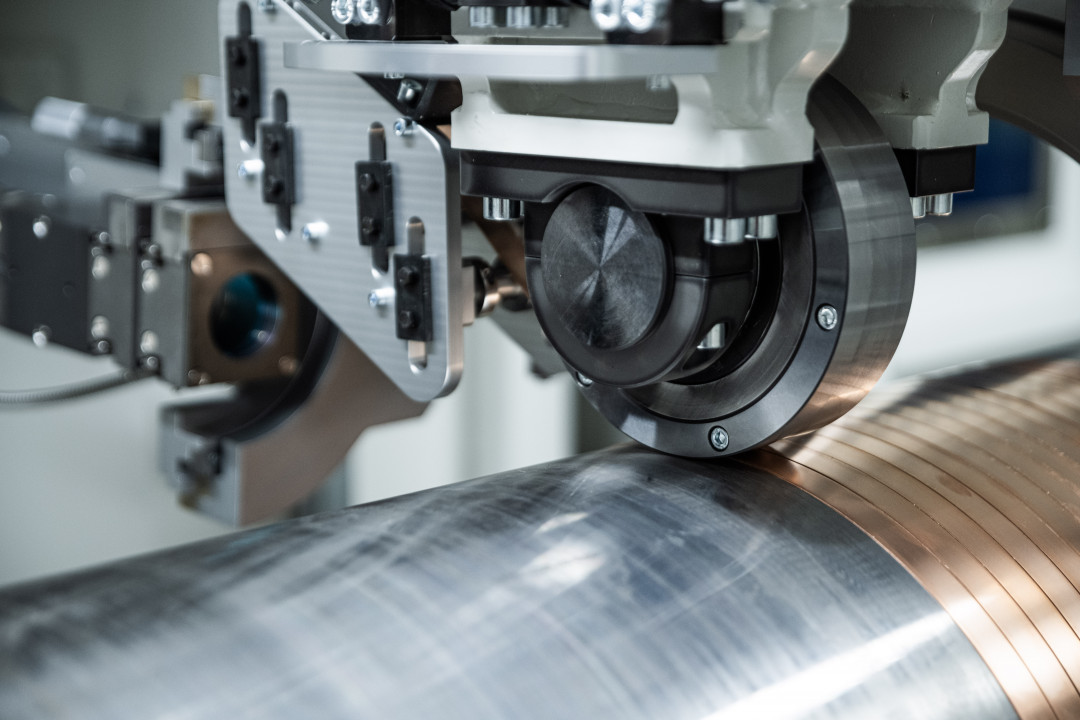
Researchers at Fraunhofer IWS have developed a new laser-based technology called Laser Direct Plating that produces metallic layers faster, more energy-efficiently and at lower cost than established processes. The team helically wraps strip-shaped metal around rotationally symmetric components and locally creates a metallurgical bond to the substrate using laser energy. The base material remains solid, the surface stays smooth and requires little to no post-processing. Users significantly reduce cycle times, energy consumption and process costs.
Laser Direct Plating combines minimal heat input with a defined forming force. At the joining interface, oxide layers rupture, fresh metal surfaces react immediately and form a durable metallic bond. Unlike laser metal deposition, the coating does not melt over a large area but remains largely in the solid phase. This mechanism lowers energy demand, increases deposition rates and stabilizes layer quality along the entire component length.
“We aim to minimize or even avoid the molten phase,” emphasizes Marko Seifert, Head of the Heat Treatment and Thermal Coating Department at Fraunhofer IWS. “We activate the contact zone with very little energy and achieve dense, uniform coatings in significantly shorter process times.”
Functional principle and differentiation
Direct plating targets rotationally symmetric components. The strip feeds at constant speed, wraps helically around the substrate and bonds to it during winding. Laser radiation heats the contact zone only briefly to joining temperature. The combined effect of heat and pressure creates a metallurgical bond. This distinguishes the process from laser metal deposition with continuous melting of the coating material. Laser Direct Plating generates the functional layer directly on the component.
Process performance and layer quality
Strip speeds in the metres-per-minute range enable high deposition rates reaching the three-digit kg/h corridor. Limited thermal impact confines the heat-affected zone to the immediate joining line and preserves the substrate microstructure. The surface exhibits a homogeneous, rolled-like texture; turning, grinding and polishing require far less effort. In an industrial reference, coating time for a hydraulic cylinder dropped from around twenty hours to about six hours. Depending on the setup, energy demand falls by up to ninety percent.
Density, multilayer design and material selection
Helical deposition creates defined butt joints sealed by a trailing joining step. For corrosion-critical applications, a multilayer design proves advantageous because from the second layer onward, similar materials bond to each other and minimize dilution. Typical layer thicknesses range from about 1 to 3 mm. Multilayer stacks reach several centimeters in total thickness. Selective volume build-up along the component length also enables tailored profiling. Different materials across layers create multifunctional coatings.
Applications in manufacturing and maintenance
Laser Direct Plating improves wear- and corrosion-resistant coatings for hydraulic cylinders, process and forming rolls and plain bearings. For refurbishing worn rolls, the process rebuilds missing volume in a targeted manner. This saves material and shortens downtime.
“We want to concentrate energy and cost efficiency within a robust process window,” Seifert adds. “This simplifies integration into existing lines and delivers reproducible quality even for large components.”
Occupational safety and system integration
Direct plating eliminates powder handling. Extraction and enclosure follow established welding and laser safety concepts. The system fully encapsulates the process, while the operating team works from outside. This reduces peripheral effort and enables integration into production environments using standardized safety modules. Investment costs fall and implementation accelerates.
Pilot system, intellectual property and technology transfer
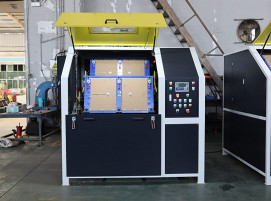
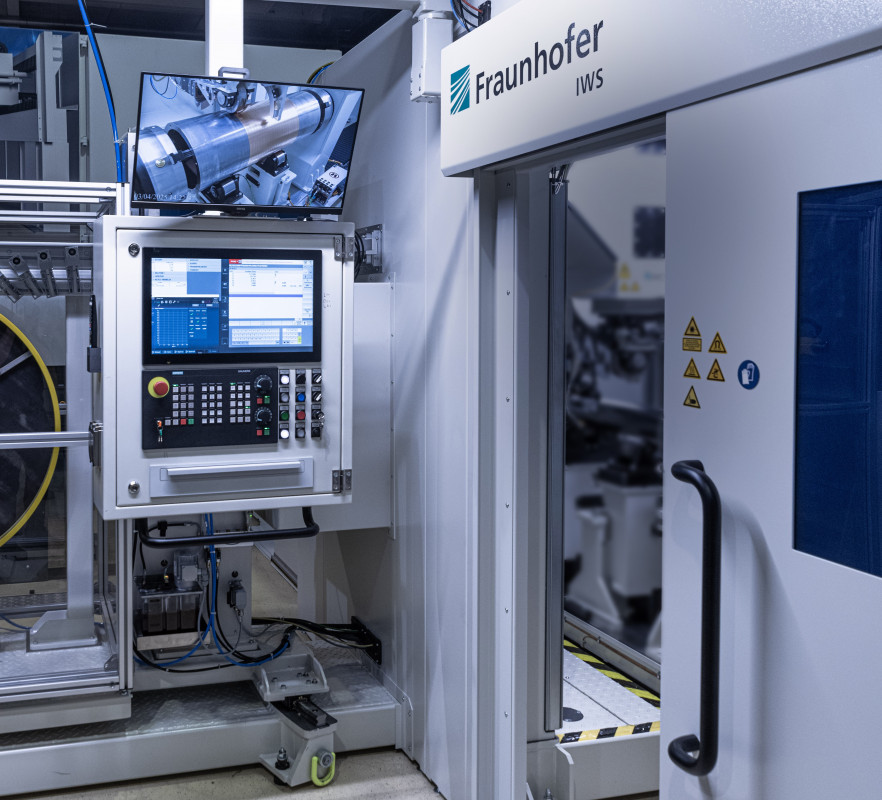
Fraunhofer IWS has filed a patent application for Laser Direct Plating and built a pilot system for components up to two meters in length. The team qualifies applications, defines process windows and demonstrates economic viability using demonstrators. Scaling proceeds in cooperation with the system manufacturer and industrial partners. Licensing and transfer models are available. The goal is a robust design for series production with clearly defined cycle time and quality metrics.
Economic impact and benefits
Laser Direct Plating cuts energy use, processing time and post-processing effort. High deposition rates shorten cycles, the joining mechanism stabilizes quality and multilayer designs expand the design space for functional coatings. Overall, unit costs decline. This improves production economics and reduces the carbon footprint.
(Source: Fraunhofer IWS)
Schlagworte
CoatingLaser Direct PlatingLaser ProcessingLaser-Based TechnologyMetal CoatingsMetalsSurfacing