
30.07.2026
Trendthema

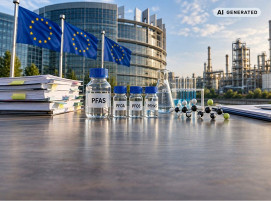
Earlier this month, an environmental organisation ClientEarth filed a human rights complaint against Belgium over PFAS pollution, reflecting growing pressure around the world to restrict these toxic “forever chemicals”. According to experts at femtosecond-laser startup Litilit, moving away from toxic chemicals will also require faster adoption of next-gen lasers. The concern about toxic chemicals was echoed in a recent report by the European Environmental Bureau, which unites 190 civil society organisations from 41 countries. It concluded that Europe is falling behind on a roadmap to curb hazardous chemicals, including per- and polyfluoroalkyl substances (PFAS).
PFAS – often called “forever chemicals" because they can remain in the environment for many years – are used in a variety of products, such as cosmetics, toys, furniture and textiles, due to their ability to resist extreme heat and corrosion. But they also carry serious side effects, including increased cancer risk, liver and kidney disease, developmental issues in children and other health problems. Back in 2022, Europe announced a roadmap to ban PFAS and expand restrictions; however, the European Environmental Bureau report notes that in the four years since, only small progress has been made. Separately, at the start of July, an environmental organization ClientEarth filed a complaint against Belgium, claiming it fails to protect its population from PFAS-related health risks. Meanwhile, the Swedish government last week announced plans to ban “forever chemicals” in consumer products such as clothing and kitchenware as early as 2028.
According to experts at Litilit, a startup manufacturing femtosecond lasers, moving away from "forever chemicals" will also require accelerating adoption of technologies that can replace them. Nikolajus Gavrilinas, the company’s CEO, says that PFAS coatings can be replaced using extremely short light pulses. "PFAS coatings are widely used to repel water, oil and stains, but femtosecond lasers offer another route: they can texture surfaces at micro- and nano-scale to make materials water-repellent without applying a fluorinated coating. It's an approach that applies anywhere water, ice or corrosion are a problem – from building materials and stone to metal, glass and everyday interior products," he explains.
Femtosecond lasers fire pulses that last a quadrillionth of a second – so brief that the light reshapes a material's surface before heat has time to spread into it. That's what allows the laser to carve micro- and nanoscale textures into a surface without damaging it. Gavrilinas notes the same principle applies beyond PFAS – ultrashort laser beams can replace chemistry in areas ranging from everyday electronics to furniture. For example, in furniture and interior design, this could be used for decorative metal elements, handles or fittings, where colour can be created without paint and ink.
According to Gavrilinas, currently, one of the biggest issues in applying femtosecond lasers at scale is that manufacturing capacity is not keeping pace with growing demand. To address this gap, Litilit has recently started construction of a factory in Vilnius, aiming to produce 3,000 femtosecond lasers a year. This would place it among the highest-capacity femtosecond laser facilities in the world. The company produces lasers based on a few patented inventions (patent 1, patent 2), made by Litilit co-founders Kęstutis Regelskis, Nerijus Rusteika, and Gavrilinas, in close collaboration with the Center for Physical Sciences and Technology (FTMC) in Vilnius. “Manufacturers cannot move away from toxic chemicals at scale if the alternative tools remain expensive, complex and difficult to integrate. That is why we are focused not only on making femtosecond lasers work, but on making them easier to produce, easier to install and easier to use in real factories,” Gavrilinas says.
(Source: Litilit)
Schlagworte
EUEuropean UnionFemtosecond LaserForever ChemicalsLasersPFAS