02.11.2026
Forschung
Additive manufacturing (AM), particularly material extrusion (MEX) with thermoplastic polymers, is increasingly being used to produce high-performance functional and structural components. However, joining technology has only partially kept pace with this development. While established solutions such as direct screwing, integrated nuts and heat-set threaded inserts are available, a solution specifically tailored to MEX technology that is simultaneously high-strength, reproducible and automatable is still lacking. This is where the new developed thermo-mechanical joining technology comes in.
Novel thermo-mechanical thread integration
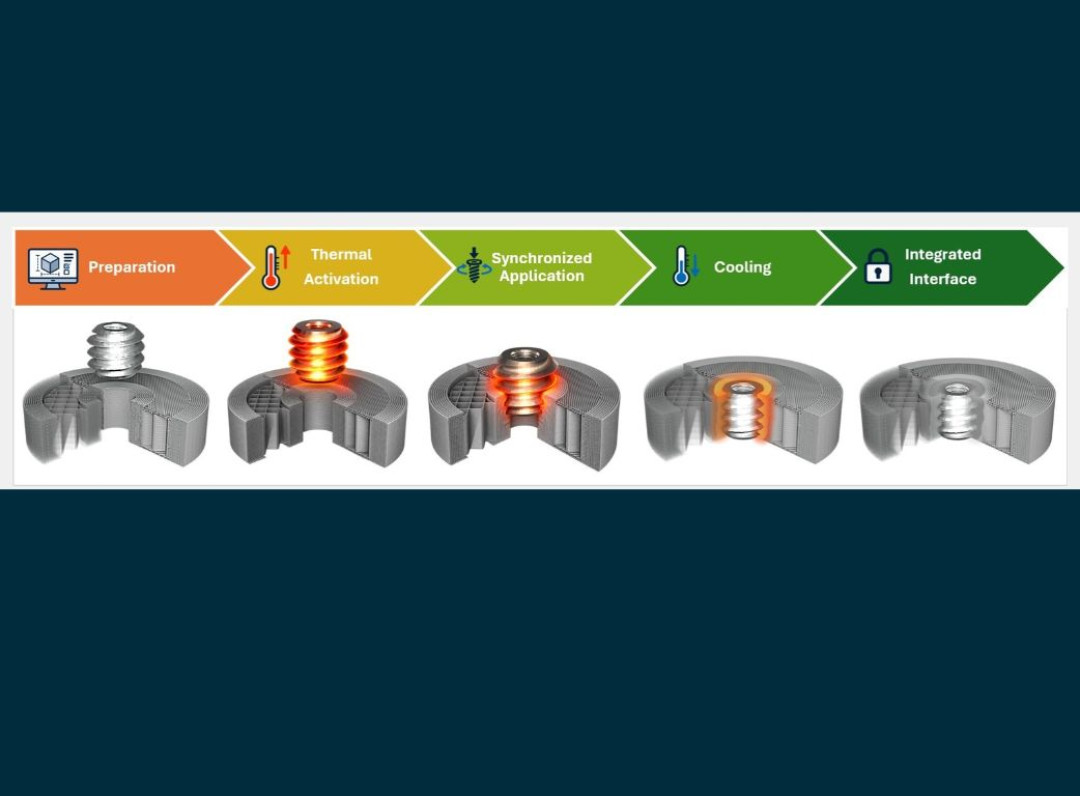
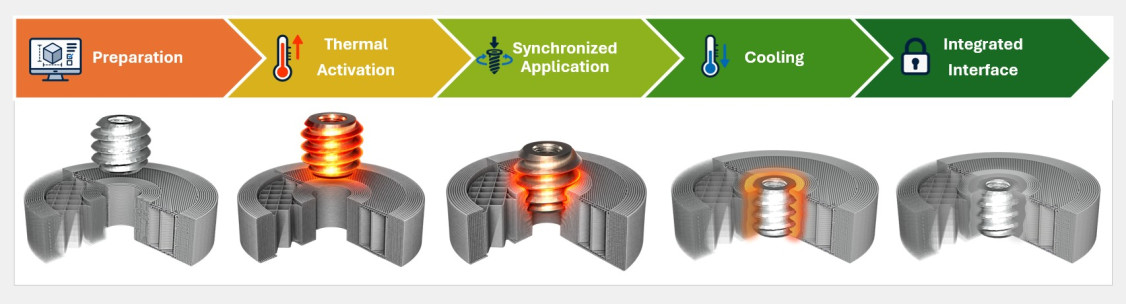
The core concept of the technology is to deeply anchor threaded sleeves with large external thread flanks in designated pilot holes of the MEX component in a load-path-oriented manner. To prevent damage such as delamination, the thread flanks are thermally activated prior to integration and used as heat transfer elements. This locally melts the surrounding material. For application, the sleeve is externally guided according to its thread geometry. Feed and rotation are synchronised to prevent the formation of cavities in the threaded region. After cooling, the sleeve is firmly anchored within the homogenised material region of the component.
Initial experimental results
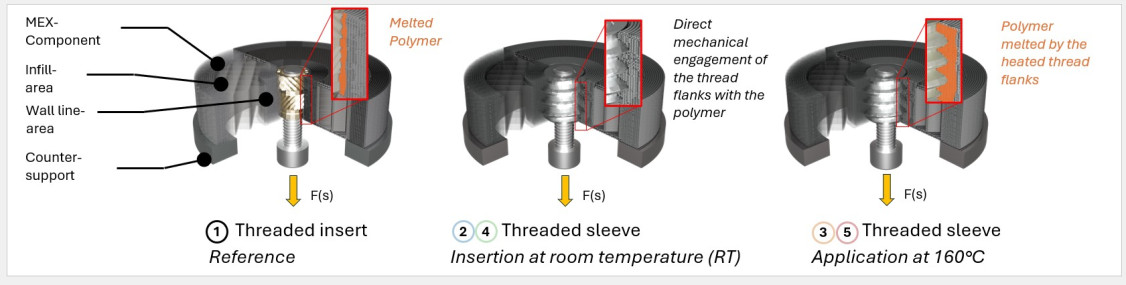
The pull-out strength of the thermo-mechanical thread integration was initially investigated using PLA (Polylactide) and M5 threaded sleeves. A conventional heat-set threaded insert in accordance with DVS 2240-1 was used as a reference and compared with threaded sleeves mechanically inserted at room temperature and applied using the thermo-mechanical process.
The initial tests show clear differences in load level and reproducibility between the investigated joining concepts.
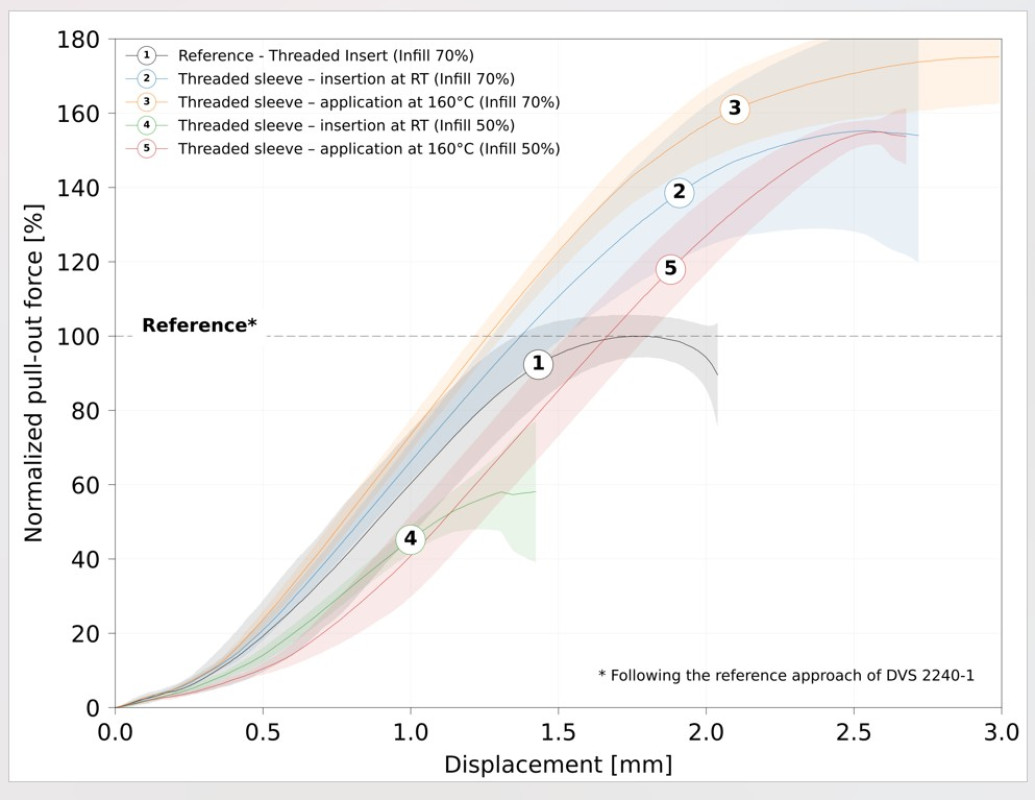
Three key findings can be derived:
- The threaded sleeve enables significantly higher pull-out forces compared with the conventional heat-set threaded insert.
- Cold mechanical insertion achieves high pull-out forces, but shows high scatter and therefore limited reproducibility.
- The thermo-mechanical application combines high pull-out forces with low scatter and enables high joint strength even with reduced infill.
From laboratory to industrial application
For industrial application, the technology will be adapted to different materials and thread sizes, with suitable process conditions developed accordingly. In parallel, its integration into manufacturing machines is being investigated. A first hybrid prototype already combines additive manufacturing and thermo-mechanical integration in a single process. In the long term, this is intended to create a continuous process chain from design to the fully integrated mechanical interface. The identification of suitable application parameters provides the basis for a qualifiable process. The transfer of the technology to the integration of conventional machine and functional components is also already being investigated.
Scientific publications
Fürst, T.; Göhlich, D.: Innovative high-strength screw connections for additive manufactured thermoplastic components, Int. J. Adv. Manuf. Technol., Vol. 135, No. 9–10, pp. 4669–4682, Dez. 2024. https://doi.org/10.1007/s00170-024-14746-7
Fürst, T.; Göhlich, D; Kirchner, E.: A novel design for the integration of conventional rolling bearings into MEX-manufactured components, Proc. Des. Soc., Vol. 6, pp. 1911/19, Aug. 2026. https://doi.org/10.1017/pds.2026.10549
Patents and patent applications
T. Fürst: Threaded sleeve for assembling with heat input in a component manufactured by FDM process, Patent No. EP 3913238B1, granted July 2, 2025; US 17/925,332 (US 2023/0193941), Notice of Allowance. https://globaldossier.uspto.gov/result/application/US/17925332/1
T. Fürst: Threaded sleeve with smooth inner surface for assembling with heat input in a component manufactured layer by layer by an additive manufacturing process, WO2025228917A1, published November 6, 2025. https://patentscope.wipo.int/search/en/WO2025228917 ; Reg./Nat.: EP/US in progress
3 questions for the developer, Dr Thomas Fürst,
on the development of the technology, initial findings and the path to industrial application.
What surprised you most about the results?
„What I found particularly interesting was that high joint strength can also be achieved with reduced infill. A high component density is therefore not necessarily required to achieve a high-performance joint. This offers interesting opportunities for more material-efficient design of MEX components. “
What are the next development steps?
„As a next step, we want to integrate the technology into a continuous process chain, from design to the finished component. We have already taken a first step in this direction with a hybrid prototype. We now need to systematically determine the relevant process parameters and their influence on joint quality. In the long term, this should provide the basis for robust design rules and design catalogues that enable the technology to be applied easily and reliably.“
What do you hope to see from industry as the technology continues to develop?
„Above all, I would be very interested in concrete applications and requirements that we can use to further develop and validate the technology together. In addition to users and machine manufacturers, I would particularly welcome interest from fastening and joining experts.“
Thank you for the interview.
Dr.-Ing. Thomas Fürst
Senior Engineer and Head of Research Laboratory / 3D Technologies Working Group
Faculty V – Mechanical Engineering and Transport Systems
Chair of Methods for Product Development and Mechatronics
Technische Universität Berlin
Phone: +49 30 314 21231
e-mail: t.fuerst@tu-berlin.de

(Source: Dr.-Ing. Thomas Fürst, TU Berlin)
Schlagworte
Additive ManufacturingJoiningJPMaterial ExtrusionMEXPlasticsPolymersThermoplastic Polymers