
16.05.2026
International
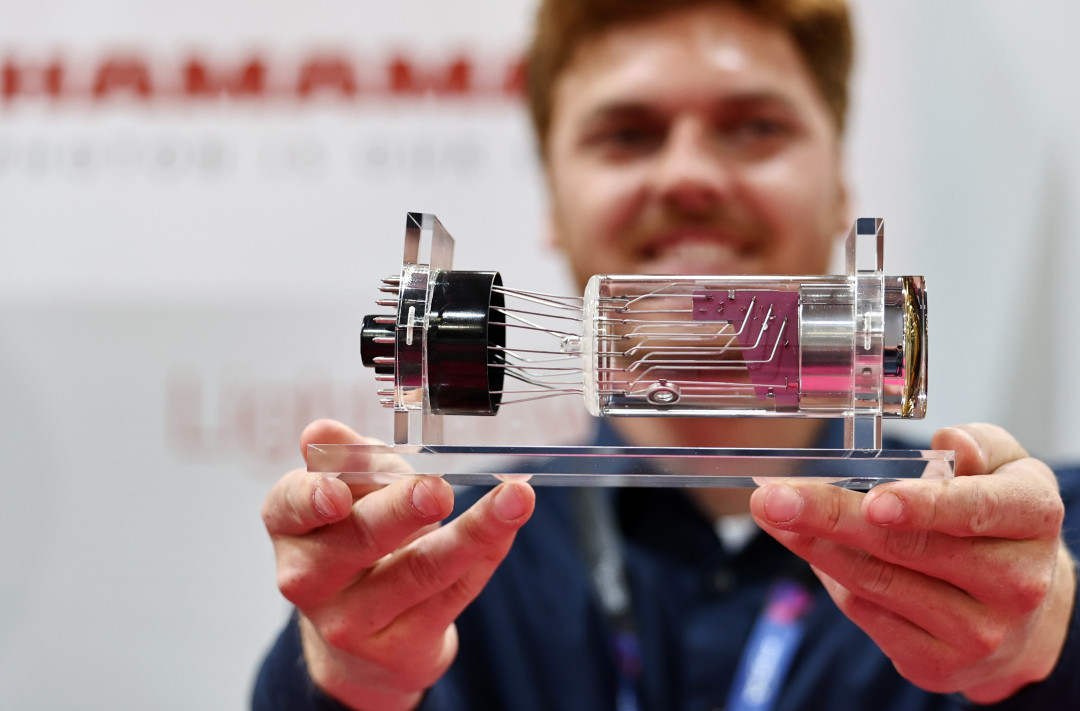
For the second time Quantum Photonics took place at Messe Erfurt, Germany, May 5 and 6, 2026. Visitors were able to attend the high-level conference programme, where experts reported on current developments, and also to talk with various companies and research institutions at the trade exhibition.
“Quantum technology and photonics are closely related,” emphasized Michael Kynast, Managing Director of Messe Erfurt, at the opening of the specialist congress. This close connection is reflected in the application-oriented congress with its accompanying trade exhibition. “Quantum Photonics offers a broad range of developments in the field of quantum technology and photonics and provides an ideal platform for exchange,” Michael Kynast explained, highlighting the relevance of the trade fair. Both the specialist congress and the trade exhibition offer numerous opportunities to present and discuss scientific findings, showcase industrial applications and promote exchange between science and practice.
Colette Boos-John, Minister for Economic Affairs, Agriculture and Rural Areas of Thuringia, particularly emphasized the novelty of quantum technology as well as its great future potential. “Quantum technology still has to prove what it can do,” she stressed. However, the conference and specialist meeting actively promote the role of quantum technology and photonics and are therefore an extremely important event. After all, quantum technology is playing an increasingly important role for industry. “Our economic future depends on this technology,” Boos-John affirmed in her opening address.
Trade exhibition
Companies and research institutions presented their products and developments at the trade exhibition and engaged in conversation both with trade fair visitors and each another. One such company was X-FAB, a semiconductor manufacturer based in Erfurt with additional sites worldwide. Its products include customized circuits for the automotive industry, the aerospace industry and other industrial applications, as well as micro-electromechanical systems (MEMS), which combine mechanical structures and electronics on a chip. “Thuringia has an extremely large optoelectronics community, for which microelectronics is a key component. As a company based in Erfurt, Quantum Photonics is a valuable opportunity for us to exchange ideas with our regional partners and make many more interesting contacts,” said Muralikrishna Sathyamurthy, Director Innovation, IP and Patents at X-FAB.
The Berlin-based company May Distribution presented modular platforms for scalable quantum and photonics control systems. These require low latency and precise synchronization as well as high signal quality. In addition, the complex systems must be scalable. The company’s answer to these requirements: standardized components, integrated cooling and engineering services that shorten development times and make it possible to realize complex systems efficiently. “We are very pleased to present our modular solutions at Quantum Photonics,” said Peter Siebertz of May Distribution.
Various research institutions were also represented at the trade exhibition, including the Institute for Photonic Quantum Systems PhoQS at Paderborn University. The researchers – an interdisciplinary team of experts from physics, mathematics, computer science and electrical engineering – work primarily in the fields of quantum simulation, quantum communication, quantum metrology and quantum computing.
Congress
The second main pillar of the event was the specialist congress, which was divided into four topics. After the welcome address, the forum Quantum in Computing & AI focused entirely on quantum computers. In the long term, these are expected to provide enough computing power to solve problems that conventional supercomputers struggle with.
René Sondenheimer of Friedrich Schiller University Jena pointed out the close connection between quantum computing and photonics. “Photonics serves as a fundamental technology for quantum computing – whether in ion-trap quantum computers or in systems based on neutral atoms." Before quantum computing becomes fully universally available, considerable technological challenges remain, he emphasized, such as photon losses in photonic quantum processors. These use photons to encode, transmit and process quantum information. Sondenheimer and his team are working on solutions to specifically minimize photon losses.
While common approaches to quantum computing are based on superconductivity or natural qubits such as ion traps, solid-state spins and neutral atoms, NVision Imaging Technologies uses molecular spins. “Molecules combine the best of these two worlds and offer many possibilities for qubits,” explained Matthias Pfender, Senior Director at NVision, in his presentation. As the basis for its purely organic quantum platform, the company uses photoactive triplet carbenes embedded in a rigid crystalline host matrix.
Security is a top priority in the field of quantum technology. To ensure this, quantum cryptographic methods must be further developed and deployed, especially Quantum Key Distribution (QKD), which, unlike conventional encryption, remains resistant to attacks by quantum computers. Experts presented relevant approaches at the forum Quantum for Cyber Security & Networks.
Nils Gentschen Felde from the University of the Bundeswehr explained what a quantum-secure communication network can look like using the “MuQuaNet – the quantum internet in the Munich metropolitan area” project. The aim is to build a QKD test environment for research and evaluation. As the computer scientist explained, the focus is on the security analysis of Quantum Key Distribution. The point is not one-off test results, but a repeatable and comparable evaluation process across different providers and QKD technologies. “QKD promises proven security,” he confirmed. After all, any attempt to intercept the transmission changes the quantum states and is therefore detectable. However, a fiber-based testbed that is also intended to be made available to other research institutions, authorities and military agencies has shown that none of the many QKD systems tested from different providers meet the necessary security criteria – not because of physics, but because of imperfect implementation. The University of the Bundeswehr is working closely with providers to close such security gaps.
TÜV Informationstechnik (TÜVIT) aims to close this gap, as Natalie Jung reported in her presentation. Together with partners from science and industry, TÜVIT is developing both a test laboratory for assessing the security of QKD protocols and a comprehensive certification system. Jung explained the threats facing the implementation of QKD systems and named the key components required for a complete certification framework.
Secure data transmission is also a key issue in defence and space, as became clear on the second day. However, if data are to be encrypted globally using quantum mechanical processes, a satellite-based network is required through which the keys can be exchanged.
Europe’s first initiative for a satellite-based QKD system, intended to connect national efforts via satellite, is the Eagle-1 mission. ESA is planning the launch for the end of 2026. Such space missions require not only satellites capable of transmitting laser light to Earth with high efficiency, but also ground stations to relay the keys into a fiber-optic network and ultimately to the end user, as Matthias Goy from Fraunhofer IOF emphasized in his presentation. One of these is the Optical Ground Station Jena, or OGS Jena, which is based on a telescope with an 80 cm aperture. “We are preparing this ground station for cooperation with Eagle-1,” Goy explained. For this purpose, the light from the satellite is directed into a laboratory using various mirrors in order to receive the QKD signals. However, one ground station alone is by no means sufficient. That is why 15 partners in the TransEuroOGS project are working to prepare and interconnect eight ground stations for Eagle-1, including OGS Jena. Cross-border demonstrations are also planned, Goy explained.
Seid Koudia from the University of Luxembourg also referred to the TransEuroOGS project in his presentation. Which quantum memories and other technologies are suitable for space? “We are currently testing what is optimal for low Earth orbit, or LEO – cooperation like that in TransEuroOGS is indispensable,” Koudia said.
Lara Torralbo-Campo with Arda Atomics reported that the QYRO project team wants to build a global network of mini-satellites in low Earth orbit, LEO. “The goal of the project is to develop a space-capable quantum gyroscope that can measure changes in the satellite’s orientation. We want to validate this in a small CubeSat satellite and compare it with existing technologies for controlling satellite attitude,” Torralbo-Campo said.
3D-NLM launch
The second day of the fair featured the kick-off presentation of the 3D-NLM project, which is funded by the German Research Foundation (DFG). The goal of the Thuringian project is to develop a system that can nanostructure and measure photonic components with very high precision. Participants include TU Ilmenau, Friedrich Schiller University Jena and Fraunhofer IOF. The planned system is intended to expand the processing area for highly precise nanostructures on photonic components from around 30 cm to up to 1 m. “The motivation comes from researching the universe: the large instruments required for this demand large and extremely precise spectrometers,” said Uwe Zeitner of Fraunhofer IOF. The new technology is intended to make it possible to realize such nanostructures precisely.
The system requirements are high, as Thomas Kissinger of TU Ilmenau explained. The system is expected to be able to structure workpieces measuring 1 × 1 × 0.2 m and weighing far more than 100 kg. The structuring must not only be applied precisely, but also checked and continuously calibrated in situ. Researchers in Ilmenau and Jena are laying the technical foundation for this.
Finally, the forum Quantum for Instrumentation & Measurement presented the possibilities of quantum sensors. Ronny Stolz of the Leibniz Institute of Photonic Technology gave an overview of superconducting single-photon detectors. “These lead us to the fundamental limits of information retrieval from the physical world,” Stolz noted. The question he and his team are addressing is: when, where and in what state does the photon arrive? To answer this, he uses quantum properties such as entanglement and superposition. Single-photon detectors are needed in numerous fields, including astrophysics and quantum communication.
Matthias Meyer of Supracon discussed the current state of quantum magnetometres, which use quantum mechanical principles to detect and measure extremely weak magnetic fields. He presented four types of quantum magnetometres. The proton-precession magnetometre, for example, stands out for its robustness, reliability and low price. It can be used to detect iron-containing materials in the ground, identify groundwater or investigate archaeological sites. By contrast, the nitrogen-vacancy magnetometre offers very high spatial resolution down to below one micrometre, is compact and robust and could one day provide an alternative to GPS in aircraft navigation. Optically pumped magnetometres can measure brain signals, for example for diagnosing brain function, while SQUIDs – superconducting quantum interference devices – can locate copper and nickel deposits in the ground.
Jan Meijer of Leipzig University presented a quantum sensor. “We asked ourselves: could it be possible to create a quantum sensor that outperforms the low-cost Hall sensor?” he recalled. Said and done: he and his team artificially produced color centers that turn a diamond red and consist of only one or two atoms plus a defect, and applied them to an optical fiber. The result was a sensor that allows absolute measurement of the magnetic field rather than only relative changes. “In 2020, we founded the spin-off Quantum Technologies using this approach,” he said. The sensor can, for example, measure directly in an electric motor, works faster than a Hall sensor and is also suitable for critical infrastructure.
(Source: Messe Erfurt GmbH)
Schlagworte
AerospaceAutomotiveConferenceMeasuringSemiconductorsSensorsTrade Fair