
18.05.2026
International

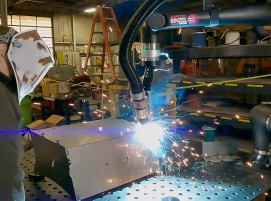
InduSuite, an ESAB brand, today announced the launch of Ocotpuz Steps, a new weld sequencing software application designed to guide manual welding operators through complex weldments, ensure every weld is completed correctly and improve productivity and consistency across the shop floor. Octopuz Steps works with ESAB’s Warrior Edge heavy industrial multi-process welding power sources.
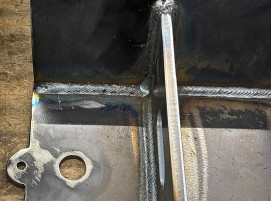
The new software addresses one of the most persistent challenges in manual welding environments: missed or incorrectly performed welds. Traditionally, operators rely on paper drawings or static work instructions that require constant back-and-forth between the part and documentation. In complex assemblies with dozens or hundreds of welds, that approach increases the risk of skipped welds, rework, scrap and costly downstream repairs.
“With Octopuz Steps, we’re giving manual welders the same kind of digital guidance and control that robotic systems have benefited from for years,” said James Schnarr, Senior Product Manager, ESAB. “Instead of guessing what comes next or flipping through drawings, operators are guided through each weld in the correct order, with visual instructions and real-time validation that the weld was performed and performed correctly.”
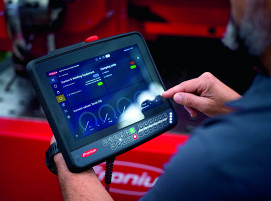
Through a dedicated screen at their weld station, Octopuz Steps presents operators with step-by-step weld instructions and WPS information. Each weld must be completed before the software advances to the next step. Through two-way communication with the Warrior Edge power source, Octopuz Steps also validates that the weld was performed within defined parameters and that the weld duration is within expected time required to perform the weld (e.g., an arc duration of two seconds for a 10-inch-seam would indicate too short of a weld). The system presents an instant pass/fail result to the operator, who can initiate a review action with a supervisor. “The validation capability of Octopuz Steps helps ensure operators execute weld sequences the way the welding engineer intended. We closed the loop between planning and execution,” says Schnarr.
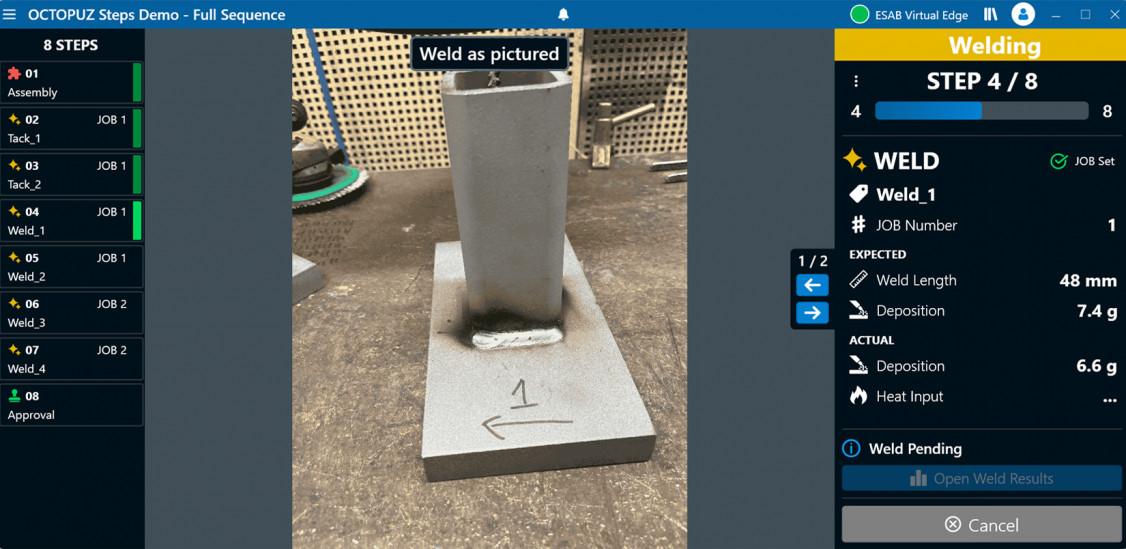
Improve productivity across operators
By defining an optimised order for making welds, Octopuz Steps ensures that every operator follows the same sequence and the same welding parameters. Standardisation reduces variation, limits over-welding, minimizes distortion from heat input and improves overall material and labor efficiency.
“If one operator over-welds by 30 % and another doesn’t, that’s a huge cost difference over thousands of parts,” Schnarr said. “With Octopuz Steps, everyone is working from the same playbook, which makes productivity predictable and repeatable.” The software is designed as a companion application to ESAB’s Octopuz Offline Robot Programming (OLRP) software. Welding engineers can design weld locations and Steps directly on CAD models inside Octopuz, then publish those instructions to the shop floor. When paired with a Warrior Edge power source, the software can automatically set the correct pre-programmed welding job for each weld, loading the right parameters without manual input. This approach creates a natural steppingstone toward future automation, allowing welds designed for manual operator-performed Steps to be reused and converted into robot welding programmes within Octopuz.
Built for connected manufacturing
Octopuz Steps fits into ESAB’s broader digital ecosystem, enabling future connectivity with WeldCloud and other InduSuite applications for data collection, quality reporting and continuous improvement. Initial target markets include mobile machinery (yellow goods), automotive and transport and other industries with critical, highly regulated welds performed in fixed workstations.
(Source: ESAB)
Schlagworte
AutomotiveCADITReworkShop FloorSoftwareWeld SeamWeld Seam InspectionWeld SequencingWelderWelding