28.10.2026
Unternehmen
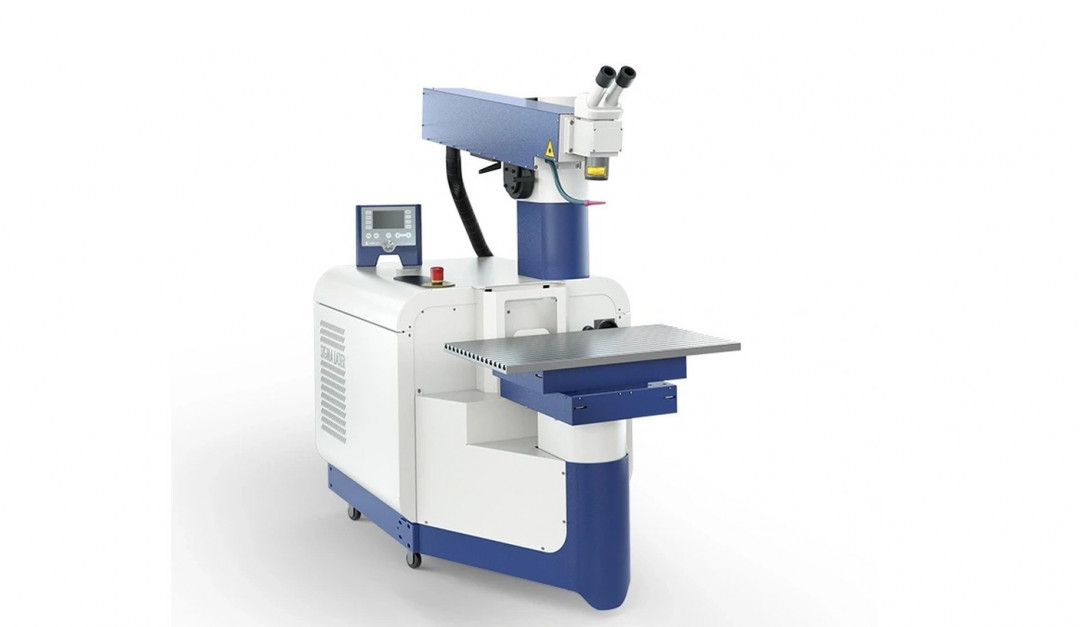
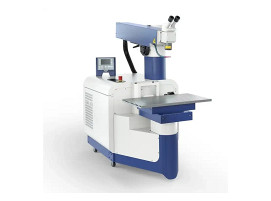
Whether a fixed welding workstation pays off is decided by 5 criteria: part transport, volume, automation, integration and location, not by machine size. Many teams still choose between stationary and mobile by machine size instead of by the production flow and the parts. A grid of five criteria avoids wrong turns. The overview of Sigma Laser's stationary laser welding systems compares Sidanus Light, Sidanus Fibre and Siega Fibre.
Criteria one and two: the part and the volume
- A stationary laser welding system is a fixed, CNC-controlled system for reproducible production and repair. At Sigma Laser a 5-axis kinematic guides the beam over the workpiece; all three stationary systems have a Leica stereo microscope, Super Pulse Technology and program memory, with an Nd:YAG or fibre laser source as required.
- Part transport: if the workpiece can reliably be brought to the machine, that favours stationary. Very large or permanently installed components remain a case for the mobile system.
- Volume and cycle time: the higher the volume and the shorter the cycle, the more stored programs (up to 100) count for consistent seams and little rework.
- Part geometry: the open frame takes parts of any size and weight, and part heights up to 450 mm are possible regardless of table size.
Criteria three and four: automation and integration
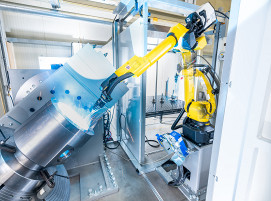
For series production the Simass base unit takes interchangeable modules. Simass Slide provides motor-driven pivoting slides for long or large workpieces, so loading and unloading happen outside the enclosure while welding continues. Simass Rotate adds a precision rotary table with two separate zones for parallel loading and unloading, freely programmable or in a fixed cycle, up to Ø 1,500 mm. Stationary systems are permanently integrated into the line and offer stable process conditions. "Nobody has to automate on day one. The fixed workstation starts manually with stored programs, and once the volume is there the rotary table or the slide is added," says Klaus Schickert, Production Manager at Sigma Laser.
Criterion five: the location
If workplaces change often or the component is permanently installed where it is used, the mobile 5-axis workstation system comes to the part. Stationary systems are designed for permanent operation in one fixed place. Sigma Laser advises on the choice between stationary and mobile systems based on the actual parts and volumes.
(Source: Sigma Laser GmbH )
Schlagworte
AutomationCNCLaserLaser Beam WeldingMobile WeldingNd:YAGStationary WeldingWelding