
24.04.2025
International
Scanlab collaborates with 1000 Kelvin to enhance productivity for industrial 3D printing
Scanlab GmbH, the leading and independent OEM manufacturer of laser scanning solutions, and 1000 Kelvin GmbH, developer of the Physics-AI platform AMAIZE, announce an innovative integration for additive manufacturing. The partnership brings seamless execution of ‘Artificial Intelligence’ (AI) in interaction with innovative laser power distribution and thermal melt pool behavior in metal additive manufacturing to industry—a cornerstone for mass production in verticals such as consumer electronics, aerospace, and the energy sector.
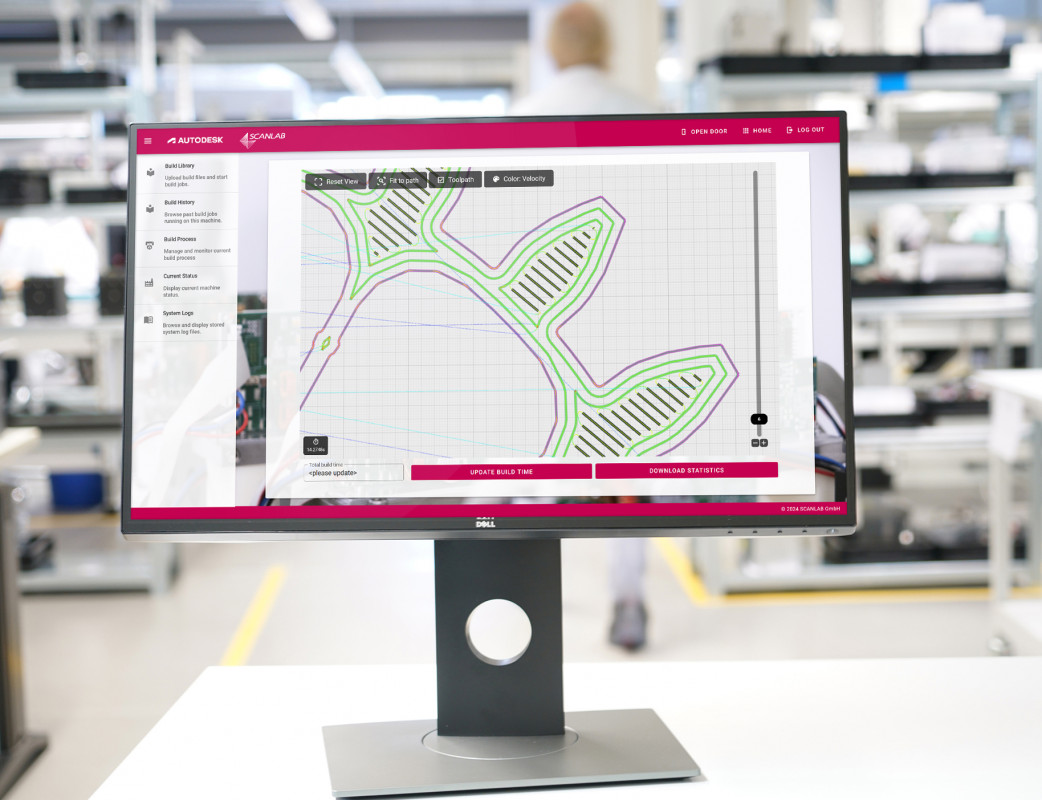
Additive manufacturing (AM) and especially metal AM strives for increasing throughput and less scrap. Data preparation is key to increase productivity and shorten process development times. The control system SCANmotionControl allows process developers to simulate the scan paths of the lasers offline on the PC. As the physical properties of the scan systems are taken into account in the simulation, the paths in the application are executed by the machine exactly as in the simulation: 'What you simulate is what you get'. The combination with the powerful Physics-AI platform AMAIZE enables manufacturers to print thin, complex geometries and engineer advanced thermal profiles with intelligent automation. Customers obtain first-time-right production, better overhangs, superior surface quality, and full transparency over the entire manufacturing process.
“This collaboration reveals the possibilities when cutting-edge laser scan systems and AI work in coordination,” states Dr. Daniel Reitemeyer, Business Development Additive Manufacturing, at Scanlab. “AMAIZE’s detailed prediction is the ideal match for our advanced SCANmotionControl solution. Our software allows freeform power profiles on a single vector, individually for every vector of a print job. The AI-based point-wise power optimization permits automated process parameter calculation, which is a pre-requisite for advanced scan control on industrial level. The combination offers our customers highest performance and control.”
The software integration is based on the open ‘3MF’ 3D Manufacturing Format, ensuring an immediate scalable deployment for machine builders. Alexander Oster, Technical Chairman of the 3MF Consortium, comments: “For years, the 3MF Consortium has been working on standardizing every step in the additive manufacturing toolchain. The craftsmanship and scalability of the 3MF toolpath extension, combined with 1000 Kelvin’s AI and SCANLAB’s high frequency control precision demonstrate the true power of ecosystem-driven innovation. We are finally witnessing the emergence of high-end geometries printed repeatable, faster, with greater quality, and with machine specific predictive optimization – while taking into account everything down to laser reaction times and the inertia of the scanning mirrors.”
“We’ve developed a physics-based foundational model purpose-built for manufacturing—trained to understand and control the laser-material interaction,” explains Dr. Katharina Eissing, CTO and Co-founder of 1000 Kelvin. “With 100 kHz temporal resolution and power modulation along vectors, our AI doesn’t just predict—it governs the process at the level where material behavior is shaped. Working closely with Scanlab, we’ve integrated this intelligence directly into the laser path control, bridging software and hardware like never before. For machine builders and end users, this unlocks a new era: the ability to print highly complex materials and geometries with granular control, computational efficiency, and reproducible results. It’s the missing piece between digital intent and physical reality. And it means that, finally, AI speaks the language of physics in the factory” she concludes.
AMAIZE’s core engine—already powering leading aerospace, defense, and energy manufacturers—together with SCANmotionControl provides machine integrators an easy to use AI-native recipe generation to differentiate on the global stage.
(Source: Scanlab)
Schlagworte
3D3D PrintingAdditive ManufacturingAerospaceAIArtificial IntelligenceAutomationCuttingElectronicsHardwareIndustryKILaserLEDManufactureSimulation